Sunday, 25 January 2015

Everything Venn

We diligently returned to Chang Sow Chai vegetarian café on Lebuh Kimberley this morning. Knowing the score, we asked what was on today. I chose loh mee from the available options and K - bravely, I thought - went with vegetarian fish head bee hoon soup. Knowing the fast and loose definition of 'vegetarian' in many countries ("you can barely see the chicken pieces, sir"), I didn't quite trust there not to be genuine fish heads bobbing in the bowl. The Buddhist Chinese Malays, however, take a hard line on vegetarianism (when they stick to it, which is typically only twice a month) and many places even leave out onion and garlic.

Loh mee

Loh mee (also lor mee) is characterised by its thick, spicy (not hot) gravy. The noodle soup I had had a distinct hoi sin taste to it, presumably from five spice. It was augmented with pieces of mock meat - roast pork, char siu pork -  and crunchy fried bits that would be crispy lardons in the meat equivalent.

Fish head bee hoon soup

The 'fish heads' turned out to be thin and crispy fried slices of tofu wrapped in nori. They were served in a clear gingery broth, which K declared "delicious".

Our intention today was to visit places of worship of the four major religions on the island, each of which is represented on Jalan Masjid Kapitan Kling - locally referred to as "Harmony Road", but also known under its previous name, Pitt Street.

The road is named after the mosque (masjid) at the southern end, which is where we started.

Masjid Kapitan Keling

Our search for someone to enlighten us about both building and the beliefs of the worshippers who attend it was somewhat thwarted. The mosque information services are closed on a Sunday, so we visited the building. K had to don a fetching lilac cloak - complete with hood - for reasons of decency, and wouldn't be let in at all were she menstruating, lest she frighten the horses.

Chinese lucky ingots

The Hindu Sri Mahamariamman temple seemed to be closed and in a state of renovation, which will make it difficult to celebrate the upcoming Thaipusam festival on 3rd February.

Kuan Im temple

The Buddhist temple of the Goddess of Mercy (Kuan Im) was the busiest site we visited, with many worshippers praying and lighting incense sticks. Aside from days of particular significance, a good handful of worshippers can be seen at the temple at all times of day throughout the week, in contrast to the Muslim five times daily prayer or Christian Sunday worship.

Large incense sticks

In the courtyard several enormous braziers were consuming oversized incense sticks the width of a man's arm and twice its length. I presume the intensity of activity will only increase as Chinese new year in February approaches. The streets surrounding the temple are currently being festooned with red lanterns in preparation.

The Chinese temple mixes Taoist and Buddhist images, although this is often a tricky distinction, as Kuan Im (also Guanyin) is both a bodhisattva, who eschewed nirvana in order to free the populace from suffering, and is also revered as a Taoist immortal. Alongside Kuan Im stand representations of Fu, Lu, and Shou - Taoist Gods of Prosperity, Status, and Longevity, respectively - and depictions of the characters from the classic Chinese novel Journey to the West.

Four heroes from Journey to the West

Unfortunately, despite the crowds at the temple, we found no ear to hear our questions about Buddhism and Taoism.

St George's Church

It was a similar story at St George's Church, which was shuttered up after the morning's services. However, this is where we needed the least orientation, as K is well versed in Christian beliefs. In fact she attended a local Methodist church this morning, the sermon of which apparently concerned 'witnessing'.

No, seriously

I have always found witnessing of one's faith an unusual use of the word, and for many people I suspect it brings to mind the door-stepping of Jehovah's Witnesses. This is an extreme form of sharing one's beliefs, but I imagine that most people can empathise with the urge to share something about which one is most passionate. To someone who has discovered a source of such joy, hope and pleasure, it seems inconceivable that others wouldn't also derive similar satisfaction, if only they knew about it. Any reservations they have might easily be disabused, one imagines.

With questions of personal taste, persuasive argument is where it ends, but articles of faith can often inspire more zealous opinions. If one believes that one's views are backed by an unquestionable, inerrant source of truth, then one can become deaf to any counter-argument. Self-righteous and arrogant rhetoric is surely the worst way to promulgate a message (see Richard Dawkins), which is why the best advocates witness through actions as much as words.

Is this the right place for an argument?

The best, but most difficult, way to approach an argument is in an open way and in a spirit of truth-seeking, accepting that one's currently held beliefs may not be correct, rather than seeking to convince the other, 'ignorant', party of their error and to bring them around to one's own way of thinking.

However, uncertainty is scary. Admitting that one's own beliefs or way of life aren't necessarily right requires bravery. We err towards, wittingly or otherwise, disregarding contradictory facts and retelling only those that fit with our personally espoused theory, in an effect known as conformation bias.

But, a lack of information concerning opposing or different theories can lead to defensiveness, which arises from fear. Fear that we may be wrong, and that others may be right. And fear, as Yoda so rightly pointed out, leads to suffering. Lack of information only strengthens our own beliefs, as any others lack depth or substance to be believable. Hence, it becomes easier to question, to misunderstand, and even to despise others who hold such obviously untenable opinions.

And so, to have moral certitude, one might want to subscribe to a specific rendering of The Truth.

History abounds with scripture and written doctrine, from the Upanishads and the Pāli Canon, to the Torah, Bible and Koran. These sacred texts are believed by some to contain revealed truths, hitherto unknown to Man, and in certain cases are believed to be inerrant in word. Subscribing to the teaching of any one of these truths may or may not be exclusive with the belief in the veracity of any of the others. However, this is not what is interesting (at least to me).

Rather than arguing doctrinal specifics, it is far more fascinating to discern the similarities between these documents - some written many centuries apart, by different hands in different lands.


Whether codified and documented or perpetuated through oral narrative and ritual custom, most religions offer a metaphysical explanation for 'how things are': How was the world created? What is the purpose or meaning of life? What happens after we die?* They may explain supernatural events, such as miracles, apparitions, and unlikely coincidences.

* Buddhism notably refuses to expound on these questions, which are considered unanswerable and the subject of counterproductive speculation.

To my opinion, none of the explanations to the above questions put forward through the years is more inherently believable than any other explanation. Some explanations have gained a certain legitimacy simply with the passing of time, but make the same unfalsifiable claims as parody religion Pastafarianism.
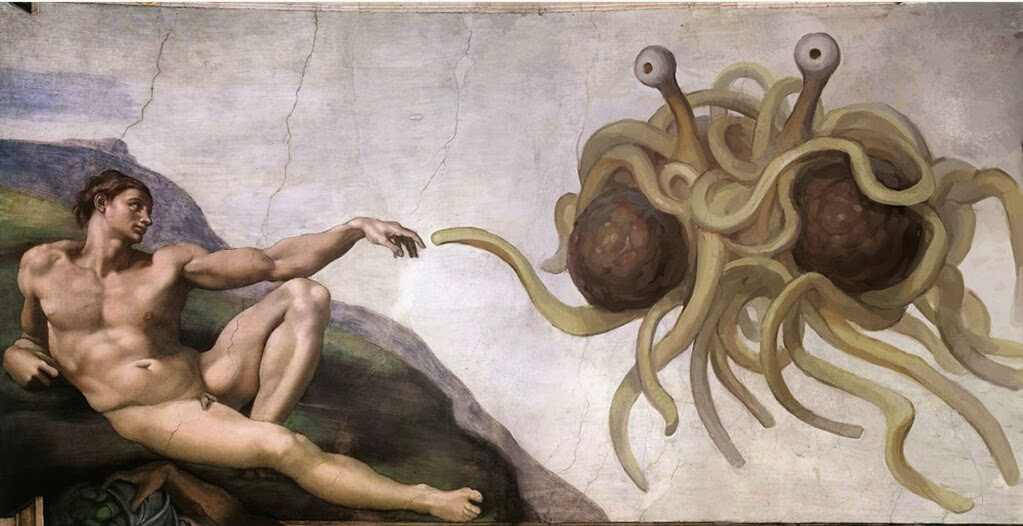
Touched by His noodly appendage

Individuals and groups have invented or received many colourful explanations to the above questions throughout history. Envisaged creators and rulers of the world and everything in it range from a merciful and benevolent Father God, through a pantheon of feuding deities and demi-gods meddling in the life of Man, to spirits possessing everything from the wind to the sea, which must be appeased through customary ritual.

Explanations for how reality came to be venture that it was the product of a dismembered divine being, or manufactured within a week by a single lonely creator, or even that there have been several worlds before this one whose people were variously destroyed by jaguars, hurricanes, and rains of fire.

Regarding the afterlife, the general nature of this depends on one's conduct in the earthly life, and one may anticipate living out eternity in a heaven or hell, whose precise characteristics have been the subject of thousands of colourful descriptions, or perhaps being reincarnated endlessly as greater or lesser beings, until one's deeds allows escape from this cycle.

While wonderful, creative, mostly beautiful and sometimes fearful descriptions, these explanations seem to me to be mere conjecture. There is no profound truth.

I suppose this is part of having 'faith'. To believe, in the face of no or unverifiable evidence, in the truth of a particular explanation for supernatural phenomena.

The need for such explanations is clear. Life is wonderful; to describe it in banal terms seems disrespectful, so we wrap it up in colourful description. Metaphor allows us to describe forces and processes for which normal language is inadequate or simply seems too prosaic. We anthropomorphise natural occurrences (e.g. Death) to make them more understandable.  Such descriptions are rich and wonderful and have influenced and coloured the art, festivals, clothing, stories and way of life of each civilisation that created them. I would not wish to get rid of them. But we should not confuse the metaphor with reality.

Confucius say

Many sage individuals have given wise advice to the people of their time, some of which has proved relevant for generations to come and has entered into the status of tradition, being repeated and followed fervently among a particular group of people and their descendants.

Personally I don't believe any of these teachings have been inspired by anything more divine than the sages' own minds, which is incredible enough. To lead, inspire and to give hope to people for generations is something to be respected. But we should not lose sight of the fact that, no matter how wise, the teachings are advisory only. Punishing, judging and condemning others for not following arcane doctrine is perverse. By all means take any set of rules of your choosing as a personal guide for how to live your life, share them with others if you feel they are particularly expedient, but do not hold others to your same standards and be tolerant of other, possibly contradictory, explanations for the phenomena you observe.

A pretty clever patent lawyer

Instead, let's focus on a common set of tenets. Harmony Road inspired me to see how four quite distinct groups of people, each with an ostensibly different faith, can co-exist and share in their common beliefs. It's like a wonderful Venn diagram, in which each group is represented by a circle. The overlapping part of these circles represents those beliefs that are the same - even though they may use different names or language to explain them - and is greater than the parts that don't overlap. You will have to imagine this diagram too, as I don't have the creative wherewithal to realise it.

John Venn. A proper Yorkshireman. From Hull

It doesn't matter whether your truth is a personally held belief, a divine revelation through a prophet, such as Jesus, Muhammed, or Moses, or wisdom dispensed by an enlightened individual, such as Lao Tze, Gautama Buddha, or Confucius. It doesn't matter whether you believe in one God, many deities, or in no particular creator, in afterlife, reincarnation, or immortality, in miracles, angels, or jinns, in salvation, moksha, or nirvana. We may use tradition and rituals as comfort, as a way to fit in with our family or community, or as a means to remind us to act in a manner that is in accordance with a way of life to which we aspire, but which we do not inherently tend, such as prayer, meditation, or fasting.

Use whatever means you must to be the things that make life good for you and for others: Love everyone, be happy, be generous, be grateful, be awed by people and nature, and believe what you like about the things you can't see or prove, but please don't try to make others believe the same or judge them because they think differently.

Seeing so many different places of worship in close proximity - distinct in their rites and practices, but respectful and harmonious - cemented for me the multi-cultural aspect of Penang. A wonderful example of this is the mixing of immigrant Chinese and Malays, which created a new people, new food, art, and language.

We visited the Peranakan Mansion - a beautifully restored 'Baba Nyonya' residence - which was occupied for two generations. While the shell of the building remained, the inside was gutted, so the contents was sourced and is indicative of the actual furnishings and decoration. The original owner of the building gained his fortune through trading in tin and opium.

As we saw from the 'self-made men', Yeap and Cheong, vast fortunes were there to be made by those with the nous. The Peranakan culture developed to use this wealth in a slightly disgraceful yet fascinating opulence.

The Peranakan 30-day weddings with all their attendant trappings, which we saw at the Penang Museum, were only the surface. The Mansion contains the everyday items of Baba-Nyonya life, the extravagance of which centres around the dress and accessories for the Nyonyas.

'Baba' and 'Nyonya'

The Peranakan tended to marry young - both the bride and the groom - often in an arranged marriage. The groom's family sought a girl that can demonstrate prowess at cooking and sewing - preferably to the exclusion of all else, such as a social life. Such unwavering dedication to craft - and, by extension, unerring devotion and compliance to a suitor - is most aptly embodied by the hand crafting of 'bead shoes', which take the little nyonya anywhere between 3 to 6 months to sew miniscule beads onto the shoe uppers, during which time she barely leaves the house. In return, the bride's family expected wedding dowries that could sink a ship.

Gold dolls' house furniture

The museum display houses such gilded everyday items as solid gold dolls house furniture and dinner places set with silver and crystal decanters.

Tradition surrounding death was as rigorous and as extensive - if less ostentatious - as marriage. Mourning wardrobes comprised clothes of a single colour only -black for the first year of widowhood, blue for the second, and green for the third - and, of course, the widow was expected to wear plain old silver and pearl jewellery rather than the usual gold bling as a sign of respect.

The one aspect of tradition that I found difficult to excuse, as it involved inflicting suffering on someone else - in this case a child - was foot binding. The deformed feet, apparently considered beautiful, were the result of tight binding from an early age. It is said that the girls, women and families were proud of this tradition.

After a day of cultural enrichments and theological - some might say iconoclastic - debate among ourselves, we needed sustenance.

Around the corner from the Peranakan Mansion we found Sri Ananada. This is a pure vegetarian Indian that features cuisine from Chettinad including traditional dishes using mock meat. However, we eschewed a fake chicken tikka masala in favour of a couple of thalis to circumvent choice paralysis and get a wider selection.

South Indian thali

We ordered a South Indian thali and a North Indian thali. The southern style had greater emphasis on lightly spiced vegetables (carrots, green beans, cabbage) and dals (spicy red, mild yellow, and a thick and salty tarka). The northern version had 'chicken' palak, and some unknown but tasty curries.

North Indian thali

In a fit of over-ordering that comes upon me in Indian restaurants, we also had uttapam - a thick rice flour pancake topped with onions and chillies - and murtabak - a roti stuffed with vegetables. Both were individually served with a portion of vegetable curry and were a meal in themselves.

We rolled fatly home only to find that Steven had left us a gift of apple pie. Such delicious torture.

Saturday, 24 January 2015

Muka Head

To make our way through the vast selection of food and restaurants in Penang, we seem to have settled into a routine of eating about five meals a day.

In an attempt to burn off the calories from constantly grazing the street stalls and cafés, we planned today a walk in the national park (Taman Negara). But first, some breakfast noodles to fortify us for the journey.

We justified this to ourselves on the basis that there are no facilities available within the national park and we would soon be relieved of any provisions we took with us by thieving macaques.

Perusing the menu in the simple café, staffed by one lady at the wok and another waiting tables, we chose at random. "Hokkien mee?", I asked confidently. This elicited embarrassed laughter from the cook, who did not seem to be expecting that particular request this morning. I backpedalled and asked what she would recommend. The other lady listed the available dishes, which notably did not include Hokkien mee, but many other kinds of 'mee' (noodles): loh mee, jawa mee, fish head bee hoon soup. Given that the café is completely vegetarian, I was intrigued as to how they would manage a fish head curry, but was still a little queasy at the thought.

Jawa mee leapt out as one of the dishes on The List to try, so we ordered up two bowls.

Jawa mee

Despit mee in the name, normally signifying wheat noodles, the soup hid a mix of these and thinner rice vermicelli, known as bee hoon. The soup was thick, made from sweet potato and tomato sauce, very like the pasembur we tried recently. Charred chunks of tofu and potato gave the dish depth and a blob of sambal (chilli sauce) livened things up when stirred through and stopped the soup from being cloyingly sweet. On leaving, the ladies implored us to come back. I have a feeling we will.

Penang National Park

Having taken the local bus out to Teluk Bahang, we got off at the end of the route outside the entrance to the national park. The park has two major trails and we had to register ourselves and select our destination. We chose the shoreline walk to the lighthouse at Muka Head, the most northwesterly point of Penang. This was approximately 4.6km away, which the map estimated taking 1h45.

We wondered at the time estimate. Not wishing to rush the walk, we were sure this was an overestimation. After being lulled into a false sense of security by the well-paved flat surface of the initial path, we soon discovered just how difficult the journey would be.

Muka Head lighthouse

We clambered over rocks, up and down the hilly terrain of the coast, and occasionally out into the scorching heat of an open sandy bay, such as at Monkey Beach. On the latter, not a single monkey was to be seen, but plenty of bald apes flouting the "no lewd behaviour" edict of the park with bikinis and tiny swimming shorts. After a final steep climb to our destination, we were rewarded with a stunning view and a cool breeze back along our route - which we then had to retread.

A well-earned view

Back in George Town, we rewarded ourselves after a sweaty and unexpectedly exhausting walk with a coffee at Ban Heang. This relative newcomer is a purveyor of the Penang specialty tambun biscuits, also known as dragon ball biscuits or tau sar pneah. Tambun means fat, and these biscuits are little round balls of flaky pastry containing a filling of sweetened mung beans and fried onions, yielding a salty yet sweet taste. This contrast is emphasised in some of the variants available, which can include ingredients such as shrimp paste. We tried a version with a centre of salted egg.

Fat biscuits

The fat biscuits were tasty and took the edge of our hunger, but it was on to Little India for the main event. At the heart of the area, on Lebuh Penang, the street reverberates to the sound of cheerful Hindi music. It is also home to many vegetarian Indian restaurants.

At Woodlands we found a vegetarian restaurant offering an overwhelming menu, full of tempting exotic dishes not often found on standard Indian restaurant menus in the UK. We found it difficult to compose a meal of sensible balance and proportion and panic ordered a selection of things.

Masala dosai and gobi manchurian

While I stuck to my favourite thick mango lassi, K ordered buttermilk with chilli, mustard seeds, ginger, and coriander, declaring it her new favourite drink. For the list of ingredients, it was surprisingly refreshing.

Dosai are difficult to come by in the UK, so I always order one when it appears on the menu. This masala dosai did not disappoint, being an enormous, paper-thin lentil crepe stuffed with potato. The sambar was not too spicy and the coconut chutney cooling and creamy.

Bhel poori

Bhel poori is a nice alternative to poppadoms and chutneys, as the work has been done for you. These cooling crunchy morsels are tiny puffed poppadoms that are spicy, sweet, yoghurty mouthfuls.

Chewy rich gobi manchurian (fried cauliflower) and paneer fried rice, which was smokey from charred vegetables, completed the feast and we rolled out happily. The front of the restaurant offers a selection of Indian sweets from burfi to halva, but we sadly had no room left.

Our next stop was Lebuh Armenian, which had been closed of to traffic for 'Armenian Street's Got Talent'.

They sure got talent

Chinese drummers, local musicians, craft and food stalls all occupied the small street to give a flavour of the local talent. It was a fun and friendly atmosphere without being unbearably busy.

Khoo kongsi

Khoo Kongsi is a clan house, which historically welcomed, housed and often found work for migrants from China sharing the same name. It had opened its doors, waiving its usual entrance fee, and was putting on a display of cultural dances.

Cultural performance

Alongside cheerful dances, a sombre opera was performed, which was rich in costume and make-up but baffling in content.

I have no idea

In addition, Master Li gave an acrobatic display of his mastery of gravity. Master Li tossed objects into the air, confident that he could control its precise position and bend its velocity at any moment to his will. He conjured a magnetic force to glue wooden blocks together, and, harnessing the gyroscopic force of a spinning rice bowl on a stick, he persuaded two knives connected only by the pointy tips to rotate about one another. His gravity-defying feats kept the audience in suspense and delight.

Friday, 23 January 2015

Art at the Heart

Three rounds of toast and jam were required this morning to power us through a self-guided walk of George Town's street art. K had mapped the route and was going to navigate us through the streets.

Penang, like Langkawi, feels like a place with a conscience. The streets are clean, but not sterile, and there is an emphasis on keeping Penang green, choosing not to use plastic bags and on cycling. Admittedly, most shopkeepers will automatically bag up even single items that are already shrinkwrapped, and most of the bicycles can be seen in shops and not between people's legs. It's a start, though.

Ubiquitous 'children on bicycle' image

People are also compassionate towards animals. With a large Buddhist and South Indian community, vegetarianism abounds. Several times I have seen a call to 'save our strays', most effectively by curbing the population of cats and dogs so that the island does not become overrun.

Bruce Lee kicks a cat

Our walk around George Town took us down back alleyways and parts we wouldn't otherwise have visited. Some of the artwork was commissioned, while other pieces appeared organically. In either case, they occupy walls of crumbling plaster, often of disused buildings, which gives the art an evolutionary aspect, as it flakes gradually away and will eventually disappear completely. This is evident by contrasting the photos in the walking map, taken only a few years ago, and the current state of the pieces.

Old motorcycle

Actually, aside from the street art, public galleries are few and far between. Most are small commercial shops displaying a single artist's work for sale. To satisfy our urge for more art, we settle on the 3D Trick Art Gallery.

Hosting a number of murals of the kind typically drawn by pavement street artists, which give the impression of an enormous chasm opening up in the flat surface of the pavement, but which is only effective from one particular viewing angle.

This was a bizarre experience, as we were encouraged to become a part of the trompe l'oeil and be snapped escaping from runaway boulders, eaten by snakes, and riding a bike with ET.

We took lunch next door at the Water Drop Café, which fortuitously served only vegetarian food. We both eulogised about the sesame 'pao', which were pillowy soft buns, coated in sesame seeds on one side and fried, filled with a barbecue soya mince filling.

Sesame pao and rojak

The café serves a different menu each day. I had the rendang set - mock beef in a rich coconut sauce spicy with cardamom, served with okra and cucumber. K had savoury braised noodles in a soup.

Braised noodle soup

We were also given a small dish of rojak, which we had been keen to try. This was cucumber and other raw vegetables dressed in a black sauce, which is typically made from slowly simmered shrimp paste and chilli, but here was concocted from soy. The 'salad' also normally includes crunchy raw fruits, such as papaya and pineapple, but the savoury sauce over the sweet raw vegetables was an odd taste combination that I was not too keen on.

Errands at the post office and launderette added to our march about town, but we finally arrived at the Camera Museum on Lebuh Muntri.

Before arriving in Penang, TripAdvisor had done it a serious disservice. In the top five attractions in George Town featured two camera museums. "This place doesn't seem to have much going on", I remarked to K. The most entertaining part was a review by a visitor who had been suspected by the guide of being an undercover spy from the rival camera museum.

History of photograpjy

The museum was full of collected antique Leica and Kodak cameras. It featured a camera obscura and explained the history of photography up until the death of film in 2009. Unfortunately, it had nothing to say about digital photography. It is odd to find one such extensive collection of photographic equipment on a small Malaysian island, let alone two museums.

In the evening, we went on a hunt for a vegetarian restaurant known as Happy Realm, but discovered once again that no matter how many technological aids we have - Google Maps, Foursquare - technology is a fickle mistress, ever bent on leading us astray. Looking for Happy Realm (it does sound a little like a euphemistically named massage parlour, so I was slightly relieved when we didn't find it) we drew a blank and gave up owing to having little time.

The reason we had limited time was that an outdoor screening of short films was taking place as part of Tropfest. As the screening was being held in Nagore Square, we swung by our new favourite restaurant, Zen Xin.

Char koay teow

There we ordered up a quick couple of dishes: Penang's signature dish, char koay teow - broad rice noodles stir-fried in a soy sauce, chilli, beansprouts, and prawns. This is found everywhere on street stalls, and this version was freshly hot from the wok, contained vegan prawns, and had a pleasing spicy warmth. K ordered Xiang Chun fried rice, which was a green colourful mound of rice with a chive-like taste that apparently comes from the xiang chun herb. We gobbled both quickly, but just had time to pick up a slice of cake from Mon Délice to enjoy with the films.

Délicieux

Down a small alley of abandoned car garages, alongisde another mural, rows of chairs had been set out and a projector rigged up.

Outdoor screening

Overhead, red lanterns had been strung, which lit up as dusk fell. Stalls selling refreshments had sprung up in the deserted garages. We were treated to two hours of shorts ranging from 10-15 minutes long. The styles were various - some whimsical, some dark and thrilling, others tragicomic. All were extremely well accomplished and enjoying the results of such great talent in the balmy evening was a real joy. More of this kind of thing, please.

Thursday, 22 January 2015

Making Merit

K normally makes the tea in the morning and so has already familiarised herself with the kitchen of our accommodation. Being up before her this morning, I bumbled about opening cupboards and trying to assemble the items required to make tea. Our host,  Steven, scratched his head in bewilderment at how I could be so clueless at such a simple task. It is astonishing how easily one can be rendered completely inept, but on the other hand how quickly one adapts to new situations. I finally located the tea bags, secured two mugs and wrangled hot water out of the machine. The first time is the hardest.

The problem is that when travelling in unfamiliar places, there are lots of 'first times'. People helpfully give advice on things they do every day, which is laden with tacit knowledge. This morning we mooned around in the vast underground cavern of shop units below the Komtar tower trying to drop off our laundry. After this challenge, we set about trying to find the bus stop for a bus out to Air Itam.

All hail Komtar!


Komtar tower is the tallest thing around in the centre of historic George Town, gazing over everything and everyone like a panopticon. It has some competition out in the urban sprawl, as heritage buildings give way to highrise blocks of flats. The sprawl ends abruptly as Penang hill rises abruptly out of the ground.

Kek Lok Si temple complex

Kek Lok Si temple complex in Air Itam sprawls similarly up the side of the hill, as new towers and halls are built or upgraded as donations from affluent Chinese roll in. This generosity to the temple is bound up with the Buddhist-Hindu concept of 'merit making'. Merit is the accumulation of one's good deeds and thoughts that is believed to lead to an individual's spiritual liberation. It is believed by Hindus and Buddhists that merit can be gained through giving, being virtuous, and developing oneself mentally.

Five pink Buddhas

Monks may do this through practising mindfulness, meditation and chanting, but lay people may also gain merit by offering service to others, honouring others, following teachings, and giving alms. Through giving (dāna), without seeking anything in return, the giver may be reborn into happier states and (ironically) greater material wealth. This notion presumably leads to businessmen believing that generous donations to and sponsorship of the Buddhist temple will lead to greater commercial success.

As if to underline this logic, the ascending path to Kek Lok Si, as well as each hall, are lined with stands and stalls selling both Buddhist and secular items. The interplay of money, commerce, and faith is plain for all to see.

Each Buddha given by a donor

The temple buildings themselves are a combination of beautifully carved wooden reliefs, gilded Bodhisattva, and a magnificent tower that demonstrates in one construct the collaboration between followers of a common faith, with a design that is Chinese at the base, Burmese at the top, and Thai in the middle.

Chinese New Year decorations

This (to my eye) aesthetically pleasing decoration is in contrast to the gaudy plastic lanterns, obviously fake trees and flowers, and flashing lights surrounding religious icons. As with the hawkers alongside a place of peaceful contemplation, the contrast between natural and plastic does not seem relevant to local worshippers. Nothing demonstrates this more than a pond teeming with koi carp, on the surface of which bob fake plastic ducks.

Goddess of Mercy

We took the slanted funicular farther up the hill to visit the enormous statue of Kuan Yin, the Goddess of Mercy, shown pouring the 'water of life' from a vase to release all devotees from suffering. As she is a symbol of compassion, Kuan Yin is also associated with vegetarianism.

Kek Lok Si houses a Buddhist vegetarian (actually vegan) restaurant. We took lunch there and were surrounded by monks enjoying the same food, as well as a less welcome pervading smell of durian (even though the fruit's season is still some months away).

Buddhist set

To ease the pain of choice, we selected the set and enjoyed ma po doufu (silken tofu and faux minced pork in a black bean sauce with a pleasant but not overwhelming chilli heat), fried sweet and sour fish (gratifyingly not cloyingly syrupy), pak choi, and a clear soup of carrot and daikon radish that was hot with white pepper.

Arriving by air-conditioned bus - public transport after months of taxis is bizarrely luxurious - back into the humidity of central George Town, we sought something cooling.

Cendol refers to green worm-like jelly made from rice flour and is served as a dessert with shaved ice. We had been told of a 'famous cendol vendor' on the corner of Jalan Penang and Lebuh Keng Kwee by our previous host in Langkawi. "Go to the one on the right, not the left. He is a copy cat", he said.

Famous cendol vendor

Indeed, as we arrived, there were two carts opposing one another in the tiny alley, one doing a roaring trade while his rival sat disconsolately without custom. The carts and their contents looked identical, even down to their "Penang Famous Chendul" banners. We went with the crowd and ordered up two bowls of cendol - a sweet milky soup of shaved ice, sweetened red beans, green jelly vermicelli, and a syrupy sauce. I wondered whether the successful seller had been more diligent in making merit.

Famous cendol vendor's famous cendol

The seller whipped up the concoction using swift, practised motions, presenting us with two bowls and inviting us to sit outside his house a few doors away. The soup was sweet but not overly so, and cooling.

George Town throws around the word 'heritage' as London bandies about 'craft'. Sadly, there are no craft beer outlets in Penang, but if there were, they would be in Nagore Square.

Nagore Square: BrewDog George Town coming soon

While not even being situated in the official UNESCO heritage zone (a boon to its indie credentials), Jalan Nagore and neighbouring Jalan Bawasah boast rows of stunning colonial-era terraced shop houses. These are occupied by galleries, boutiques, stylishly bijou eateries with pavement dining, and, naturally, a "micro coffee roastery". If ever the hipster scene takes off in Penang, this will be its hub. There are even empty garages in which night market stalls set up, but which would be perfect for a series of micro-breweries, Bermondsey Mile-style.

On the hunt for 'baba nyonya' cuisine - the fusion of Chinese and Malay from early immigrants - I have scoured many a menu of authentic restaurants and found an emphasis on seafood, chicken and pork that is incompatible with a vegetarian diet.

Zen Xin is a vegetarian restaurant set up next to Nyonya Baba Cuisine. While the latter's menu is sadly prohibitive for vegetarians, the former offers meat-free versions of nyonya fare, presumably influenced by its neighbour.

Nyonya baked fish

We chose nyonya baked fish, which was foil-wrapped slices of delicate tofu in a well-judged spicy sauce, and sambal king - a mix of purple aubergine, petai (stink beans!), and okra, which offered three contrasting textures soft, crunchy, and a nice bite.

Sambal 'king'

Taiwan-style monkey head mushrooms was a departure from the nyonya theme, but were new to me. They had a meaty but slightly fluffy texture, and a sweet spicy sauce with licorice Thai basil. While the food was not at Fat Mum standards, it was probably the best vegetarian restaurant we have tried so far in Penang.

Monkey head mushrooms

The waiter lamented that a recent pair of German tourists complained of too much chilli, and so was heartened to see we lapped up the spicy food. We have had similar observations from several other people about our love of spicy food (and similar incredulity at our ignorance of football). Are we that anomalous?

To complete the nyonya experience, we stopped by Nyonya Bean's for some nyonya beancurd. This was similar to the tau fu fa we had tried in Langkawi - a very soft chilled silken tofu in green tea and black sesame flavours, only without the gula malaka syrup.