Showing posts with label food. Show all posts

Friday, 3 July 2015

Conquistadors in Cusco

We marched down the hill from our quiet retreat this morning, past the fields of red and black quinoa and the Temple of the Moon and arrived in the midst of the bustling town centre. Cars were ushered around the Plaza de Armas by traffic officers in green uniforms and gloves in Peruvian red and white, while women line the large grey stones of the walls brandishing massage pamphlets at the tourists.

Typical cusqueño street

At the tourist information office, we bought a boleto turístico - the only way to enter the Incan ruins in the Cusco area - which includes entrance to over a dozen places of interest. While we intend to take in the ruins on another day, we started with the small but informative museo histórico regional.


House of Garcilaso

In a white-washed colonial building with striking blue balconies, a series of rooms surrounding a central courtyard tell the story of Peru from the point of view of the town of Cusco.

Accelerating rapidly through the prehistoric times of South America, whose people fashioned pots and flints, like every other ancient culture, the museum quickly arrives at the Incas, the foundation myths of "Qosqo" and the people's animist beliefs. The Incas deified certain animals, such as the puma. In fact, the Qoa was a giant mythological animal in the form of a puma, whic shot lightning from its eyes, spat hail from its mouth, urinated rain, and growled thunder.

Fast forward to the middle of the 16th century and the Spanish arrived, opening the doors to the Andean treasures to the kingdom and the rest of the Europe. In fact, the arrival of the Spaniards in the new world precipitated the plundering and melting of the Inca gold and silver, and an almost wholesale suppression of their beliefs and culture.

The Spanish evangelised to and attempted to convert the indigenous people, righteously believing that a Christian God supported their actions. Various Saints appeared to leaders of battle, assuring them of victory, as they murdered people with superior force. In fact, in a display which may well have been written by the victors, the apostle Saint James (Santiago) appeared before the frightened 'Indians' in the form of a terrifying lightening storm.

Having imposed Spanish dress and customs on the native people, the conquistadores spent centuries subjugating them with corrigimientos (places of correction), repartos (distribution of European goods), and mitas (collective work for the state).

One particular Inca, Túpaq Amaru II, having witnessed the punishment meted out to his people by the Spanish, fomented revolt among the Incas and eventually captured and executed one of the corregidores, José Antonio de Arriaga. In retribution, the Spanish captured and executed Túpaq Amaru in Cusco's Plaza de Armas on 18 May 1781.

The nuns of the Santa Catalina monastery loaned a crucifix to the executioners to "grant them a disguised indulgence", but did not accept its return because of the dreadful acts committed by them.Ironically, his ancestor, Túpaq Amaru I, died in similar circumstances at the hands of the Spanish two centuries earlier.

Over a century before Túpaq Amaru II began his revolt, another man of mixed descent - his mother an Inca, his father an influential Spaniard - started a different kind of revolution using the pen. Owing to his fortunate position, he benefited from a good education. He eventually went under the name "El Inca" Garcilaso de la Vega and, using his literacy, recounted tales of pre-Columbian Incan greatness in his book Comentarios Reales, giving identity to the new generation of mestizos. He died in 1616, on the same day as Cervantes and Shakespeare, and his work would later be influential to Túpaq Amaru's more physical rejection of the conquest.

On leaving the museum, we got a steer to what must be the best vegetarian restaurant in Cusco. At Green Point, we drooled at the general menu and food arriving from the kitchen into the small and incredibly busy restaurant. To avoid choosing and because it was superb value for money (12 soles), we both decided on the set lunch menu.

Best vegan salad

The lunch came with a serve-yourself salad of healthy, delicious, vegan and mostly raw items. This was followed by sopa china - an Asian-inspired soup with a spring roll floating in it.

Waiter, there's a spring roll in my soup

For the segundo, I had a plate of arroz verde with pumpkin fritters, while K tucked into a decadent mound of quinotto - a vegan quinoa-based risotto which had a creaminess not attributable to dairy products. With a cup of chicha morada and finishing with a vegan chocolate truffle, we were convinced to return.

Green rice

Peru, having done substantially better than Bolivia in the Copa América, saw Paraguay in the third place playoff this evening. Our host, not usual given to follow football, was glued to the match out of a fit of patriotism, and saw them reach a 2-1 victory.

Shunning the match, we instead settled into our cosy bungalow in front of a raging log fire with a glass of Peruvian red wine.

Thursday, 11 June 2015

Lagoons and Flamingos

Breakfast in the middle of the desert, as yesterday's dinner, was surprisingly good. As well as cereal with yoghurt (the only milk available was powdered), there were eggs cooked a elección, bread, fruits, and a strange white drink apparently made by boiling fruit and spices. Supposedly supplies are shipped in every fifteen days but it all tasted fresh.

Shipping out in the pristine white Lexus Landcruiser - Wilson, the driver, painstakingly polishes the exterior whenever we stop and clears out the dust we have tramped inside - we ventured farther into the desert, which was dotted with incongruous lagoons.

Laguna Honda

Frozen Laguna Honda, meaning 'deep', was anything but deep. The shallow waters had partially frozen in the high altitude temperatures, leaving a picturesque surface in the shadow of the hill.

Off season

Farther along, we encountered another flock of flamingoes. Despite the works going on to extend the hotel on the lakeshore, the birds had settled there.

More flamingoes. *yawn*

After the final lagoon, we left behind all signs of water for rocks and dust. It was tricky driving at low speeds over a constantly shifting terrain. Occasionally, other jeeps sped towards us out of the distance, leaving Road Runner-like plumes of dust in their wake.

Please don't break down

In the middle of this landscape lay a petrified lava flow, like a frozen sea of rock, forming cresting waves around the base of the volcano that had produced it. It was odd to climb over the remains of such a powerful natural force that had been rendered inert.

Petrified lava flow

Having left behind the volcano, we drove out onto the salar de Chihuana. The large expanse of mostly white salt flats saw nobody else for miles around as the wheels of our vehicle crunched over the salt crystals as though it were ice and snow. Suddenly, our driver pulled off the unmarked straight path he had been following until then and stopped. He and our guide leapt out, opened the boot and started assembling a table and chairs.

Spot of lunch

Having unpacked an entire picnic onto the fold-out table, we installed ourselves on the small green plastic chairs and tucked in. We were the only people for miles around and finished a simple lunch of rice, omelette, and salad without seeing another living soul.

Beyond the mountains surrounding the flats lay the small village of San Juan de Rosario. There an equally small museum told us about the life and customs of the indigenous Aymaras and Quechua people. Alongside the usual impressive creation of tools, vessels and clothes from local materials, there was the unfortunate practice of animal sacrifice, which is apparently continued to this day, and which reminded us very much of our experience of Balinese Hinduism. In fact, the offering of coca leaves, sweets, alcohol and other items as part of a ch'alla* bore a significant resemblance to the carefully constructed canang sari in Bali. This kind of cross-cultural spooky influence at a distance, where no cultural exchange can have taken place, is not isolated. In the same museum, skulls of Inca nobility showing signs of cranial deformation were displayed. Apparently, similar conical skulls have been discovered in Egypt, which our guide explained by a common influence on both cultures: a visit from pointy-headed aliens.

* The ch'alla is offered to Pachamama, a representation of Mother Earth that was allowed to persist alongside the Catholic God after Spanish conquest, in order to appease the indigenous people. The other gods of their animist beliefs were abolished.

The museum is built in front of a necropolis, whose tombs have been fashioned from petrified coral. As the area was long ago under water, coral that has ossified abounds and now houses the mummified remains of ancient cultures.

Coral necropolis and San Juan town

Exiting San Juan, it wasn't long until we experienced our first glimpse of Uyuni's remarkable salt flats.

Loading textures...

Out of the otherwise brown environment, a dazzling expanse of sudden pure whiteness opened out in front of us. Even having seen photos of the environment, nothing prepared us for the vastness of the salar. It stretched off beyond the horizon, meeting the blue sky without punctuation in some directions. Even the hills that apparently signified the end of the flats turned out to be islands in the middle of the 12,000 square kilometre region.

Sun sets on the cacti

The islands are, as the necropolis, made of petrified coral. These were once on the bed of the giant lake that submerged the area, and the salt was left behind as the water evaporated. At this altitude, it is pure sodium chloride for many metres below the surface.

Of the many islands, we stopped at isla del pescado, fish island, which I failed to perceive in the shape of its namesake despite a concerted effort. Incongruously for a dead mound of coral, its sides and top were strewn with cacti. We gingerly scaled the razor-sharp coral incline and perched to watch the sun set over the salt flats.

Fading light on the Uyuni salt flats

Traversing the flats their entire length from south to north, we arrived at the sister hotel to yesterday's desert lodgings, the Tayka de Sal. This construction is entirely made of salt, the bricks forming the walls being cut directly from the salt flats and set using a salty mortar. Yes, we even experimentally licked the wall to prove to ourselves we were living in a more-salty-than-sweet Hansel and Gretel tale.

Saline abode

Again, for such isolated accommodation, dinner was an extravagant three-course affair of cream of mushroom soup, followed by rice, potatoes, and a stuffed tomato with cabbage. Chocolate mousse finished us off, but to be honest I was ready for bed long before dessert arrived. Seeing amazing things is exhausting.

Saturday, 6 June 2015

Treading Water

Today was one of those days that feel as though we have spent too long in one place. On a year's tour it is important to have rest days, as relentlessly seeing and experiencing new things each day, as wonderful and enriching as that is, can get tiring. That said, we have made our home more easily in some cities, towns and villages than others.

We made the decision early not to move on every few days in the pursuit of covering more ground, but instead to let ourselves sink into the culture and pace of daily life in one area of a country. In some places this has been easier than others, and even over Christmas we soon found ourselves very at home in a small fishing village on a Thai island.

So, size of the place has little do with how comfortable we feel there. San Pedro is tiny. Certain things I do not tire of, such as the view over the Andean range, and our hostel offers a constantly rotating selection of friendly faces. Still, today I found myself twiddling my thumbs and eager to move on to Bolivia. However, with our trip across the salt flats to Uyuni booked for a few days' time, and budget not allowing for any exciting excursions, I found myself at a loose end.

Happily, preparing and cooking food rarely fails to lift my spirits, and stops me falling into a pit of middle-class ennui. So, I whipped up a lunch to nourish our world-weary souls.

Too much time on my hands

Much to the surprise of many of the other guests, I monopolised the kitchen for over an hour in preparing the food. Partly this is due to the inefficiencies inherent in using an unfamiliar or poorly equipped kitchen, but mostly it is a desire to elongate the process that I find so enjoyable. Eventually I emerged bearing mushroom quinoa, topped with a chunky slice of grilled courgette with cheese, salsa and guacamole. It was a welcome distraction in the middle of one of those days that Alain de Botton tells us will eventually fall victim to the inevitable attenuation of memory.

Thursday, 4 June 2015

Lazy Travellers That Lunch

There was plenty of nattering round the breakfast table this morning, although sadly not in Spanish, as the other guests are all from Germany. Judging solely from our travels and the people we have met and overheard, Germany is easily the most widely travelled European nation.

The sound that typifies Chile for me is the car alarm. One of the German guest's hire car insists on serenading us with its familiar tune. From Santiago to San Pedro, all cars seem to have the same alarm. Unlike the 'wee-wee-wee' or 'honk honk' alarms, which repeat the same sound and, if set off accidentally, can eventually be tuned out, Chile's cars emit a medley of sound effects that are remarkably similar to the little toys that boys used to show off in the school playground, which cycled through terrible 8-bit effects of grenades falling and machine guns being fired.


Our schedule was gruelling today and involved having an extended lunch at Quitor, a restaurant slightly away from the centre of town, but with an excellent reputation. Having sampled little more than the cheapest café and empanada shop in town, we had little idea of what to expect.

The three dishes on the menú del día were flavoursome and clearly created with love and attention, going gar beyond the expectations set by the 6000CLP price.

Entrada

With a punchy rica rica sour cocktail, we started with an 'apacheta' (named after the pile of stones seen around the desert) of black beans and large white hominy corn stacked using potato crisps, and a salad.

Plato fondo

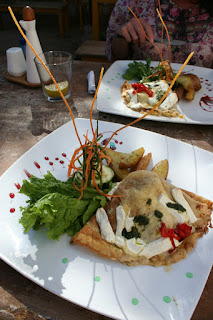
Next up, we had a crêpe filled with creamy mushrooms and vegetables and topped with cheese.

Postre

This was followed by manjar de quinoa - a pudding made from the 'ancient' grain and dulce de leche. Delicious. I imagine we will return here before leaving San Pedro.

Thursday, 28 May 2015

Artisans at Work

It seems that San Pedro is a town of artisans. The streets abound with artisanal products, hand-made and eminently purchasable.

Artisan jumpers

We made our way through the tucked away stalls groaning under the weight of alpaca knitwear, decorations fashioned from wood or dried gourds, and natural remedies sourced from desert plants. For me it is the textiles that characterise the atacameño handiwork. Most are woollen garments designed to combat the chilling desert nighttime - scarfs, hats, long socks, gloves, jumpers - all are available in temptingly soft alpaca wool. In the purpose-built 'pueblo de artesanos', we found at least one woman at a loom, painstakingly producing chunky-knit ponchos.

Artisan village

Having had our fill of knitwear, we indulged in some artisanal ice creams. This time the shop came good with flavours sourced from local desert ingredients: algorrobo and chañar. Neither were bold flavours, and it turns out that alogorrobo is similar in many ways to carob, and so the ice cream had the same flavour as imparted by this ersatz chocolate, while chañar gave a subtle caramel note.

Artisan ice cream

Having been in email contact with the owner of Cervecería Saint Peter, I discovered that there was more than meets the eye to this hidden brewery. After a few words of halting Spanish to the ladies at Ayllu restaurant, we were met by the brewer and ushered behind the restaurant to visit the premises, which can be reached by invitation only.

The brewing premises were little more than a small room, but the brewer, who started the venture two years ago with his girlfriend, was happy to 'show us around'. In terms of artisan beer, he is certainly crafting from local ingredients but finds that the San Pedro water is not completely suitable and so uses the bottled variety. However, he highlighted a Chile-grown hop, Bravo, which makes up one of the seven in the Saint Peter Ascenso IPA.

While his customers in the vast majority prefer the golden ale he produces, flavoured with the herb rica rica, there were bottles of Ballast Point and Hertog Jan knocking around the brewery, so it wasn't a surprise to discover that he is a fan of big beers such as super-hoppy IPAs, Belgian tripels, porters and barley wines, as well as an experimental beer by Kross aged in Carmenere barrels, named Kuad. The line-up of Saint Peter beers reflect his adventurous palate. On recommendation we took away a few of his favourites for later. In terms of artisan credentials, table-mounted bottle-cappers were in evidence, and one of the bottles was grabbed from a box and labelled by hand as we purchased it.

Artisan beer

We congratulated ourselves on being able to sustain a conversation entirely in Spanish on such a technical subject. We can't claim to have understood everything, but, with confidence buoyed, we marched across the street to Queso y Olivias to source some queso de cabra (goat's cheese). As luck would have it, alongside artisan bread (natch), the 'emporio' also stocked soya mince.

With our newly procured artisan cheese, we arrived home to a much busier hostel than we left. Jostling for kitchen space, we crafted ourselves aubergine stuffed with soya mince, cheese and onion, alongside fried potatoes.

Tuesday, 26 May 2015

Knock, Knock. Who's There? No Bodies

San Pedro is home to a small museum covering the history of life in the Atacama desert, which was set up by a Belgian priest Gustavo Le Paige. Having been sent over to Chile to help another priest, only to discover that he had died several months previously (presumably why they thought he might need help), Le Paige eventually settled into a pastoral role in San Pedro.

Le Paige

Aside from looking after the well-being of the town and its people, he also took a keen interest in archeology. Alongside the pots, baskets, tools, weapons, pipes, and snuff trays that he discovered buried under the dust and sand, he also exhumed several mummified bodies of Atacameños (people of Atacama). These were, until very recently, on display in the museum. However, understandable concerns were raised by the current Atacameño community - who only recently seem to have been given a voice - about the dignity of displaying the remains of their ancestors to gawping tourists.

Snuff tray

Whether right or not, the museum heeded the indigenous people's request and removed the bodies. However, now the central pit, which previously housed the mummies, has been hurriedly converted into a simulacrum of an archeological site, complete with tape measure, trowel, and safety glasses.

Empty pit

During our travels, I like to pick up unusual ingredients with which to cook. This can sometimes threaten to backfire - such as the poisonous beans in Thailand - but mostly ends in delicious results. We picked up some unusual-looking corn at the market the other day - larger than usual and mottled white and purple. After soaking the kernels overnight and observing no change, we went back and asked the friendly market stall holder for advice. From her gestures, more than her words, we understood that the corn was meant for popping. Unlike the usual variety, which turn themselves inside out with the force of the escaping steam, these kernels puff only slightly but made for a tasty snack.

Kernels: before and after

Trying to cook local dishes using produce at hand is sometimes a challenge. Chilean cuisine has not inspired me a great deal, porotos granados aside. However, this evening, K had the marvellous idea of stuffing tomatoes with quinoa (a grain of Andean origin, but still surprisingly expensive).

Stuffed tomatoes

The tomatoes exploded somewhat but, served alongside a ratatouille of vegetables, fried plantain and (of course) avocado, they made a filling and tasty meal of local ingredients.

Sunday, 24 May 2015

San Pedro

Breakfast at our lodgings largely comprises bread and jam. The Chileans are bread crazy and eat it with practically every meal, even if they also eat rice. There are many different kinds of bread, the one which we ate this morning comes in small sturdy rounds with dimples in the top, and is called pan amasado - literally 'kneaded bread'.

Pan-demonium

As we leave by the front door, we are confronted by the imposing presence of the volcanic mountain, Licancabur, its bulk split between Chile and Bolivia (unevenly in favour of the former), as it rests on the border between the two countries.

Licancabur

The mountain's peak rises to an elevation of almost 6km (at 5,920m it is around two-thirds of an Everest). Its summit is well beyond the limit at which people should suffer from oxygen deprivation and potentially pass out. This is around 15,000 feet (4,572m), the altitude at which I last year leapt out of a plane. The reason for not ascending higher was that low pressure would cause us to pass out in the unpressurised cabin of the plane. However, climbers make the ascent far more gradually than an aircraft, acclimatising as they go, meaning they can climb beyond this limit, even if they eventually need oxygen tanks at the summit (as in the case of Everest).

At an elevation of only 2,400m, altitude sickness can still cause problems. However, a departing German couple gave us some dried coca leaves and sweets with essence of coca, in case we have trouble ascending farther. The coca leaf is the same as is processed to produce cocaine, but the alkaloids are present in such low amounts in its raw form that it shouldn't be habit forming. Nevertheless, it is illegal to take the leaf across borders.

In the last few days before we left, Santiago had become much cooler with the transition from autumn to winter. San Pedro, however, has cold mornings and nights, but an intense sun that heats up the ground and walls of the buildings. We soaked up some of the sun we had been missing before taking a walk into town.

Aside from the main square, with the currently being restored church and high-profile police station for the Carabineros, the main street in town is Caracoles.

Ever since yesterday, I've been seeing this shape

The volcano looms over the town and manages to insinuate itself into any view. Practically every place in town is a restaurant, tourist agency, or artisan craft shop. Or craft beer brewery!

Atacama craft beer

Actually, there is only one brewery, Cervecería Saint Peter, which seems to be tucked away somewhere on Toconao, but which appears to be fronted by the restaurant Ayllu. This stocks bottled beers by the brewery that claims that "el desierto no es tan seco" (the desert is not as dry) since they have been in operation.

I'm not sure where they source their water, as there isn't much in the arid desert, but the adjuncts certainly have a local flavour. When we were there, three beers were available, each unique to Atacama as they use ingredients native to the region: A golden ale with rica rica (a verbena-like herb that gives a lemony, soapy, sorachi-hop taste), a Scotch ale with chañar (a fruit that is processed into a sweet dark molasses), and a Porter with algarrobo (a green pod-like fruit that is also used to produce an atacamenian liquor for celebrations).

Despite only stopping by to sample a couple of beers, we were given a small plate of rice to eat. We thought this was the waitress mothering us, so that we didn't drink on an empty stomach, as she was also concerned we would burn sat outside. However, it transpires that proprietors in San Pedro are nervous of serving drinks without food, since the authorities shut down a number of unlicensed venues where tourists were routinely getting drunk.

To be honest, we probably would have eaten a meal, but San Pedro is expensive by Chilean standards. Prices seems to be roughly 1.5 to 2 times as dear as Santiago (the beers were 4,500CLP, versus 2,800 for similar artisan ales in the capital, while a plate of chorrillana would have set us back 12,000, and could be had in Santiago for under 6,000). Given this, we approached the local market to get some produce for cooking at home.

The vegetables were good quality and we simply threw together a medley of tomato, aubergine, onion, and courgette on rice, set off by a guacamole made from the most magnificently ripe and tasty avocados. After weeks of eating bread and stodge in Santiago, it is a pleasure to tuck into a plate of fresh and tasty vegetables.

Vegetable medley

Avocados are abundant in South America and delicious. I believe the taste is so good because they are allowed to ripen on the vine, rather than being cold-shipped as green bullets to the UK, where they sit in the fruit bowl for two weeks before being forgotten about and turning brown.

Thursday, 21 May 2015

The Glorious Navy

Today is a national holiday in Chile in honour of the nation's navy, or more specifically the naval glories, as it is known as El Día de las Glorias Navales.

However, the day chosen, 21st May, commemorates a less-than-glorious event - the Battle of Iquique - on the same day in 1879, in which a Chilean ship blockading the Peruvian port was destroyed.

This battle was among the first of the initial naval campaign in the 4-year-long War of the Pacific between Chile, Bolivia, and Peru.

This battle, and the war of which it was a part, was ostensibly caused by a controversial 10 cents tax hike imposed by Bolivia on Chilean mining operations in territory mutually agreed to belong to Bolivia, but from which it would receive tax revenue. In reality, there were already simmering border disputes around the nitrate-rich Atacama area - nitrate was used both as fertiliser and in explosives - and the treaty-busting tax increase catalysed all-out war.

Peru entered the fray as it was allied with Bolivia through a previously undisclosed treaty and refused to declared its neutrality. This led to Chile occupying the Bolivian mining town of Antofagasta and blockading the  Peruvian port of Iquique to prevent them gaining command of the sea. Despite the losses on 21st May, Chile's subsequent land assault was eventually successful and boundaries between the three countries were redrawn in a peace treaty, allowing dominant Chile to annex both of the above-named towns, leaving Bolivia landlocked - a subject which is sore until this day and which is currently being taken to the World Court by president Morales to once again give Bolivia access to the sea.

In Santiago, all of these skirmishes seemed an age away - the Bolivian corridor to the sea across Chilean land is rarely mentioned. The day was cloudy and rather cooler than of late, but still warmer than most British summer days with a high of 20°C. Still, the local Chileans were duffled up even if they were running or cycling up St Cristóbal hill - the mount that overshadows much of the centre of town.

We joined the well wrapped-up folk on their day off for a jaunt up to the summit. Although rising to 880m above sea level, the climb is only a few hundred metres up a dirt path to the peak. Still, there is a funicular for those not inclined or unable to make the ascent.

View from the top of San Cristóbal

The hill was for a while privately owned, during which time the rock was quarried for construction in Santiago. The highest point is now surmounted by a large statue of the Virgin Mary and an amphitheatre for outdoor ceremonies.

Gran Torre - the tallest building in Latin America

Having 'summited' the small cerro, we attempted a different route down that would lead us to the east side of town, away from the access point in Bellavista. A few unsuccessful attempts led us down steep dirt tracks, which were gleefully being used by local downhill mountain bikers. Eventually we discovered the less trodden Sendero de las Grandes Travesías, which brought us out into the affluent and residential area around the autumnal tree-lined Av. Pedro de Valdivia.

Autumnal avenue

A few streets from here, we found El Huerto - an upscale vegetarian restaurant (commensurate with its surroundings), which was not only open on the public holiday but doing a roaring trade. The waiters and waitresses were run off their feet attending to the flood of customers demanding all-vegetarian dining. I was flabbergasted that this kind of venture could not only survive, but thrive in meat-obsessed Chile.

Middle-class vegetarianism

K and I both plumped for the 'Anatolia' menu of the day, which included a Turkish potato soup, spinach pancake, babaganoush, hummus, olives and roasted carrots, followed by baked pear and a cinnamon-spiced compôte. The food was well presented and reasonably tasty, but slightly overpriced owing to the location.

Wednesday, 20 May 2015

La Prueba

The end of our 2-week Spanish course is in sight. A test (una prueba) usually accompanies the graduation from the course, traditionally taken on the last Thursday. However, since tomorrow is a national holiday (feriado), the test fell today.

The morning started dark, with an unusually overcast sky and light drizzle. I have made it a habit to walk to school wearing a T-shirt, drawing askance looks from the Chilean passers-by, who are muffled up for winter. The temperature at this time of the morning is usually healthily in the teens, but even I donned a jumper in this morning's chill. The streets were also relatively empty, presumably as the exodus for the holiday weekend begins. Thursday is the only official day off, but many will make a four-day weekend and flee the city.

The test proved much more difficult than I had imagined. Instead of testing solely the knowledge we had gained in class, which has largely focused on use of the present tense, the article offered for comprehension and subsequent questioning included constructs unfamiliar from the teaching material.

The subject of the afternoon conversation class was sparked by a newspaper article on how the majority of genes of the average Chilean come from Europeans - versus indigenous Latin American people or from Africa. While the 'discovery' by Chilean geneticists was incidental to their search for a cure to certain diseases suffered by Chileans, my teacher considered the tone of the article (or at least the motivation behind its particular spin) to be symptomatic of deeply entrenched racism in the country. She's radical like that.

I had to agree, even with my shaky grasp of the article's contents, that the subtext behind the headline was, at best, suspect and, at its ugliest, a celebration of the Chilean people's ethnic purity and an attempt to distance the 'average' Chileno from indigenous Americans with associations of poverty and poor education, and, by extension, to align themselves with affluent, developed, white-skinned Europe. It was a nasty window into a world that seemed all too familiar to me from reading the British press and listening to received opinions on immigrants, their doubtful qualities and their apparently deleterious effect on British society.

The subsequent text presented for comprehension revealed a similar set of erroneous beliefs about immigrants and exploded the myths one by one. Immigrants to Chile are predominantly Peruvian, are better educated than many Chileans, and do not seek to burden the public infrastructure, paying for their use of the education and health systems as any other. However, stereotypes and prejudices cause specious logic to take root in the public consciousness. Immigrants from neighbouring countries with a higher percentage of indigenous people and questions over an individual's racial composition co-mingle in a way that leaves a bitter taste in the mouth.

The teacher was surprised to learn of similar, if not identical, concerns from a certain camp in Britain (naming no Ukip voters). She wondered how such negative stereotypes of immigration could persist after decades and centuries of cultural mixing on the island. I conjectured that it was an attitude born of fear of change and difference, in which each new generation of Britons (themselves descended from immigrants) may fear and resent the effect that the newly arriving immigrants will have on their established society.

Inside-out rolls

As if to underline the cross-cultural influences, the area around the school abounds with sushi restaurants. I'm not entirely sure how the archetypal Japanese dish arrived in Chile, as there does not appear to be a large Asian community. I suspect its popularity came by way of California, as the offering is almost exclusively the filled and sliced rolls that have sparked a slew of variations in North America.

A little digging revealed a local enterprise serving up an inventive vegetarian and vegan take on the California rolls. WunjoSushi does not have shop premises - the owner makes and sells the sushi directly from their apartment. Having placed an order (pedido), I arranged to pick it up in the evening. Finding the flat was simple enough, but being buzzed in to exchange cash for sushi felt more like making a shadier exchange and I left wondering whether I would be picked up by the Carabineros to investigate the contents of my bag.

The mixed box contained three varieties of 'inside out' rolls, with the nori on the inside, leaving the outside ready for a variety of treatments. We had palta, tomate envuelta en almendras (avocado and tomato rolled in almonds), sevillana, zanahoria, queso en sésamo mixto (pepper, carrot, cheese in mixed sesame), and champiñón, palmito, queso en ciboulette (mushroom, palm hearts, cheese in chives). Each was delicious and reminded us of how much we miss Asian food.

Friday, 15 May 2015

¿Cuánto?

At the end of the first week of intensive Spanish lessons, we have only just got round to learning how to count. This is by no means a criticism of the teaching, as numbers can easily be self-taught but, judging from the competency around the table, few had bothered. That includes me. This is because it is boring. I was able to count, roughly, up to around 20, but much higher resulted in errors and guesswork.

However, numbers are important. We already failed to attend a lesson on time earlier this week, as I had misunderstood the times. Prices on the market are similarly tricky, especially once I learned that among the 'exceptions', there is a special word for the often used 'five hundred'. While I had been listening out for 'cinco cientos', in fact the stallholders had been holding out their hands for 'quinientos'.

Being the end of the week, the teachers planned a learning game. The game, "What am I?" (¿Qué soy yo?), is the familiar process of selecting a card bearing an object and attempting to divine its identity solely by asking questions of the other players. This required us to remember and correctly decline nouns and adjectives, as well as differentiate between ser and estar. Amongst cards depicting animals, items of clothing, and furniture, I was landed with describing a rainbow (arco iris) - something with which I would struggle even in English.

In the afternoon's class, we tried to jump start the conversation with an article from the newspaper. The teacher chose one of the free 'metro' papers, principally because it contains short articles on (hopefully) simple topics.

Skipping over the pages of articles on football and the approaching Copa América, much to my teacher's dismay, I selected an article on recycling. This turned out to be a poor choice, as the journalist had chosen to write it in a specifically emotive idiom, which avoided the use of verbs in favour of sentences solely comprising lists of nouns and adjectives. Demonstrating her quick-thinking and great adeptness for teaching even awkward buggers like me, my teacher suggested we try to find the missing subject and verb in order to reformulate the sentence to be grammatically correct. This became tiresome after the first paragraph, so she (equally astutely) proposed that we give it up as a bad job. We ended up discussing an article on Gaspar Noe's film, 'Love', which courted controversy at Cannes and talked generally about explicit and award-winning cinema at the French film festival.

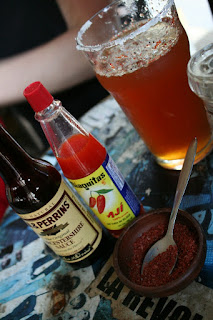
K and I repaired to the excellent Café 202 for some end of the week cervezas artesenales. K opted for a 'Michelado', which is any light beer served in a salt-rimmed glass with the addition of lemon juice, black pepper, Tabasco sauce, and merquén (a smoked, ground chilli pepper).

Spicing up the beer

Similarly indulgently, we proceeded to vegetarian restaurant, Sujo. In recognition, the waiter gave us a friendly smile and indulged our poor Spanish. K went with the heavy but delicious dish of pastel de choclo, while I indulged the Chilean penchant for bread and had another enormous sandwich, this time filled with a pseudo-fish slice of nori-wrapped tofu.

Tuesday, 12 May 2015

Spanglish

Second day of class today. The topic of the group lesson was the agreement between the gender and number of nouns with their definite and indefinite articles, and with descriptive adjectives. Having learned both French and German, the theory is well known to me, but is anathema to those English people who have never studied another foreign language. Long ago, we simplified out any difficult declension, requiring us only to use one form of 'the' and 'a', and the odd 's' on the end of words to indicate more than one of anything.

Spanish still clings onto the fact that every single object (as well as less tangible things) has to be either male (el lápiz, the pencil) or female (la mesa, the table). This leads to a never-ending list of nouns that have to memorised and classified into two camps. Fortunately there are some rules governing which gender things might have. Nouns ending in 'o' are largely masculine, while those with 'a' are feminine. Of course, where there are rules, there have to be exceptions - la mano (the hand) is feminine, while el día (the day) is masculine. And, if you have managed to get your head around this, aesthetics comes to mess things up for you. While agua (water) is, as you have every right to expect from the last letter, feminine, nobody in their right mind would say "la agua", because the extended vowel sound from the combined a's is offensive to the ears of sensitive people. So, it is rendered as the gender-swapping "el agua", but don't forget that any adjectives have to agree with the real gender, resulting in the following confusing juxtaposition: "el agua fría" (cold water).
Despite the exceptions - goodness knows English has enough - the theory is simple to grasp and the lesson was a good chance to get to know a stack of vocabulary. I tend to prefer learning the structure of a language, and so spend more time absorbing the grammatical rules and patterns, while being lazy about reading word lists and using the language in practice.

Fortunately, our course includes a private conversation class each day, solely for the purpose of getting me to open my mouth and think on the spot. However, with a currently limited vocabulary, this quickly turned into a cultural lesson covering la gente indígena (indigenous people), the benefits of being united by a common language throughout Latin America, as well as the differences in pronunciation between the countries (Peruvians apparently enunciate, while Chileans gabble).

For making it through the day, we rewarded ourselves with a visit to the tucked-away vegetarian restaurant, Soju, in el centro histórico. While the location is not the best - stuck inside an arcade/gallery, like a miniature mall, of the sort that seem quite popular in Santiago - this cosy place serves up Chilean 'specialties', such as hamburguesa a la pobre ("poor man's hamburger", with a fried egg on top) and chorrillana (a heart-stopping plate of chips topped with cheese, fried onions, faux meat, and a pair of fried eggs). After the ubiquitous bread and pebre (a very fine salsa), we were served an unusual mushroom, tofu, and onion ceviche. This vegan version of the traditional dish involving raw fish cured in lemon juice was a much welcome flavour bomb.

El sandwich

To eat, I plumped for "El Chorizo", a mock meat hamburger flavoured with the eponymous sausage spices, in an enormous bun. K went for slices of 'beef gluten' (known elsewhere as seitan) with rice. Both were tasty but felt a little nutritionally deficient. This kind of food is all too easy to find in Chile, which is a shame, as the fresh produce is fantastic, including enormous and tasty tomatoes and avocadoes.

Mock beef and rice

The immersion continued as we plucked up the courage to join the weekly 'Spanglish' party at Le Pub 36½ in the trendy Providencia area of town. Just half an hour's walk brought us to an area buzzing with people, bars, and restaurants. As is commensurate with our British reticence, we hung in the doorway for a good while, wondering whether we had arrived at the correct venue. Fortunately, the host soon approached us, greeting us with the exuberantly continental 'air kiss' that seems to permeate all countries that speak a Romance language. We were immediately introduced to a group of girls from Argentina and Mexico, studying in Santiago, and keen to improve their English. Judging that their competence significantly outweighed ours, we switched between hesitant Spanish and a rather more fluid conversation in English. Part way through, a native 'Santiaguino' burst into the group, announcing himself, barely able to contain his energy. The conversation negotiated the usual territory between foreigners, through respective travel plans, slang, to cultural differences. The Mexicans maintained that the people of Chile were cold and Mexicans were more friendly and looked out for each other far more, while the born-and-raised Santiaguino thought that the problem was one endemic in large and capital cities across the world. I must say that the people we have met so far in Santiago have been muy simpático.

Thursday, 7 May 2015

Full Immersion: Vino, Spanglish and Pisco Sours

As well as the imposing sight of the Andean mountains forming a backdrop to Santiago, Chile is also famed for its cerro - small hills that rise out of the streets.

Castle on Santa Lucía

This morning we climbed nearby Santa Lucía, popular for a couples' stroll at dusk, and topped with the slightly odd-looking, red-painted castle ramparts of Castell Hidalgo.

Defending the hill

Albeit small, the summit provided good views of the city and the orange smog-covered Andes.

Smoggy San Cristóbal hill

Descending from the mountain, we stopped by a small vegetarian- and vegan-friendly café, Girasol*, for an empanada - a savoury pastry a bit like a pasty. As well as having veggie credentials, the owner upped the stakes by using wholemeal flour for a dense and 'healthy' snack.

* I'm not sure what it is with sunflowers (girasol) and vegetarianism, but I have seen the two connected in several countries.

The language school, at which we will be starting a course next week, organises many cultural activities throughout the week. We thought it would be good to immerse ourselves in these ahead of the classes, both to meet people and to get an initial grip on the language. The empanada lined our stomachs for today's activities, which included a winery tour and a pisco sour tasting evening. I'm not sure how 'cultural' either of these activities are, but they were certainly a baptism of fire into the Spanish language.

We found ourselves in a minibus full of students who had been learning Spanish for anywhere between six months and six years. For all intents and purposes, they seemed fluent to our ears. The  native-speaking teacher wasn't taking any hostages either, as she addressed us and the rest of the group in no-holds-barred Spanish. At the vineyard, Cousiño-Mucal, just thirty minutes outside of Santiago centre, she instructed the guide to do the same, so we understood little of the tour, but filled in the blanks from our recent trip to New Zealand's Marlborough and Central Otago regions.

Family vines at Cousiño-Mucal

Unlike the modern metal containers of NZ, the Chilean grapes are fermented in enormous 100,000 litre barrels fashioned from mighty Californian redwoods. Two of these giant vessels are solely for "the family's" use.

Just hook it to my veins

After the tour, we tasted three wines - a Sauvignon blanc, a Cabernet Sauvignon, and a Syrah.

Degustación

None set my world alight but the latter was poured with a handy little aerating gizmo, which may or may not have contributed to its round and smooth character.

I can see this going wrong after a glass or two

Back in the city, there was little time before it was pisco'clock. Pisco is a spirit made from distilled grape wine, akin to brandy, and this evening was a masterclass in its various preparations. In anticipation, we bolted a horrible sandwich from a comida rápida (fast food) restaurant, ironically named 'Sandwich Master'. It turns out that if you take the carne out of a charrasco italiano, it's a wholly unsatisfying sloppy mess of avocado and mayonnaise in a bun. No me gusta.

Pisco sour is normally blended from the spirit itself, plus lemon juice, sugar syrup, and ice.

The indomitable Jaqui makes pisco sours

Over an array of traditional sours, as well as those containing fresh basil, mango purée, and raspberry purée, we attempted a few faltering Spanglish conversations, and resolved to get much better, muy rápidemente.