Showing posts with label Bali. Show all posts

Tuesday, 3 March 2015

Going Down Under

We rose and motivated ourselves relatively late this morning, as we suspected we wouldn't get much sleep on the overnight flight to Sydney. This isn't because we don't sleep well on flights, but because long-haul journeys offer the opportunity to watch several films back to back. So, after the lights go down, and everyone else snuggles under their blanket in an attempt to sleep, we watch our way through the catalogue of entertainment like children furtively reading by torchlight under the covers. If we are really lucky, our movie screening is accompanied by food and drink.

We fastidiously planned our couple of days we plan to spend in Sydney, as though it were a military operation. The laid-back approach afforded by our extended stays in other places is unfortunately not applicable to our whistle-stop tour of Sydney.

Once tired of planning, we headed back to Warung Soputan for a final dose of sweet, foamy teh tarik and roti prata with mung bean dal. It was predictably great and we bade farewell to our breakfast tradition.

Packing the final things into our bags threatened to be thwarted as the launderette we used to wash our clothes had unexpectedly closed today. We imagine picking up a neat package of freshly ironed garments, and slotting them into our rucksacks. Instead, I phoned and beat down the doors of the laundry business in an attempt to retrieve our clothes. Eventually, and understandably begrudgingly, someone opened up the premises, folded and returned the washed items. "Not ironed. Come back tomorrow?" implored the man. I tried and failed to explain that we had a flight in a few hours and returning the next day might well be a long and expensive affair.

With everything finally backed, our host very kindly drove us the short distance to airport, braving the scrum of traffic that was involved in such a journey.

Checking in was a relatively painless procedure, although we had a surprise departure tax of $20 per person levied - completely legitimate, but a shock after the $35 p.p. arrival tax.

Having paid out all our last rupiah, we were unable to buy any water for the flight at the inflated airport prices - a 4000 rupiah 1.5 litre bottle at the local supermarket suddenly commands the princely sum of 30,000 rupiah in the confines of post-security departures. A pox on the ingenious terrorists who manufacture in-air explosives from plain water!

Fortunately our access to the Premier Lounge also gave us access to small bottles of water, which we furtively secreted into our carry-on baggage.

The internet at the airport proved itself no better than anywhere else on the island, popping up and disappearing with the regularity of a parent playing peek-a-boo. I was less than amused as the metaphorical child, however, and consoled myself with the selection of beer, wine and food from the buffet.

Anker pilsener was the only malt-based beverage available, although the Jakarta-brewed beer also seems to contain 'jagung', or corn. I mentally added this lager to Angkor and Anchor, from Cambodia and Singapore respectively, as a homophonic beer of similar quality.

"How do you do?"


Sadly, the vegetarian options at such buffets are often limited. We tucked into a salad, followed by fried rice and vegetables, which were oddly cooked in a Chinese, rather than Indonesian, style. It's odd how just fried rice can have such differing preparations - this was certainly not nasi goreng as we knew it.

Fortunately, the wine selection, among the obvious Australian contingent, included a superbly sweet and fruity white from Bali's own Hatten vineyard.

Excitingly, the entire airport was plunged periodically into darkness, the melodic gamelan music in the lounge ceasing abruptly, as the power went out. I only hoped that the more critical functions are on a separate circuit, although it might explain why the WiFi is so poor.

On board our Malaysia Airlines' flight, the genial, everything-not-quite-as-it-should-be atmosphere  reprised itself from our outward journey. Among increasingly consternated outcries from the passengers about the entertainment system - for which the headphones, this time, had been provided, but which had failed to kick in at cruising altitude - it was rebooted, revealing an old Mac OS-style cross on a grey background, followed by the safety announcement (again). This procedure was iterated a few times before a missive arrived that the entertainment would be unavailable.

Without wishing to sound like a curmudgeonly old bore - I relish flights and look forward to the food, which is generally excellent, and the films on board, while the longer the flight the better to enjoy both of these - but the food was horrible. It was a travesty when compared to the delicious cuisine available throughout SE Asia - the rice and vegetables were both overcooked and flavourless.

We switched planes at Kuala Lumpur, where we saw no sign of either koalas or oompa loompahs during our short layover.

The flight from KL to Sydney took us back the way we came, passing almost directly over Denpasar. Still, the backtracking enabled us to peruse the film selection. We chose The Host out of the catalogue, which despite its name is not a 1970's horror, but a recent science fiction film. Sadly, the conceit of having aliens take over human hosts is a tired one and the script, including a voiceover from one human trapped inside their own body, was full of unnecessary exposition.

Taking two flights in a row often means eating two meals. The Denpasar to Kuala Lumpur leg presented us with 'supper', so I'm not sure how to designate the subsequent meal. However, as it arrived around 12AM, I think we can call it a midnight feast.

Mile-high meal

The caterers redeemed themselves with this offering of rice, a spicy kidney bean curry and a creamy vegetable korma. A baby corn salad, and a dinky portion of cheesecake also didn't go amiss.

And with that, I fell into a fitful sleep.

Monday, 2 March 2015

Farewell Flavours

This morning's breakfast was a celebration of Indonesian ingredients and flavours. I suppose it could be classed as kwetiau goreng, as it was technically fried kwetiau noodles.

Kwetiau goreng with kemangi

I fried chunks of tempeh with noodles and garlic, combining them with a sauce of tamarind, mushroom sauce, soy sauce (sweet and regular), and sambal. The crowing glory was handfuls of zesty kemangi (lemon basil). Lip-smackingly good.

We packed, soaked up the sunshine at the pool and went for a walk. Unfortunately, while we have seen some singularly beautiful areas of the island, our initial of impression of a paved paradise was not undone by the short walk we took around the local area. The traffic seemed worse than when we arrived and we haven't grown any more accustomed to bellowing to another over the din. K quickly developed a headache, which turned into a migraine, although the blame for this can't all be put on the motorists.

"If you can't beat them join them" is not at all a sustainable solution, but one that is selfishly tempting to satisfy one's own needs to the detriment or all. We guiltily followed this maxim, and joined our host in his car for a slow chug through Denpasar's already saturated streets.

The destination was an excellent choice, however - the city's own franchise of Loving Hut, a vegetarian restaurant that we also visited in Ho Chi Minh City.

The choice was overwhelming, but haste was called for as the waitress returned, expectantly tapping her order pad. After a couple of false starts on items that were no longer available, I settled on mie ketoprak. A deeply savoury and peppery sauce contained fried tofu, triangular dumplings filled with minced beef, tempeh, and chewy noodles.

Mie ketoprak

K went with soto betawi, a soup which contained tofu, 'meat' balls and noodles. She declared it not as good as the soto ayam prepared at our local vegetarian restaurant, Looi Bazaar.

Also on the table were fuyunghai, a kind of Chinese omelette, covered in a sweet tomato chilli sauce and peas, as well as sate. The latter was convincing to the point that the meat-eaters couldn't tell the difference. As a long-term meat-dodger, however, I could taste the distinctive presence of soy.

On the way back, our host insisted that we stop for terang bulan. We relented, having had our arms thoroughly twisted (not really). The unique selling point of this terang bulan was that the sponge itself came in many flavours, from pandan to chocolate and orange.

Terang bulan pandan

We selected pandan and ended up with a bright green sponge, with an aromatic taste reminiscent of subtle mint.

Sunday, 1 March 2015

Xenophobia's Paradox

Breakfast comprised an oddly comforting assortment of garlicky creamed corn, sticky rice and boiled egg this morning. The corn was made creamy with coconut milk and a squeeze of lime juice to cut through the fattiness. Using up things in the fridge is always a challenge I relish, but tends to result in odd meals.

Creamed corn. Yum?

In our last couple of days in Bali, and also in SE Asia, it seems as though we should be making the most of what the island, and this area of the world, has to offer. This is a familiar feeling from exiting other countries on our trip, and risks becoming a feeling of limbo as we anticipate and plan for our next move - in this case heading to Australia, initially landing in Sydney.

Of course, we could choose to move on before now, circumventing the next few days of aimlessness. In theory, our flights are flexible, but in practice the cost and effort of changing plans mean that we typically see out our arranged schedule. Besides, we need the time to plan and reconfirm flights, hotels and other travel plans, as well as to get excited about what the new locality will be like.

Our journey through SE Asia - taking in Southern Vietnam, Cambodia, Southern Thailand, Western Malaysia, and Bali - has been a fascinating experience. Having the opportunity to soak up the life and atmosphere in each location before leaving, rather than rushing from place to place, has revealed certain similarities and differences across the countries. Similarities are to expected, especially as many neighbouring countries resulted from the same historical empires, or have subsequently imported influences over the border from one another, or been subject to change by an outside force (e.g. China, India, or Europe).

Bali has been a hard place to get to know. It has offered some of the most exhilarating and memorable moments of our trip so far, but has also been one of the places with which we have found it hardest to get to grips.

Thinking about Bali and the other places we have visited, certain characteristics stand out to me. The following is not meant as a representation of the individual people I have met, who have been friendly, happy, extremely hard working, and, for the most part, honest. Instead, it is an attempt to characterise the differences I perceive between the nations. Some might call it glib, reductionist, and probably unhelpful anthropomorphic stereotyping, but some people are too sensitive (and seem to have swallowed a dictionary).

Bali I see as a character of a middle-aged, work-weary man. His once quiet and serene life, full of order, colour, a healthy environment and family is slowly being overtaken by traffic, pollution and noise. The things he loves and holds most dear are being subordinated to a pressured sense of having to progress. Progress, he thinks, seems to have come out of nowhere. It seemed like a good idea at the time, when people came and took an interest in him. For a while, things were quite exciting, but modern life seems to have got the better of him and is, well, a bit rubbish. He is probably separated from his family for much of the time. He still recalls the traditions of his ancestors and the heyday of his youth, but somehow he finds himself stuck on a path that he is not sure he wants to be on. For too long, he has let people take him for granted and he is concerned about where it might lead. I would say he is heading for a breakdown and, if he were a friend of mine, I would be having a word to help limit the damage from the processes already set in motion.

Thailand strikes me as a young woman, who is naturally and effortlessly devastatingly attractive, laid-back and easy-going, but a little listless and feckless with it. While not well off, money seems to be coming in from somewhere, which has led her to be complacent. She is a hedonistic person, parties a lot, but also sleeps a fair amount if she can get away with it.

Cambodia gives the impression of a tragically desperate woman. Although beautiful, her difficult past threatens to blight her future and her situation leaves her vulnerable to exploitation by others. In response, she is often the one to react first, in defence, biting the hand of those that try to help. She makes herself difficult to love, perhaps because she finds loving herself just as hard.

Vietnam is certainly a young and thrusting man, who is idealistic, optimistic, and full of hope about the future. He is hardworking, industrious, and inventive and has countless ideas about how he is going to improve himself and show the world what he is made of.

Malaysia comes across as a 30-something man or woman, who is comfortable in their own skin. They are happily rolling along, seeing where life takes them. They really enjoy art and nature, and food - mostly food. They don't mind having noodles for breakfast, lunch and dinner. And maybe just a small slice of cake. They are wise and tolerant of others. Funnily enough, this was the place we felt most at home.

So, there you are. Five nations caricatured in as many paragraphs. Frankly, with that kind of writing, I'm surprised that Private Eye hasn't picked me up yet. Or the Daily Mail for that matter. I could have a column called "Reasons to be Fearful", or "Xenophobia's Paradox", and engage in some wonderfully fallacious reductio ad absurdum arguments about the relative merits or otherwise of foreign cultures. For example, "if any other country had anything of greater cultural worth than Britain already has, we would long ago have colonised said country and claimed whatever it was for the good of the empire."

Meanwhile, back on planet Earth, in Bali, our funds and provisions were rapidly diminishing and we required sustenance. We dithered for approximately two seconds before unanimously deciding on tahu tek from our favourite local, Warung Mantap.

Good honest food at Warung Mantap

The husband and wife partnership seamlessly coordinated to fry the tofu and egg, snip it up with rice cake, and package it with beansprouts and a spicy peanut sambal. It was every bit as good as last time.

Saturday, 28 February 2015

Seminyak

This morning's breakfast was a helping of sticky rice, tofu lok lak and corn on the cob with a fried egg.

Taste for tofu

After nearly four weeks in Bali, we finally spent a day at the beach today. Aside from a brief evening watching the sun go down with our host here, we have focused our attention on the interior of the island, which more than merits our singular attention.

Neither of us are particularly beachy people, lured by the opportunity to turn ourselves a delightful golden colour, or to engage in surfing, parasailing, or banana boating. So, a trip to the beach is more an opportunity to sit in awe at nature's wonder - its ability to pound rocks and shells into dust through the repeated crashing of waves, and its twice daily show of kaleidoscopic colour that lights up the sky - and to splash about a bit in the shallows.

We took a taxi to Seminyak beach. This is the more exclusive end of a long stretch of sand on Bali's west coast, the southern part of which is home to the revelry of Kuta. Up at the quieter end, there are few water sports and beach bars give way to expensive bistros. We settled in to a pair of sun loungers and whiled away the afternoon watching a couple of body boarders and surfers tackle the waves.

Live for this (brief) moment

Hawkers patrol the beach, either carrying large portfolios of sunglasses under their arms or baskets of assorted items on their heads. We noticed that very few of the items on sale are things that we would want. We already have sunglasses, evident on our face, and don't want a tattoo (temporary or otherwise) or a fake Rolex. One woman seemed to have a basket containing ladles, a cheese grater, and a wooden-handled flick knife. I can't see much use for kitchen equipment on the beach and wondered why they don't sell things we do need or want, such as suntan lotion or ice creams.

Boondoggles and cheese graters!

While the waves on the coast of Bali are impressive and certainly larger than those on any of the islands we have visited so far (hence the attraction to surfers), the beach itself is very ordinary. In fact, taking a walk around the locality is very different to the area we are staying, and the other places we have visited on the island. Upscale restaurants serving predominantly western food abound, as do pavements connecting them, allowing tourists to peruse the selection of available cuisines. The Balinese also use the pavement, but drive down it on a moped to get three doors along. It's altogether an odd and unsettling place.

Outside of the centre of Seminyak, the hotels and fancy restaurants are sparser and, in between them, small unnamed warungs make an appearance, in which only Balinese are to be seen. Presumably these will be bulldozed when the land becomes more valuable as high-end properties. Several Balinese have voiced to us that this area is not considered 'Bali'. There is no malice intended in this observation. The tourists are welcome, they say, but they are not visiting Bali.

We dithered over whether to stay and eat in the area or to return home and go to one of our regularly frequented eateries, in which Balinese and tourists eat shoulder to shoulder. We settled on eating at the Queen's Tandoor - an authentic Indian restaurant, which mostly seemed to be patronised by visitors from India.

#BucketOfDal

The food was excellent and the people friendly. After poppadom and chutneys, as well as a bonus tomato soup that appeared, we tucked into paneer kashmir masala (Indian cheese in a rich, creamy, but peppery sauce), dal fry (a spicy and chunky dal of split yellow peas), pulau chollay basmati (rice and chickpeas tempered with butter), and garlicky naan bread. It hit the spot for Indian food that we had been missing.

Friday, 27 February 2015

Burnt Rice, Chaotic Rice

Back in the kitchen of our cabin in west Denpasar, I had a second stab at bubur injun - black rice pudding. If the rice wasn't black before I started, it certainly was by the end. The pot boiled dry and a layer of rice turned to carbon at the bottom. I will shamelessly blame the hob, which seems to have two settings - 'off' and 'rolling boil' - which makes simmering rice quite difficult.

Say what you like about bad workmen blaming their tools, but some tools genuinely do have shortcomings, and if my Dad taught me anything, it was always to use the right one for the job. He also taught me that no food should go to waste, so I served up the burned offerings.

K was characteristically enthusiastic, and one might poetically describe the rice pudding  as having a delightfully smokey taste, but I rather less charitably felt as though I was chewing on a piece of charcoal.

During the day, we picked up K's top, tailored in the style of a traditional Balinese garment. The lady looked relieved that it a) fitted, and b) K liked it. And so she should; it looks good, really good.

To avoid the pain of hovering over the pan waiting for the moment when the rice goes from raw to a state in which it is fused with the metal, I proposed that we pick up some fried rice this evening.

We returned to the husband and wife duo at the end of our street and ordered up a couple of helpings of nasi goreng mawut. This seems to translate as 'chaotic fried rice'. The chaos, it transpired, seems to arise from the inclusion of short lengths of noodles in amongst the rice.

Rice! And noodles?! Chaos!!

I was about to claim that pandemonium didn't result from our eating such blatantly disorderly food, but in fact the power went out just as we were tucking in. This left us having to finish up in the pitch black and find a torch.

Out of interest, we ventured out onto the street to see how the Balinese cope in a power cut. They revealed themselves to be most resilient. All the warungs remained open, some with presumably battery-powered light, and the street stalls continued by candlelight. Impressed, we ordered up a wonderfully indulgent, but hopefully non-chaotic terang bulan (stuffed pancake) from our local vendor. It was glorious, but as we sat decadently in bed, gorging ourselves on it, the bed and cabin shook. We presume aftershocks from an earthquake elsewhere in Indonesia, but it makes me think twice about what we eat next time. Perhaps just straightforward nasi goreng from now on.

Thursday, 26 February 2015

Keeping Bali Green - Talking About Sustainability

Our last day in Munduk started with a chocolate pancake for me. Sadly, this was decidedly stodgier than the coconut version I had tried a couple of days ago.

Having engaged the services of a driver for the day (far more economical, it appears, than making several short journeys), we planned to wind our way home via a few stops.

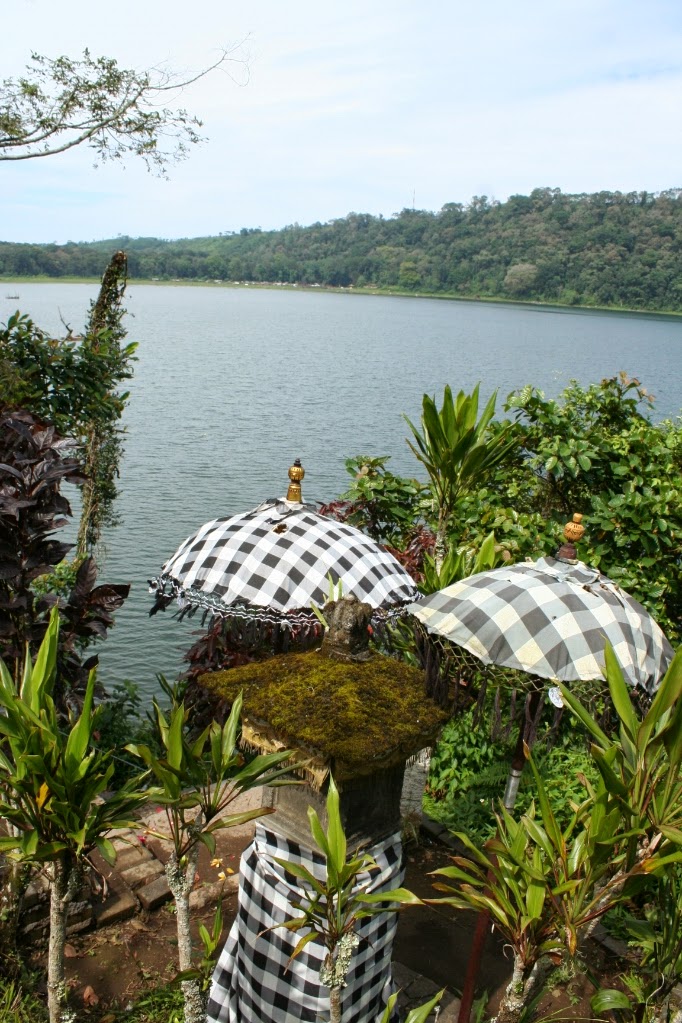
Our first port of call was Pura Ulun Danu - a temple on Lake Beratan. This is a pura tirta, a water temple that regulates the use of irrigation water to the surrounding rice fields through the timing of ceremonies.

Pura Ulun Danu

During our visit, a procession of men and women arrived, carrying penjor, parasols, and what appeared to be a yellow and white empty throne, presumably to the same deity Sang Hyang Widhi Wasa to which the many other thrones across Bali are dedicated.

Procession at Ulun Danu

The procession made its way down to the water's edge where the offerings were laid out, which, to my understanding, are made to Dewi Danu - the goddess of the lake.

Ceremony at Lake Beratan

Apparently, according to the PBS documentary, "The Three Worlds of Bali", the farmers abandoned the tried-and-tested temple-driven orchestration of irrigation in favour of watering their crops as quickly as they could grow and harvest them. It was a disaster, using up the irrigation water too quickly and leaving some fields dry and others infested with rats. They returned to the traditional, sustainable approach.

Jatiluwih rice terraces

We made our way from Lake Beratan down some windy, bumpy roads to Jatiluwih. This place is famed for its picturesque rice terraces. While terraced rice farming occurs all over Bali, the fields here are protected and designated a UNESCO Cultural Landscape. A stroll through the green steps in the clear air and peaceful countryside was a tonic. Mt. Batur and Mt. Agung were shrouded in cloud in the distance. This scene has not changed significantly for centuries, and thanks to the protection order will not be marred by development in the future.

The next visit was to a place that embodies the environmental awareness and harmony with nature that has typified Balinese culture, but which risks being lost to modern building materials, consumerism, and a time-pressured way of life.

Heart of Green School

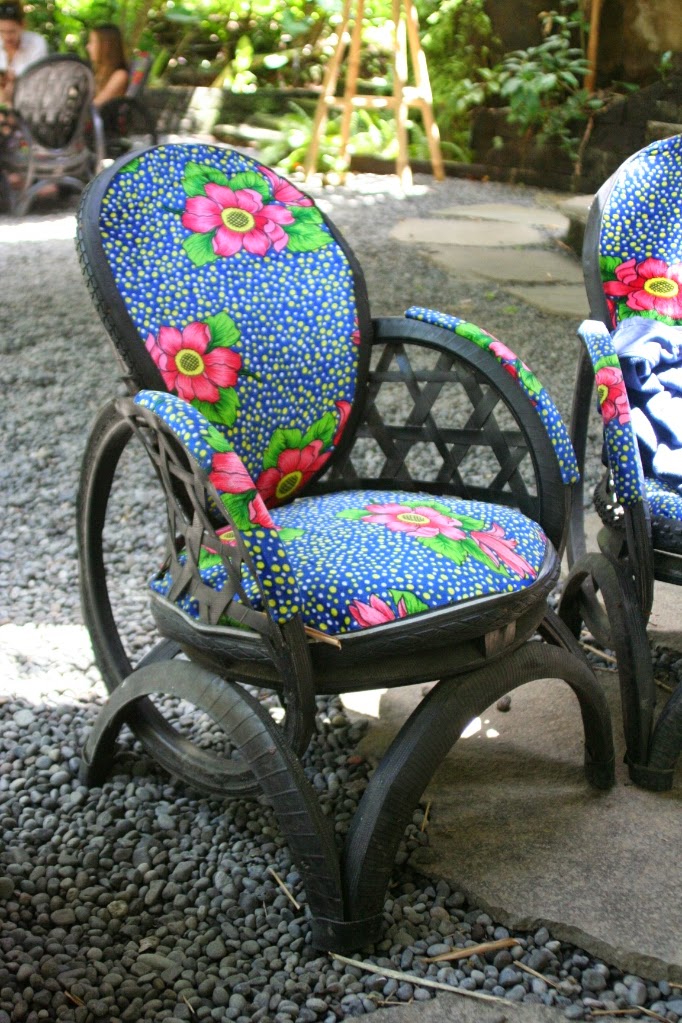
At Green School, founder John Hardy has created an architecture, an environment, and a method of learning that aims to create ethically conscious people. Students graduating from the school will have learned the skill of thinking sustainably - not just for themselves (no middle-age burnout for them), but also for the wider world.

Trained as a jeweller, John Hardy brought his design skills to bear on the architecture of the school, eschewing a traditional box-like structure. The heart of the school, where all the pupils meet and have lunch is a double helix design entirely constructed from bamboo. Every classroom has open walls, meaning that we were greeted by the sound of jazz floating out of the music 'room'.

More important than the architecture is the ethos and teaching. Leading by its principles, the school focuses on recycling, composting, vegetarianism, and green energy from its hydroelectric 'vortex' and solar panels. The children rush to follow this example, and we were greeted by a self-led body of students whose aim is to rid Bali of plastic bags. Until they succeed (I'm sure they will), the junk (non-reusable) plastic is collected, melted and turned into shipping palettes by a local company. The school even has an animal conservation program, breeding and releasing the rare and endangered Bali starling on its campus. Far more than dry text books does this give the children a tangible handle on their effect on the ecosystem.

Chair made from recycled tyres

We lunched at the school's Living Food Lab, where every dish is not only vegetarian or vegan but often raw. Having earlier declined an expensive tourist trap for lunch that our driver dropped us at, we were glad of the opportunity to sample an 'Avo BLT', with aubergine 'bacon', tahini 'cheese', 'rawmesan', sandwiched between two chewy onion crackers. I wonder whether the students appreciate this food or just want chips.

Avocado BLT

While using internationally recognised curricula, the teaching is grouped not by subject but by thematic units. These crosscutting themes bring together important skills in a way that is interesting and more rounded than the typical  focus of lessons on intellectual rote learning or on single-skill problem solving. Green School teaches creative problem solving, using not only the pupils' intellectual capabilities but also their emotional, spiritual and physical (kinesthetic) capacity. It recognises that each individual is different and responds emotionally. The students aren't patronised or admonished. They are given real responsibilities - the children built a pizza oven that now serves the canteen - and respond accordingly. The paths are made from sharp cobbles and nobody falls and scrapes their knees. The students practise a Brazilian-Balinese martial art in mud pit, known as Mepantigan, and love it.

There must be something in the method, as the faces of the children we saw were full of laughter and happiness. Nobody was dragging their feet, picking on or pushing other children. In fact, we were told that bullying is not an issue. One could point to the small numbers for an answer to the quality of the education; there are 420 pupils in the school. While the school is international, teaching both in Bahasar and English, at least 20% of the student body is Balinese, many on scholarships. With so many international students, one would expect most of them to board at the school. In fact, there are only ten boarders, while the other pupils' families have moved to Bali on the strength of the education their children will received here. That is an impressive commitment to the future.

Back in Denpasar, we went out to our usual vegetarian haunt, Looi Bazaar, where we always seem to be the only customers.

While K sampled the veggie soto ayam, I went for siobak singaraja. Siobak means pork belly, while Singaraja is a town in Bali, so I presume this is a reference to a style.


It arrived as a bowl of slightly sweet, thick, dark sauce hiding morsels of fake meat of various textures, chewy and crunchy. It reminded me a great deal of the loh mee we ate in Penang. I threw in the contents of a small dish of slice green bird eye chillies, which helped complement the sweetness. It was no bakso or soto, but tasty enough.

Wednesday, 25 February 2015

Gesing

Ginger is widely touted in Asia not only as a delicious spice, but also a kind of cure-all. Hot ginger tea is, especially in the cooler air of the mountains, an excellent way to start the day, regardless of its health benefits. It is prepared by boiling chunks of fresh ginger root in water, leaving it to steep with tea, then reboiling with sugar when ready to drink. The results is beautiful copper-coloured liquid. The sweetness brings out the fire of the ginger. In Bahasar, it is called teh jahe.

Pisang rai and teh jahe

Another local specialty is pisang rai. Pisang (bananas) get into just about everything sweet - if not, it's usually coconut. Pisang rai is dish of rice flour dumplings stuffed with banana and covered in fresh coconut and palm sugar. In this case, the dumplings were coloured green with pandan. Sweet, chewy little morsels for breakfast went well with the tea.

After breakfast, the owner of the homestay took us down to the plantation behind his home. Being at the top of a hill, the garden lies on a slope, which has been terraced like the land used to grow rice. The land has been in the family since his grandfather.

The upper terraces closest to the house are full of vegetables that need regular tending, such as cucumbers, chillies, garlic, onions, cassava, sweet potato, as well as fruits, such as papaya, avocado, and pineapple, not to mention a collection of orchids. Many of the plants are still young and will take another five years to bear fruit. However, the owner showed us a 40-year-old clove tree that he remembers his father planting, and a young tree that will mature in his own son's lifetime.

Beyond the fruit and vegetable-laden upper terraces, it's pretty much coffee and cloves - typical crops for this area - all the way down. The coffee is robusta, as it grows smaller than the Balinese coffee plant, and so is easier to harvest.

Na

The owner harvested a ripe avocado and papaya, knocking the latter from the tree with a stick. The fruit was quite a size and landed with a thud. He prepared both fruits for us and we enjoy the papaya with a squeeze of lime and the avocado as an unadulterated juice. There's no fresher taste than straight from the garden.

Avocado juice and papaya

Our walk today took us out of Munduk and towards the next village of Gesing. Although not far (about 5km), the route wound its way up and down the hilly landscape, affording us occasional glimpses over the fertile rice terraces.

Rice terraces at Gesing

It wasn't until we reached what we assumed was the village centre that we stopped at a café, persuading the owner to open up, and enjoyed a panoramic view over the green steps thick with crops.

We returned home the quicker way, carving a path directly through the valley and up the steep hill alongside the irrigation system of the rice terrace, drawing some odd looks from workers in the fields.

We rewarded ourselves with dinner at Aditya - a homestay and warung close by that offers an uninterrupted view over the same rolling hills as we had been clambering through earlier today.

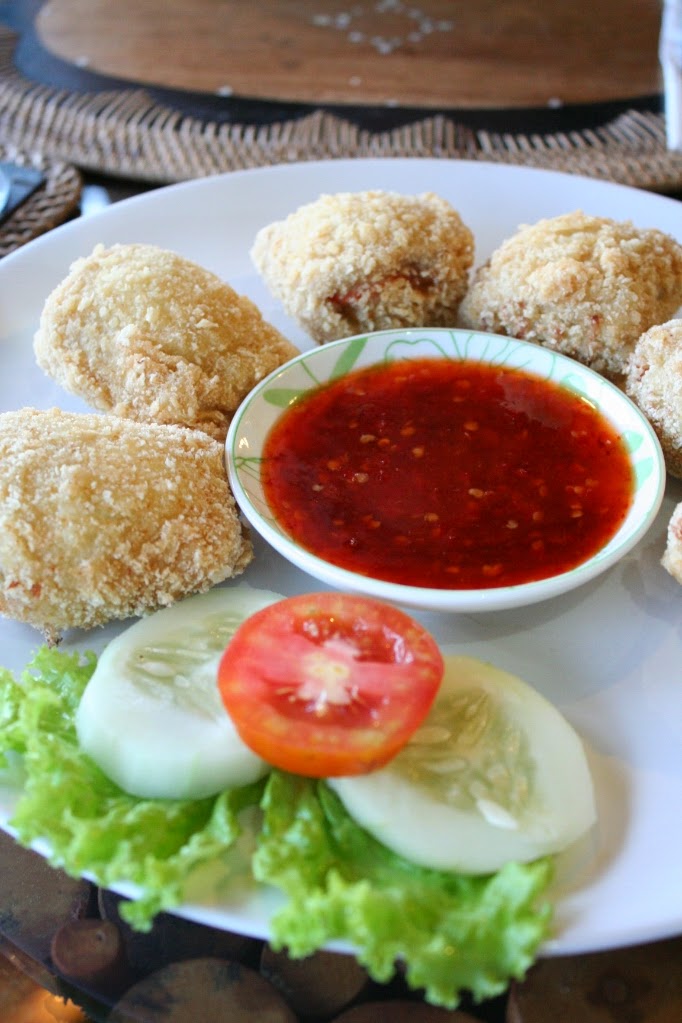
Tahu isi

Tahu isi were an appetiser of breaded tofu pockets stuffed full of vegetables and served with a sweet chilli dip.

Kare tahu tempe

To follow, I chose kare tahu tempe - a curry that was strong with dried spices and crammed with vegetables, soft pieces of fried tofu and meaty cubes of tempeh. K selected tahu saos teriyaki - tofu in a sweet, rich teriyaki sauce, which was an unusual menu item for an otherwise Indonesian selection.

Banana caramel ice cream

We both finished with sweet caramelised banana slices and ice cream. In many other places, I could imagine the view would command a high price or, worse, the food and service would be an afterthought to the natural aspect. Happily, the staff were super friendly, the food inventive and delicious, and the bill the same or less than any other warung.

Tuesday, 24 February 2015

Twin Lakes

For breakfast this morning, K ordered a 'jaffle', in order to finally discover what this foodstuff that we have often seen gracing menus actually is. Based solely on the sound of its name, we had previously speculated that it might owe something to a waffle, and might be a porte-manteau of jam and waffle, or perhaps it might be a sort of crumpet-like thing, or a muffin, or something more exotic.

It turned out to be none of these and in fact is a (to us) very familiar toasted sandwich, made in the kind of sandwich press that seals the edges of the bread and forms two triangular pockets. I went with a coconut pancake, which ironically turned out to be a variation on the usual thin crêpe or soft and spongy American versions, and was instead stuffed somehow with a fresh coconut and palm sugar mixture. Nom nom.

Coconut pancake

After this, we were picked up for a half-day guided trekking by Made (no, not that Made, another one). We guided ourselves through the local countryside yesterday, by way of two waterfalls, principally using local roads. Today we hoped to be taken through some more out-of-the-way paths. This was certainly the case, as we were dropped off at the top of hill leading down to the shores of Lake Buyan with our guide, Wayan, who promptly disappeared into the long grass and trees, beckoning us to follow.

Lake Buyan

Our route led straight down the side of the hill and was less a path and more of a rut, furrowed into the earth by the passing of people from the village on the lake, and wide enough only for one foot to go directly in line with the back foot. A foot wrong meant treading into vegetation with no solid base, followed by a journey down the hillside the quick way. The way was slippery from the rain that fell here last night and we were glad of our walking boots, although Wayan gaily tripped down in nothing more than plimsolls.

Gear

In fact, Wayan told us he used to live near the lake as a boy and that this was his usual route to school. It took him two hours in each direction. Nowadays the children ride motorbikes to school and can be seen tearing away in uniform at the end of the day, barely tall enough to reach the handlebars in some cases.

Our trek took us through dense jungle, far different from the small roads and paths we had followed yesterday. In here, we would have been lost in seconds without a guide. Wayan breezily pointed out plants and trees, noting the ones to avoid touching. Indicating an innocuous-seeming round-leafed plant, indistinguishable from many others and not at all prickly, he said, "is nettle; if touch, itching for a week". I became rather more cautious of brushing through the undergrowth after that.

Lethal. Apparently

Eventually, we emerged at the water's edge on Lake Tamblingan, aside a temple whose tower, made of corrugated sheet metal rather than the usual black palm tree hair, had rusted. After a little while, a figure appeared on the lake, rowing what looked like a diminutive catamaran.

Lake Tamblingan

Having reached shore, it appeared to be a boat fashioned from two dug-out canoes, linked by three planks of wood. "Women do the rowing," said our guide, "the men are busy cock fighting". Nevertheless, he and I, as well as the women, all took up an oar and we all four of us rowed to the far side of the lake, under the shadow of Gunung Lesong.

Rowing

Alighting at a small fishing village, where a group of young students from Denpasar had set up colourful tents and were getting a taste of country life, we continued our trek.

Temple and Mt. Lesong

Out of the jungle, the area is still verdant and every spare inch is used to grow crops or else is full of fields of blue hortensia used in Balinese ceremonies.

Blue hortensia

Back into the jungle we went, where the forest floor was covered in clumps of bright pinkish-red wild ginger flower. Sadly this is one of the members of the ginger family that is not edible.

Wild ginger flower

Close to the end of our trail, we heard a screeching sound. Our guide thought it was a monkey, but as we neared the source of the sound, it revealed itself to be a mewling litter of puppies. Six small multicoloured dogs writhed over one another on a bed of grass by the side of the road. We assumed the mother was away hunting, but our guide informed us that they had most likely been abandoned. "People only want male dogs," he told us, "these are all female". We stood helplessly, asking whether there was anything we could do, anywhere they could be taken. Was there an animal sanctuary on the island? "There is nothing we can do; they will die here," he said matter-of-factly. He didn't lack compassion, but he was realistic about their chances of survival without a mother's milk. K, especially, was full of righteous indignation, as this treatment of animals - not spaying pets and, when inevitably they become pregnant, ditching them or the resulting offspring - is something we have seen again and again in SE Asia. In a culture in which animal sacrifice is routinely practised, surely, I wondered, these puppies could have been humanely destroyed rather than left to starve slowly to an undignified death. I mused that this is probably low on the list of most countries' priorities. Once they have established sound sanitation, good schools, a health service, and an uncorrupted political system, then perhaps they will get round to animal cruelty.

It was a sad end to an otherwise wonderful walk through quiet countryside, full of the thrum of nature and not engines. We arrived at the top of a hill overlooking Lake Tamblingan, where the organisers of the walk have a restaurant, Terrasse du Lac, and where lunch awaited us.

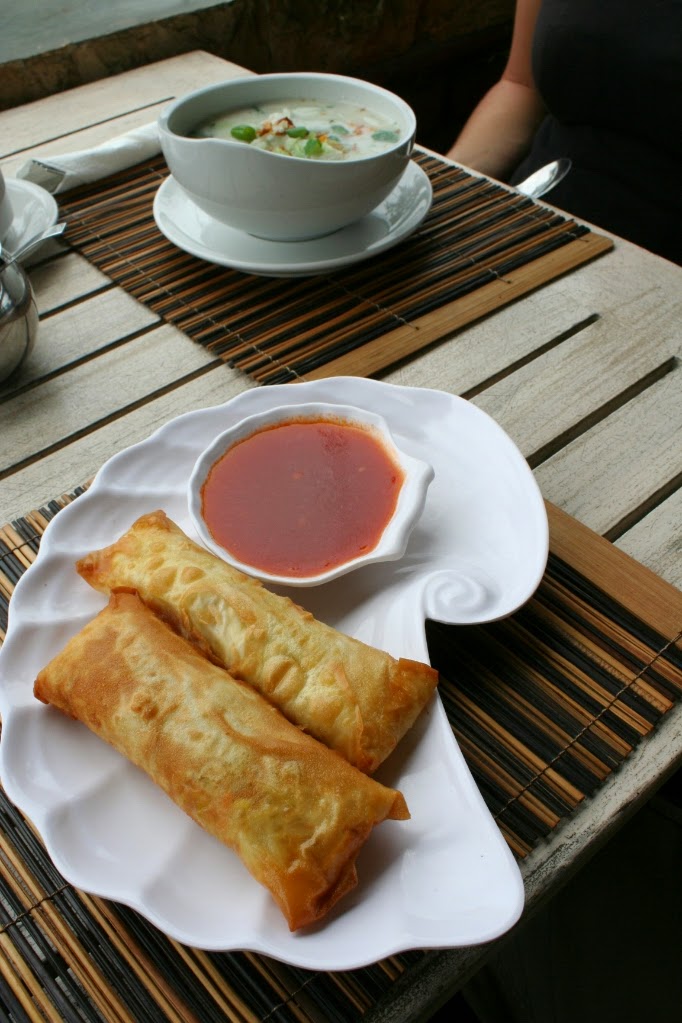
Lumpia and coconut soup

With a front-seat view of nature, we enjoyed appetisers of lumpia (spring rolls), which were full of vegetables and had a slightly European twist of tasting as though they used filo pastry. K had a coconut-based vegetable soup that was similarly replete with local produce.

Aubergine parmigiana

The vegetarian menu was more western than Indonesian, offering only gado gado as a concession to local dishes, but neither of us could resist a melanzane parmigiana. Soft-baked slices of purple aubergine in a rich tomato sauce served au gratin was delightful and flavoursome. We both revelled in the now unfamiliar aroma of oregano.

Steamed caramel cake

For me, the dessert was king. A steamed caramel cake that, although being made from wheat flour, seemed to owe some of its bounciness to the local tapioca-based varieties, was served with ice cream and small but sweet locally grown strawberries and a palm sugar sauce. Heavenly.

In the evening, we ate lightly at the warung in our accommodation, looking out at the sound and light show as a thunderstorm rolled in.

Urab timun

I had urab timun - a salad of cucumber mixed with freshly grated coconut and fried shallot. So simple and yet, with rice, just what my overindulged stomach needed.

Monday, 23 February 2015

Munduk

I finally got to taste a real bubur injun (also injin) this morning. After my attempt, the restaurant variety of the Indonesian black rice sweet dish was more soupy than rice pudding consistency. The rice was also softer, indicating a longer cooking time than I had had patience for. The addition of sliced banana was a nice touch and it was not so rich as my version.

Bubur injun

The idea of staying in Munduk was to take long hikes into the steep and windy paths of the surrounding countryside to see how people there live. The paths from the village were slippery with moss and the torrential rain that fell during the night. Amazingly, people still manage to navigate the extreme gradients of the narrow paths on motorbike.

Up the garden path

Our walk took us first to Air Terjun (waterfall) Melanting - at least a view of it from afar. It looked a long way down and, indeed, it was. We soon came upon a set of steps leading to its base, some 85 metres and 449 steps (I counted them) down.

Melanting waterfall

Last night's downpour meant the waterfall was flowing with full force. We sat a while watching the water pounding the rocks with the spray and wind caused by this buffeting our faces. It was a naturally awesome sight.

At this altitude, trekking is cooler but still thirsty work. Having polished off a couple of litres of water already, we stopped at a lonely hillside café in amongst the jungle trees.

At Warung Junction, we sipped a restorative ginger tea and the owner, Made, persuaded us (without very much real effort required) to try his "modified" pisang goreng, which he dubbed "Bananes Madé" after his own name. These were breaded, not battered, giving the bananas a goujon-like crunch, and topped with strips of cheese and chocolate sauce. After initially being sceptical about this salty-sweet combination when first tasted in Langkawi, I thought this variation of textures and flavours worked well.

Bananas + cheese + chocolate

The proprietor was super friendly and invited us to his house for dinner in the evening. We accepted.

Rejuvenated, we carried on upstream (and uphill) to Red Coral waterfall. This was more of a straight jet of water onto the flat rock surface below than the romantically tumbling white foam of Melanting. We later learned that this is because the river has been dammed at this point.

We circled round to the rice terraces and small villages on the south side of the main road, nodding, smiling, and exchanging pleasantries with the people that live there. We noticed a real energy and industriousness. Construction was going on in the hills, with people building new homes, restaurants, and temples.

In the evening, we made good on our promise to visit Made at his home. Dinner turned out to be he and his wife serving us as though at a restaurant, which was sweet but a little awkward, as they took it in turns to engage us in conversation. The food, however, was unequivocally delicious.

Young bamboo soup

Made was keen for us to taste a seasonal specialty, jukut ambong. This is a soup of young bamboo shoot, which, like soto, uses as its base a stock flavoured with turmeric for a distinctive yellow colour, as well as ginger and pepper.

Rijstafel

Next we were served a lovingly prepared 'rijstafel', as Made styled it, using the Dutch term for several small dishes served with rice. Tofu and tempeh fried with kecap manis was crunchy, chewy and sweet, while blanched bitter cassava leaves were balanced by sweet lemongrass, and perkedel jagung (corn fritters) fresh from the fryer were perfectly light, soft and fluffy inside while being crunchy outside.

Kolok pisang

Kolok pisang was for dessert. Banana slowly simmered in palm sugar releases all the sweetness from the bananas as they start to disintegrate and, I imagine, would go down well with children everywhere. It belongs to that category of foods that taste far better than they look.

Dragonfruit

Unsure of whether we were overstaying our welcome after second Balinese coffee (grounds in, like the Greek), Made ushered through to his pitch-black garden (when it's night out here, there is precious little other light). Using his phone as a torch, he illuminated a dragonfruit tree. As a member of the cactus family, this had long thick spiny green tendrils, in amongst which hid pink-purple jewels. Made sliced off the alien-looking fruit and prepared it for us. The succulent white flesh was quite the sweetest and tastiest I have tasted.

Sunday, 22 February 2015

Treetop Adventures in Bedugul

Having decided to get out of the crowded south for a few days, we headed for the lakes in north-central Bali.

Sounding like something a character from the Magic Roundabout might do to you, Bedugul is the name of the area around Lake Beratan, famed for its strawberries, and home to the Eka Karya botanical garden (kebun raya).

Our taxi driver told us that today is the last day of a long weekend, as Friday was a holiday. We saw coachloads of visitors who had taken the ferry over from Java, recognisable by their headscarves, as well as many Chinese tourists, as it was recently new year for them.

Many of the Balinese were taking the day as families and groups in the park, and were bringing baskets of food for picnics.

Picnickers

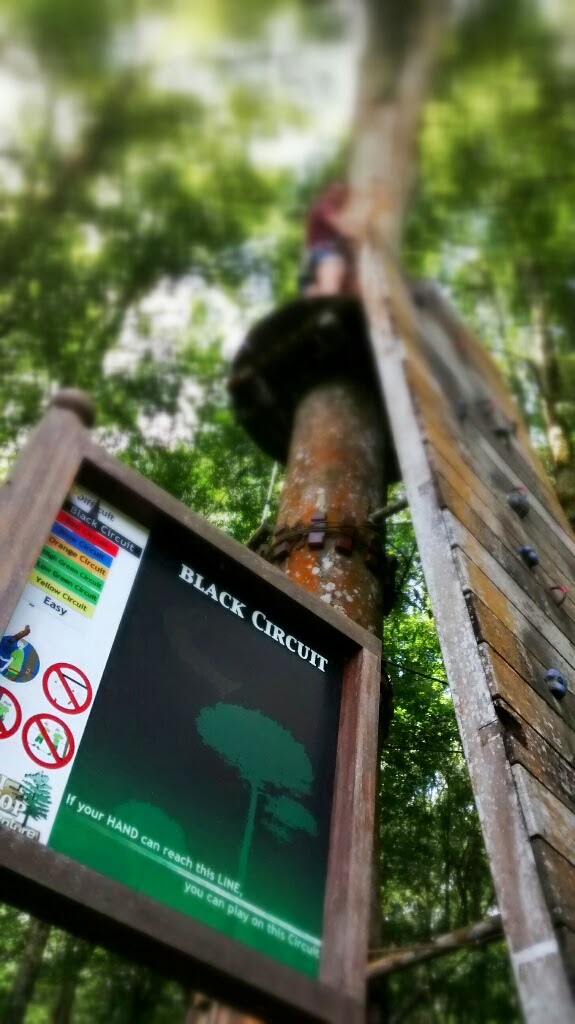
The botanical garden is also home to the Treetop Adventure Park, which was our destination for the morning. This modern park boasts "European standards of safety" and "French management", which I can understand will allay the concerns of nervous travellers, but I thought a little insulting to the entirely Balinese staff who work there.

The park has a similar set-up to the Go Ape parks in the UK, in which one traverses platforms suspended around tree trunks using a variety of means of conveyance, from tightrope wires and wobbly bridges, to Tarzan ropes and zip lines.

Crawlspace

Our Balinese instructor harnessed us up and took us through initial orientation. This convinced us that the set-up is almost identical to Go Ape, so we leapt straight into the 'blue' level of the graded courses, hoping to make our way up to the 'black run'.

We clipped and unclipped the carabenas, shuffled along taught wires, clambered up nets, wobbled over wooden planks and through tunnels suspended between the trees, and generally had a great time. We were rewarded with a straight run on a zip wire to the end of the course.

Wheee!


K's confidence was bolstered, so we took on the blue course. This was more of the same, although there was a tricky swinging rope thrown in, which required some coordination to let go and hurl oneself into the awaiting net on the other side. K clung to the rope and tried to secure herself to the net with her foot, losing a shoe in the process. Fortunately, her footwear was restored and she was pulled back for a second, successful, attempt, and we completed the course without further incident. 


Living dangerously

The black course started with a vertical climbing wall. I have tried climbing in the distant past, and found I spent more time hanging around depleting energy than going up. However, this was only a short climb and we both made it without too much bother. The difficulty came when, a few stations on, we faced a much longer Tarzan rope swing. This required some confidence to leap off the platform, knowing that we would free fall before the slack rope took up our weight. There were no second goes on this, so if we missed the net, we would have to head back to the climbing wall.

Geronimo!

Fortunately, we both made it, much to the amazement of open-mouthed picnickers below. The following stations amped up the challenge by taking us up to 20 metres above the ground and asking us to cling on to a series of smooth logs hanging vertically, with only tiny pegs as footholds. There was no turning back, so we pressed on and were glad when we zoomed along the final zip wire, slamming into the net at the end with enough force to knock the wind out of us.

Garuda attacks Rahwana

The botanical gardens are also home to statues depicting characters from the Ramayana epic. These are wonderfully detailed and life size, which in the case of the giant Kumbakarna (Rahwana's right-thinking brother), is quite big indeed.

Kumbhakarna battles the monkey army

After a stroll around the botanical gardens, a persistent rain set in that convinced us we should head to our lodgings in Munduk.our daredevil antics this morning, we were thoroughly bedugul'd anyway.

Munduk was recommended to us as a quiet small village to which one could retreat in the mountains. Sadly, we didn't seem to have retreated far enough to escape the traffic, as the main road resonated with the sound of motorbikes roaring up and down. Apparently, during the European summer holidays, in July and August, the area is inundated with French people looking for good hiking.

Taman Ayu, Munduk

Our accommodation, however, is lovely, offering a view over the tree-lined valley and a roof-top warung. We took dinner there and, at K's insistence, indulged in a glass of wine to soothe our frayed nerves after this morning's antics.

After the boozefest that was Langkawi, including its ruinous final evening, the past five or so weeks have been completely dry (apart from a glass of wine for me at a film showing, but show me a person who turns down free wine). This is as much a reaction to a dearth of good beer as it is self-imposed abstemiousness. The selection tonight included Bintang beer (Heineken by another name) and brem.

#PintOfBrem

Venturing into unknown territory, we ordered a glass of brem, and received a light pink liquid, smelling of sake but tasting both sweet yet slightly sour, making us wonder whether plums or even some of the local strawberries had been used. It turns out to be neither and the colour comes from a mix of white and black glutinous rice that is fermented into alcohol. It was a marvellous aperitif.

Red bean soup

Palates awakened, we started with soup - mine a sup kecang merah (red bean), K's a sup telor putih (boiled egg whites), both of which were in the hearty vegetable broth mould that befits the cooler mountain climate. Actually, given the prevalence of French at certain times of year, I'm surprised there isn't a mock chalet offering cheese fondue.

Gado gado

Mains saw the reappearance of two staple Indonesian dishes: perkedel jagung (corn fritters) and  gado gado salad. Both were decent examples and we tucked in with hungry bellies, mopping up the plates.