Showing posts with label Cambodia. Show all posts

Thursday, 4 December 2014

Farewell to the Kingdom. Greetings to the Kingdom

Today we switched one Kingdom (of Cambodia) for another Kingdom (of Thailand).


As a last taster of Khmer food, and as fuel for our journey, we returned to Vitking House for a bowl of their sumptuous bobor. Hiding at the back of the photo above is the secret sauce - sieng phaem - sweetened fermented soya beans (not nearly as scary as that sounds), which add a depth of umami richness to the rice porridge. This version also comes with a number of mock meats - pseudo ham, chicken and pork balls it would appear - to mimic the usual recipe, but it is tasty without these impostors.

Western Baray

We boarded our flight to Krabi, via Bangkok, and said goodbye to Siem Reap. We took off from the same landing strip we cycled around on a trip to the Western Baray a week or so ago, and were afforded a magnificent view over the enormous body of water and the West Mebon temple at its heart.

Air travel has been internationalised so

Wednesday, 3 December 2014

Amok and Apsaras

We awoke this morning to our last full day in Cambodia. Finding ourselves in a similar position to leaving Vietnam - namely, how best to say farewell to an entire country - we decided against any showy last-minute displays. We didn't do one last circuit of the Angkor temples, nor did we go ziplining at the Flight of the Gibbon adventure park.

After a fruit-based breakfast, we packed up our things and went out for the day.


We joined our neighbour at Blossom Café for a coffee and a delectable mini-cupcake. We were greeted by staff in festive red hats, a large white Christmas tree, and jingly songs playing. Coming in from the 30-degree heat, where no trace of advent could be found, to a tinsel-strewn winter wonderland was a bizarre and discomfiting experience. At home, I enjoy the preparations for the holiday season and string out the sherry and mince pies as much as possible. However, the 25th December has been far from my mind and for it now to be brought to my attention caused me to imagine how we will spend it in Thailand. Will we approximate a Christmas dinner from the Thai ingredients available? Will we play Christmas tunes?

Our neighbour met a friend for lunch, so we switched venues for one offering more savoury fare. This was fortuitously timed, as some persistent rain rolled in as we arrived.


My Little Café has a small selection of reasonably priced vegetarian dishes, including the ubiquitous amok (tofu) and lok lak (also tofu). K selected the latter, which was by far the better choice, as the former was crammed full of onions and lacked the subtle flavour of any version of the dish I have thus far tasted. A side of morning glory did not disappoint, however, and we whiled away the time under a sagging canvas awning until the heavy shower gave way to a bright blue sky. Just in time for...


We gatecrashed Children's Day - an event organised as part of the Angkor Photo Festival that included a demonstration of Phare circus skills outside the luxurious-looking Shinta Mani Resort.


This was primarily aimed at entertaining and inspiring young Cambodians, and so the troupe hammed up the clowning and slapstick, but the acrobatics were no less awe-inspiring for it.


Showing that they don't need a big top to perform, they rolled out a rug in the middle of a closed-off road and turned somersaults, cartwheels, backflips and impressive feats of flexibility.


From there, we slid by the Peace Café before presenting ourselves at the equally plush Angkor Village Resort for an evening of Apsara dance theatre.


Dinner came as part of the package and we were lined along long low tables - a Japanese design with a sunken floor to make space for the diners' legs, known as horigotatsu. On a tray, we were served delicious freshly fried spring rolls and samosa (crunchy), a green papaya salad (can't go wrong), a small salsa, fried tofu and beansprouts, and a green coconut curry, the last of which disappointingly lacked any distinguishing flavour.

The dancing, however, did not disappoint. Apsara are creatures - half woman, half goddess - that emerged from the churning of the sea of milk in the Hindu fable. The carvings show ethereal dancers with elaborate costume, their hands and feet posed in unnatural but symbolic positions. The physical versions of these nymphs also have the uncanny ability to bend back their fingers and toes as depicted on countless sandstone temple walls. Were they born this way, or does it take years-long training - as for the circus performers - to reach such a degree of suppleness and flexibility?

The female apsaras, sporting fantastic headdresses, dance a slow, rhythmic, and circular set of steps using hypnotic and precise hand gestures. While beautiful, the symbolism eluded us. The accompanying description is available only in French and is written using the past historic - the tense I largely ignored in my studies, assuming it to be outmoded and used only in stuffy broadsheets. I translated the description for K and a couple from Boston sat next to us (although I'm sure the silent gentleman sat beside me was in fact French and inwardly decrying my brutalisation of his language). The translation was not hugely elucidating and so we satisfied ourselves with watching the mesmerising display.


Aside from the apsara dancing, we were treated to a selection of other performances: young fishermen court the shy girls of the village; the two faces of Mekhala (god of water) battle until wet seasons triumphs dry, bringing beneficent rains; the clacking of coconut shell halves shows the peaceable harmony of Cambodian village life. Finally an extract was shown from the Ramayana epic in which Rama, in search of his love, Sita, who has been captured by the evil Ravana, sets out with his brother Lakshmana to recover her. Accompanying them is Hanuman and his band of monkeys, who battle Ravana and the demons, returning Sita to safety. While familiar with the story, which permeates much of SE Asian culture where Hindu influences are prevalent, the theatre was slightly confusing, possibly owing to the time-honoured tradition of gender reversal between the cast and their characters.

Tuesday, 2 December 2014

The Moving Image

I sliced up a bowlful of mango, pineapple and banana this morning for breakfast. This was the healthiest thing we ate all day.

The day seemed to pass in a series of good intentions. We promised ourselves that, once we had completed one small task, we would do something. Without necessarily meaning it, I stumbled from one thing to the next without getting on with anything in particular.


Breaking from my procrastination for a moment, I answered my rumbling tummy with noodles, tofu and pak choi in ginger, chilli and soy sauce.

After this, we took a walk into town to blow off the cobwebs and get the blood circulating. The route to the centre takes us along National Highway 6 (the road to and from Phnom Penh). It is busy and dusty at the best of times and the pavement, such as it is, caters mostly to parked cars, motorbikes, duck rotisserie stands, and all the visitors to the Phsar Leu market. It's a busy, crazy, vibrant and sometimes dangerous stretch of road, but today these characteristics were amplified. Diggers were tearing up the pavement, kicking up more sand to add to the vast dunes that already occupy the space between road and shop frontage. The volume of traffic was doubled - louder and more congested than we had ever seen it. We crawled along with the other road users towards the crossroads marking the middle of Siem Reap.

We were in search of, literally, a haven from the chaos. Haven is a training café and has a good reputation for the food and atmosphere. Sadly, we found it between its lunch and dinner service and were greeted by a closed gate.

We changed course to Sister Srei on the riverside, where we indulged in late afternoon cake - mine cheese, K's chocolate. Neither hit the high watermark that is Blossom Café's cupcakes.


Continuing the trend of the day, we returned home to eat dinner. Picking up some oyster mushrooms and small green-and-white, perfectly spherical Thai aubergines, I had in mind a coconut soup. This we ate with some cassava bread, as we had depleted our stocks of noodles and rice. I must confess that I am less a fan of the Thai aubergine, which is mostly seed, than I am of the succulent purple variety.

In the evening, we watched The Missing Picture (L'image manquante) by Rithy Panh. The film focuses on the director's experience as a young boy in Cambodia during the reign of the Khmer Rouge. With foreign correspondents banned from the country, the only images captured on film of that time were controlled by Pol Pot and other cadres. Panh uses this propaganda - full of smiling faces and cheering for the Party - but fills in the blanks - the real experience of the people away from the cameras - with scenes crafted from clay. The earthen figurines stand in for the director's friends and loved ones as he tells a very personal story in the context of a human holocaust.

Monday, 1 December 2014

The Englishman Who Went Up a Mountain and Came Down a Hill

Today is 1st December and the day's forecast looked like this:


The temperature was a few degrees lower than the average for the past few weeks, but a storm was advancing and threatening to turn the nascent dry season wet again.

In lieu of opening the first door of a chocolate-filled calendar, we had planned an advent(ure) - groan - on Phnom Kulen.

Phnom means 'mountain' and Phnom Kulen is a 40km chain of plateaux situated northeast of Siem Reap. Sadly, for this Englishman, the peak of 487m falls short of the official UK (DEFRA) definition of 'mountain' (600m). This didn't lessen the effect of seeing the range rise out of the surrounding flat land, which we initially tackled by four-wheel drive. The sandstone was quarried as a source of building materials for the temples of Angkor, although I don't know how they managed to transport the rocks without such vehicles.

Despite its name meaning 'mountain of lychees', Phnom Kulen seems most famous for the bananas that grow there with a fittingly festive red hue. The car stopped at one of the sellers and our guide bargained a good price for a hand of the jaunty fruit. Belying their exotic appearance, the bananas tasted more akin to the typical Cavendish variety found in Europe and less like the sweet Asian varieties.


The hill-mountain is a site of significance for Buddhists and Hindus, being home to a temple and religious carvings. Many Cambodians and tourists alike make the pilgrimage to the waterfall there, which can get quite busy.

Our canny guide avoided the crowds and took us first on a trek along the hilltop. This was a chance to break in my walking boots, although the walking was not arduous along the plateaux - a point proven by our guide, who made the same journey in flip-flops.

Having set off before 7am, it had taken the 4WD car a couple of hours to reach the summit and we had not yet breakfasted. We stopped by a stream - the natural spring water is bottled and sold as Eau Kulen - and tucked into the baguettes I had packed. The bread is chewier than a standard French loaf, which our guide observed was due to the use of cassava flour, as wheat does not grow in Cambodia. I should have realised.


Our trek took us across the strange terrain of smooth sandstone, intermittently scarred by perfectly circular holes. The area used to be home to elephants and tigers, but these were scared away when people settled there. The villagers themselves were driven out by the  Khmer Rouge, who used the hill as a stronghold, and the original settlers have only recently returned.


Aside from a couple of huge squirrels and a golden snake, the only animals we encountered were carved from stone. Even the inhabitants of the so-called 'bat cave' were frightened off by a meditating monk. At Sra Damrei (Elephant Pond), deep in the jungle, all that remains are sandstone sculptures of an elephant, a frog and two lions amid the jungle growth. It was an eery discovery at the end of our walk.

Part way through our walk, the driver had joined us. Turning back, we discovered he had driven the car over the rocky terrain until eventually abandoning it. The return journey, while in the cool air-conditioned interior, was much slower than on foot, as the driver eased the 4WD carefully over each bump and dip.


Noung is primarily an 'eco-guide'. On our trek, she took great delight in pointing out the flora and fauna, of which she is very knowledgeable. Her delight at seeing birds, snake tracks, and discovering several varieties of wild mushrooms was palpable. By contrast, her interest in man-made artifacts was muted. We visited  Preah Ang Thom, which was sited by enormous boulders and outcrops, one of which had a large reclining Buddha carved into its tip.


The Buddha now has stairs to access it and a platform and roof for viewing it. It must have been quite a feat to carve it out of the rock in the 16th century.

The 1000 lingas are carved into rock over which a stream flows. For being in constant contact with moving water, they are remarkably well preserved. The lingas show ancient cultures' preoccupation with fertility and virility. Earlier versions apparently owe more to their phallic origins, but the representations by the 9th century had become inoffensively abstract. In fact, the linga (male) and yoni (female) sculpture at Preah Ang Thom is worthy of Miró.


At the waterfall, we stopped for lunch. Along the way we had picked up a pineapple, which Noung promised to show us how to carve in the manner we had seen on the market stalls. In the restaurant, she asked confidently for a sharp knife and a plate with which, essentially, to prepare our own dessert. I imagined her being set away with a flea in her ear by a British restaurateur. Nevertheless, Noung set to peeling off the tough outer skin. Nature loves patterns and She has bestowed the pineapple with a set of 'eyes' arranged regularly around the fruit ("you can't hide anything from it"). Following the line of eyes, cutting out small wedges of flesh, creates a pretty spiral and an entirely edible artifact. Sprinkling with salt, followed by a good wash, neutralises the acids and makes the fruit more easily digestible.


We shared red vegetable curry, mushroom amok and garlic-fried morning glory. In this instance, the red curry overshadowed the signature amok with an intensity of flavour that lifted the humble potatoes and carrots. For a plate of fried green vegetables, morning glory delivers so much in flavour and manages to stand alone as a dish.

After this feast, we contradicted every mother's advice and went for a postprandial swim.


The water at Phnom Kulen falls twice - first gliding over another Hindu relief carving and dropping a few metres before cascading nearly twenty metres over the final drop. This was the highlight of the day and we took a dip in the clear, cold water. Braving the spray, we attempted to near the base of the waterfall but were forced back by the buffeting current. It was ferocious and exhilarating.


Descending from the 'mountain', we made a brief visit to the 10th century Banteay Srei. This is also known as the 'pink temple', owing to the dusky pink of the sandstone used there. According to our trusty friend Maurice (Glaize), this kind of stone has weathered rather better than the usual grey Angkor stone and so the intricate carvings are far better preserved. However, the remote location of the temple means that it was not rediscovered by Europeans until 1914, after clearing on the main Angkor temples had already begun.


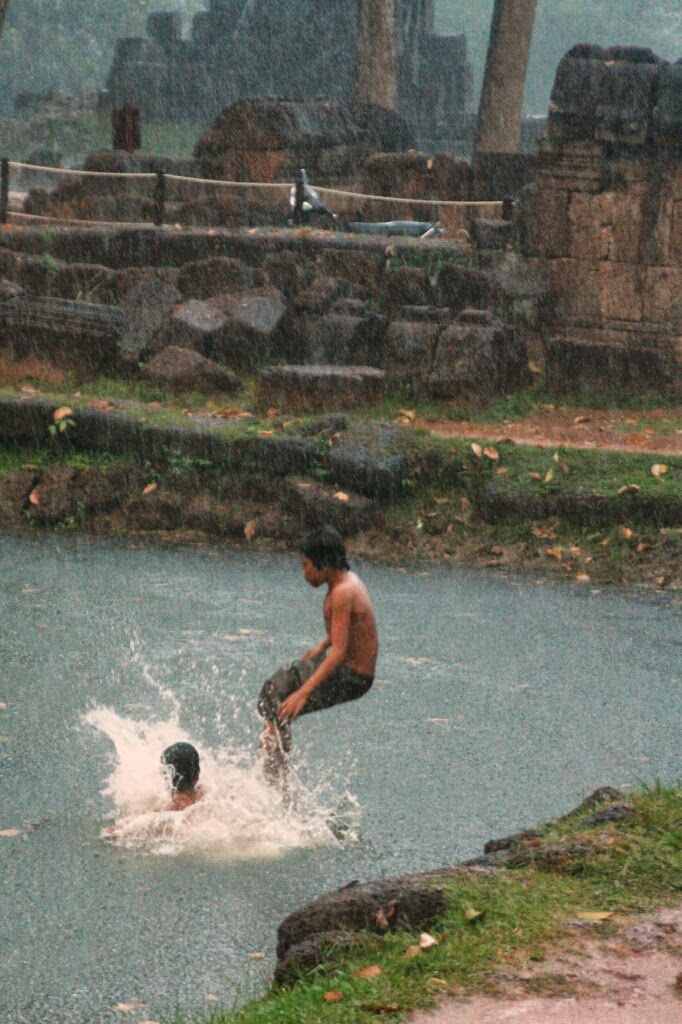
The forecasted thunderstorm had been conspicuously absent thus far, but dramatic grey clouds now wisped their way rapidly towards our exposed position. Unlike other temples, Banteay Srei has no roof, so with nowhere to run for cover, we sheltered as best we could under the lintel of a doorframe. This provided poor cover and, within moments, enterprising children, who had until then been hawking postcards, came running clutching waterproof cagoules. Alas, it was too late, as we were already soaked through. With their sales thwarted, the young entrepreneurs reverted to being children and hurled themselves into the ponds either side of the temple with great gusto.


As the rain departed as quickly as it had arrived, the rusty red of the temple was enhanced by the pools of water turned orange by the sand.


As we dried off, we made a last-gasp whistle-stop tour of the Landmine Museum before it closed its doors. We learned of one man's campaign to rid Cambodia of the explosives, many of which he regrettably laid himself as a young member of the Khmer Rouge.


In trying to make good his mistakes, he has set up a registered initiative to de-mine the countryside and now helps people who have been victims of detonations, some of whom live on site.


The day was exhausting and we collapsed at home with a comforting bowl of spinach and shiitake pasta (coconut cream taking the place of more conventional dairy) in front of a film. Aptly, we chose to watch Lara Croft - Tomb Raider, which is partly set in the ancient city of Angkor. Having not before seen the movie, we wanted to see some of our favourite locations on screen. In deference to the 'plot', the logistics of time and space take a back seat, as Lara runs in one scene from the gates of Angkor Wat to the top of the waterfall we saw today, some 30km away. Outside Angkor Wat an entire floating market had been constructed and underneath Ta Prohm an Indiana Jones-style temple of doom was conjured. It was cinema light and a good way to turn off our brains at the end of the day.

Sunday, 30 November 2014

The Still Image

Having tried a few versions of rice porridge in Thailand (chok), Vietnam (cháo), and now in Cambodia (bobor), I decided to try my hand at it.


All descending from the Chinese mother recipe, congee, rice porridge (also known by the off-putting Dickensian word, gruel) in Asia is a comforting breakfast food primarily given to sick people. In Khmer Rouge-era Cambodia, rice was heavily rationed and so the people made it go further by turning it into a soup. Today's versions are more nutritious than these meager meals and typically include a host of additions to spice up the bland base.

My version was based on shiitake mushroom stock with wholegrain rice and pak choi. The whole grain means that the rice does not disintegrate into a starchy, gloopy soup. I floated half a boiled egg and served it with accompaniments of bean sprouts, fresh herbs, sliced ginger, dried chillies and fried tofu. Pretty good, but not up to the standard of Vitking's.

In the afternoon, we joined the regular Khmer lesson at the peace café. We arrived late but the lesson 'plan' is loose with no fixed end-point, and so it segues easily between language and culture tips to plans for tomorrow and beyond. Besides picking up a few phrases for our remaining days in Cambodia, our main purpose was to meet up to go to a photography exhibition.


The Angkor Photo festival is now in its tenth year and takes place each year in Siem Reap. We visited the opening of two special exhibitions at the McDermott gallery.


One of these comprised some beautiful photos of cityscapes by Gabriele Croppi. These black-and-white images have been precisely shot, using high contrast, to achieve an effect close to graphic design. They could be pen-and-ink illustrations. They contain large blocks of negative space - often swathes of black shadow - which are given a tactile dimension through the Hahnemühle cotton paper on which they are printed. The final result appeals to my aesthetic.


Following the exhibition opening, we moved to the FCC (whose Phnom Penh branch we visited while in the capital), where an outdoor slideshow of work by Asian photographers was being shown. The selection of photographs from 24 different artists was mostly excellent. Two in particular caught my attention.


Munem Wasif lives in Old Dhaka and has caught images of everyday life. His ability to intrigue the viewer is uncanny.  Each photo hides a story. A knife is held to a boy's throat by a group of other boys. He is smiling. Is he being threatened or shaved? A picture of a Bangladeshi street reveals a mass of overhead cables. Silhouetted at the top of the frame is a monkey making its way carefully on the urban vines. A photograph of ladies laughing. What's so funny? We want to share in the joke.

Another sequence of images by Ronny Sen brought to my attention a phenomenon of which I was completely unaware. In Jharia, India, an underground fire has raged in the city's coalmines for nearly a century. The longevity of this natural disaster has rendered it normal. People still live in the town. The collieries burned long before the current crop of residents were born and will probably continue to burn during their children's and grandchildren's lifetimes, as all efforts to extinguish the flames have proven ineffective.

Saturday, 29 November 2014

Food and Friends

Among the selection of Khmer breakfasts, noodles feature both as soup and fried (mi cha, មី​ឆា).


This morning, I cooked us mi cha with fried tofu, beansprouts and an egg. Khmer breakfasts are traditionally substantial in order to see the workers through the morning's physical labour. We burned fewer calories than the average farmhand, as we passed a largely sedentary day.

In the evening, we had dinner outside with our next-door neighbour, her friend from Thailand, and the cat. Our neighbour cooked us a meal, like herself, from everywhere and nowhere in particular. Chunky carrots and ginger sautéed in olive oil until tender, omelette, and shirazi - a simple Persian salad of diced cucumber, tomato, and onion. Good food, good company and good weather meant that we sat out until late talking.

Friday, 28 November 2014

How Soon is Never?

At 3:30 this morning I was awake. Did I have a flight to catch? No. I had a sunrise to catch.


Our destination was Phnom Bakheng, the 9th century hilltop temple just south of Angkor Thom. This is a very popular spot for taking in the sunset, as it affords a view over Angkor Wat. Every day at dusk the temple is mobbed by hundreds, if not thousands, of tourists queuing for the ascent. So popular is it, that only 300 people are permitted on the upper terrace, for fear of structural collapse and injury.


At sunset, elephants can be hired to make the climb to the summit. However, these beasts of burden were still asleep as we arose this morning. The normal approach is to take a tuk-tuk to the base of the hill and walk up. Bucking the trend, our journey began on bicycle. Fortunately, the outside temperature at this time of the morning is still north of 20°C, so getting up is less of an endurance test than seeing a chilly British sunrise.

We had hired two White Bicycles the previous evening, which awaited us in the dark hours of the early morning. Sadly, only one of these had a dynamo-driven light, so I cycled clutching a torch to the handlebars. Having made the journey several times by daylight, the route was familiar to us, but the surrounding trees, harbouring amorphous shapes, whether real or imagined, took on a different character.

At this hour, we had the path to ourselves, save for a few market stallholders setting out for their pitch. As the Angkor complex does not open until 5:30AM, we breezed past the usual checkpoint on Charles de Gaulle, which was unmanned.

Phnom Bakheng

After some guesswork, we arrived at the inconspicuous entrance to Phnom Bakheng at 5:00AM. My torch illuminated a figure in the woods. It moved and approached us, lighting up a torch of its own. The figure revealed itself to be the Angkor security guard for the temple. He and others like him sit watch throughout the night, enforcing the opening hours.

We parked our bikes and joined the sentry at his post, perched on a wooden fence. With our torches extinguished, no other artificial light was visible, and we sat in companionable silence observing the blanket of stars above us and the sounds of nature in the surrounding jungle.

Not long after, a pair of cycle lamps approached. "Is this a good place for the sunrise?" asked an accented voice out of the blackness. We were joined by a Dutch couple, who had also made the journey (naturally) on two wheels. Unlike sunset, this end of the day is far less popular with visitors, and so the four of us made up the entire party of sun worshippers today.

Despite not rising until 6:10, by 5:30 the advancing sun had already brightened the sky considerably to a deep blue. Reaching the top of the hill, we groped for the staircase to ascend the temple walls. On top, we were rewarded with a largely uninterrupted view over the surrounding flat plains. As the blanket of night was drawn back across the land, it gradually revealed the distinctive form of Angkor Wat, whose grey silhouette popped out of the misty landscape like a layer of a diorama.

View of Angkor Wat from Phnom Bakheng

Photography was tricky in the half-light, and the flaming red sun was partially obscured by a bank of cloud on the horizon, but the atmosphere was magical. We made the descent shortly after being joined by a group of early-morning joggers clad in identical pink sweatshirts, and proceeded to a couple of temples with the aim of enjoying the peaceful atmosphere without the braying of tour groups.
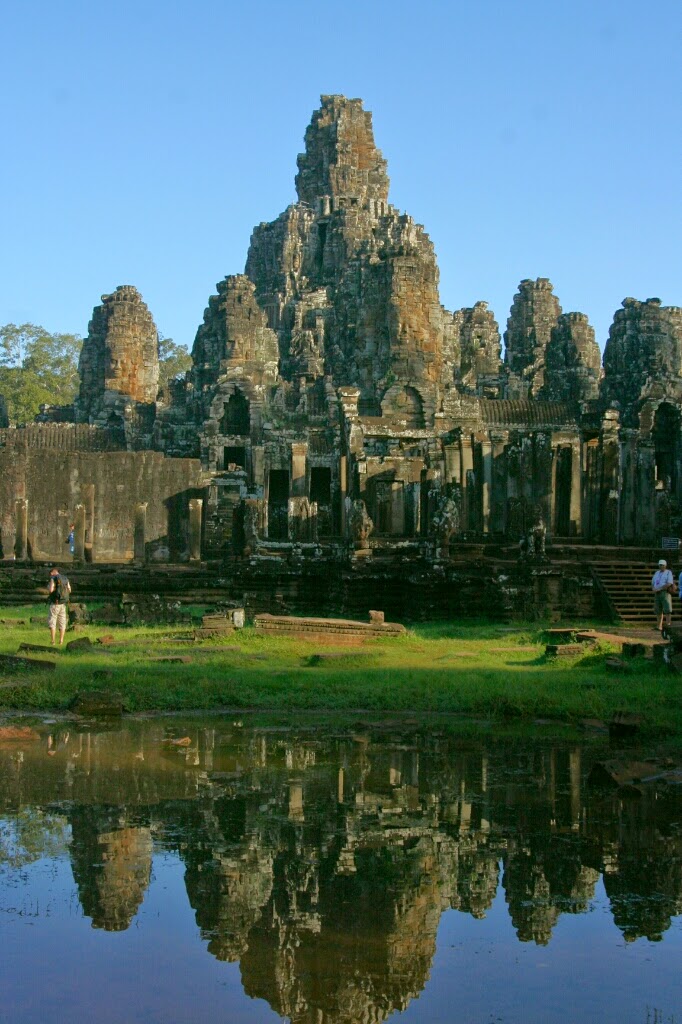
Bayon

We made a brief stop at Angkor Thom's centrepiece, the magnificent Bayon, with its fifty towers, and two hundred smiling faces.

Ta Prohm

Arriving at one of our favourite temples, the overgrown Ta Prohm, we realised a fundamental truth of visiting Angkor: there is always a loud party of tourists arriving just as you get there. Fortunately, the maze-like temple allowed us to slip away amid the tall trees, which seem to have reached down their finger-like roots from the sky and taken hold of the stone walls.


In the grounds, we also came across a number of the tiniest frogs imaginable. At first we thought they were crickets or another small insect. They were camouflaged brown against the earth, so that the very smallest ones appeared as a speck of dirt. The above frog was one of the larger ones and even its weight was not sufficient to bend a blade of grass.

By the time we had finished inspecting frogs, it was later than we realised, given the early start, and so we doubled back after revisiting a couple more temples. Outside Angkor Wat's western gate is the Angkor Café. This caters predominantly to the large tour groups we had been trying to avoid. Fortunately, as they were still marauding about the temple complexes, the café was empty. Less fortunately, the tour operators had booked out the entire space for their customers. We joined the waiter in laughing at the irony of having to seat us outside the completely empty restaurant and ordered brunch.


As usual, vegetarian options were more prevalent in the western section of the menu than in the Khmer food, so we gave in and had a tofu burger.

Tempted by the menu of ice cream confections, we attempted to order dessert and fell foul of a cultural misunderstanding. "We only have vanilla and chocolate", said the waiter. I had my heart set on a decadent sundae involving peanut-flavour ice cream and a chocolate brownie. I expressed my dismay. "We pick the ice cream up from the market every day at 11am". I observed that it was already approaching midday and that we would be happy to wait a little while fora greater range of flavours. The waiter looked confused and a little embarrassed. "I think maybe it is running late. It will probably be a long time for you". I was nonplussed. Was he trying to save us from a wait of indeterminate length, or was he politely implying that no matter how long we stuck around, the ice cream would never arrive. Unable to discern the truth, we intimated that we would stay awhile and try our luck. However, inwardly we puzzled. When would the ice cream arrive? Never?

We have had a few such confusing exchanges while travelling. Some we have put down to a lack on both sides to find and understand the right words to adequately explain a nuanced problem. On other occasions, we have realised that procrastination and, in some cases, prevarication are methods used to avoid giving an outright negative answer and to save face.

Confusion is not always the result of a lack of understanding but can be feigned in order to save a lengthier explanation and to avoid any confrontation that might result. Most of the time, however, we often expect a direct response and fail to take the hint. If there is no ice cream, just let us know. If you don't know how to operate the credit card machine or fill out the correct paperwork, please tell us. For us there is no shame in admitting to a shortcoming. We won't make a fuss. But some tourists might make a scene and for some cultures it seems to be more important to smile and maintain a happy relationship than necessarily to satisfy the customer's every whim.


Happily, we were proven wrong in our presumption on this occasion. The waiter came to tell us the good news and we indulged in dessert, which was predictably delicious. The taste was tinged a little with guilt at our suspicions and, as we ate, we realised that we are equally apt to create confusion through politeness and obfuscation.

A weekend trip we had planned to join out to Preah Vihear - a temple near the Thai border whose ownership is hotly, and sometimes violently, contested - fell through at the last moment. Several members of the group had decided to switch to a different tour operator, making the shared cost for the remaining individuals too high and the trip unviable. However, the original trip wasn't being run by a tour operator, but by our Khmer teacher, who organises transport and accommodation more as an outing among friends, rather than as a business. Determined to make the plan successful, she suggested that we could go by motorbike instead of bus. We were less than sure about making the 500km round trip by bike, and told her so. However, we hedged and caveated our response, using "I think..." and "perhaps" to soften the blow of our refusal. Despite speaking and understanding English to a high level, this indirection muddied the message for our teacher. Did we want to go or not? In the end, we discovered that brevity is the brother of clarity. But the delivery seemed too curt to our sensitive British ears. We wanted to prevaricate, to avoid a negative. The use of language implies a lot about a culture but it seems that the approach between East and West is differently similar enough to lay a minefield for the unwary.


Having gorged ourselves at brunch, we dined lightly in the evening on a rice pilaf using aubergine, pomegranate, cucumber, tomatoes, and a handfuls of fresh mint and basil.

Our Khmer teacher realised that talking face to face would lessen the gap of misunderstanding, and so she joined us in the evening. We shared a beer and our mutual disappointment that the trip would not go ahead. Instead we made plans of our own for Monday that could not be stymied by others' lack of commitment.

Thursday, 27 November 2014

Back to the Circus

I awoke this morning feeling a little off colour. There was nothing particular that I could put my finger on, but I had a certain lethargy that wouldn't leave me. I had no desire to go to the market, so breakfast had to be scavenged from our rapidly emptying cupboards. Without staples such as cereal or bread for toasting, assembling a meal was not an easy task.


Having recently seen the laborious manufacture of rice noodles in Battambang, I decided to reprise my attempt at veggie num banh chok. Out came the pestle and mortar, with which I pounded the paste of lemongrass, lime leaves, garlic, and turmeric root. The preparation was therapy and the result a comforting bowl of noodles in a yellowy coconut soup with a fresh topping of grated papaya.

A recuperative day was called for, so K and I took a break from doing, in favour of being.

As the shadows grew long, we hatched a plan to blow off the cobwebs and revisit the Phare circus that we had so enjoyed last week. Being narrative-driven, we could experience a new performance this week.


Scraping together our impoverished ingredients, I improvised a spinach, pumpkin and tofu curry in a peanut/coconut sauce with half a boiled egg for dinner. The chilli spice hit the spot and gave us the energy we needed to leave the apartment.


This evening's performance was called Sokha, the name of a girl who lived through the Khmer Rouge regime. Although a fictional character, the basis of the story is drawn from the life of one of the founders of Phare Ponleu Selpak.

Owing to the subject matter, I anticipated a more sombre tone in comparison to the joviality and outright clowning in the previous performance (Chills). Indeed, the performers were initially dressed in austere black and white. An old lady, Sokha, entered the stage and, whirling and shedding the signs of age, brought us back to the time of her youth. The atmosphere was joyful and energetic, the classmates turning impressive tricks in their youthful high spirits. However, the tale took a grim turn with the Khmer Rouge's coup and reign of terror.


The show combines acrobatics, dancing, live painting and percussion to portray the horrors perpetrated by the Khmer Rouge torturers, the performers' faces hidden behind frightening masks. Having survived the ordeal, Sokha is plagued by her memories. As she sleeps, her body is wracked by tortuous nightmares and she enters a macabre dance with the spectre of her fears.


Having conquered her own anxieties in a stunning and acrobatic feat, Sokha helps others to come to terms with their past. In one of the most emotionally charged scenes of juggling(!) ever imagined, black juggling balls serve as a metaphor for a young man's deep-seated trauma caused by the concentration camps. It was a brave choreographer that pitched this particular scene, but it, as the whole, is effective and moving. Despite its weight, the story manages to be hopeful and uplifting, and was a real tonic.

Wednesday, 26 November 2014

Coconut Lyly

The breakfast menu at our guesthouse seems to cater first and foremost to the appetite of the largely French-speaking guests, offering baguette and 'confiture', omelette and 'cheese', by which is meant 'la vache qui rit' dairy triangles. Actually the omelette and bread are rather good and were a step up on yesterday's pancakes.

Having checked out, we were met by the chef of a cooking school, with whom we had booked a lesson this morning. Lyly, a young Cambodian, is fresh out of Paul Dubrule's 'Ecole d'Hôtellerie et de Tourisme' in Siem Reap. Having done stints in hotels in Siem Reap and Sihanoukville, Lyly opened the Coconut House restaurant in his home town of Battambang, which he runs with his parents.


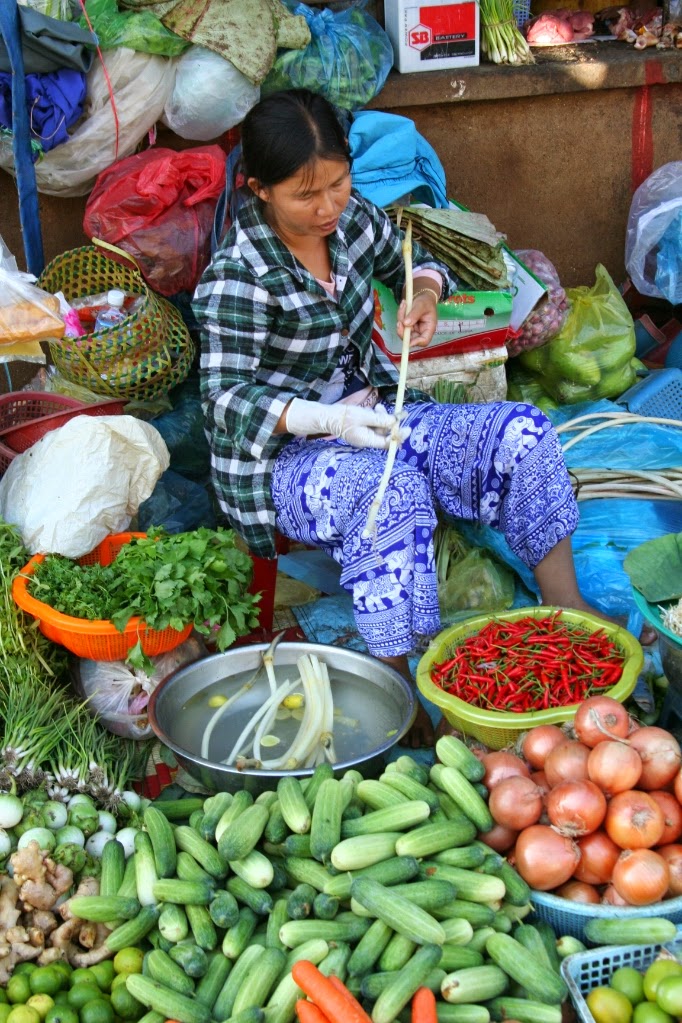
Our first job was to head to the market to pick up a few fresh items. While Lyly had already laid in many of the required ingredients for the four recipes we would be preparing, he was keen to show us the vegetables at Phsar Nat. Not being entirely 'green' when it comes to exotic produce, Lyly showed us some vegetables with which we were already familiar and some we didn't know. We can now distinguish morning glory for frying (green) and that intended for soups (reddish purple). He also gave us some unexpected warnings about frightening food combinations that we should avoid lest they cause a serious reaction. On the list of potentially fatal pairings are: durian and cola (no chance of that), mangosteen and sugar, black jelly and honey. Suitably chastened by these casual warnings, we collected the lemongrass and freshly squeezed coconut milk and returned to the restaurant.


It was a personal lesson with the chef, as only K and I had signed up for the morning session. Our first of four recipes, working in reverse order, was Lyly's signature dessert, a coconut panacotta. This was simple enough, with the chef putting in most of the work blending coconut flesh with fresh milk. I stirred the heated mixture until the sugar melted and K looked decorative. The mixture was poured into ramekins and went into the fridge to set.


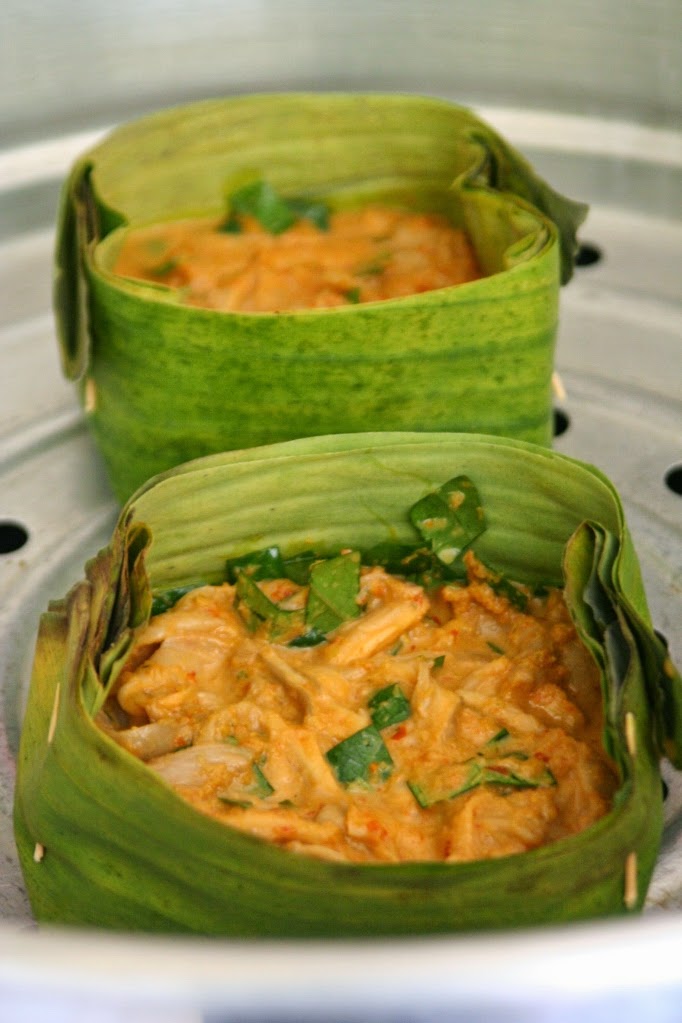
Lyly accommodated our vegetarianism well and substituted ingredients in his usual recipes. Next up was that well-loved Khmer specialty, amok. With oyster mushrooms taking the place of the fish, we did most of the work on this dish. Excitingly, we took the traditional route of steaming the curry in banana leaf baskets. Lyly showed us how to fold these and pin them with cocktail sticks. While mine looked the part, filling it with the mixture revealed a structural weakness and it had to be replaced by the exemplar.


As to be expected, the equipment in the kitchen was top-knotch and we enjoyed razor-sharp knives and a heavy stone pestle and mortar with which to slice and pound the tough lemongrass into submission. The ingredients for the amok paste have become second-nature by now, but this included the lesser-spotted fingerroot (k'cheay) alongside the turmeric root, dried red chillies (for colour and flavour, not heat), kaffir lime leaves, shallots, garlic, and galangal ("never ginger!"). Lyly was exacting on the consistency of the paste, so we pounded until our arms ached and we feared the mortar would crack. We mixed the paste, coconut milk, palm sugar, and torn oyster mushrooms without heating and filled the banana leaf baskets. These were popped into a steamer for later. Beyond the key ingredients, Lyly told us that amok can be prepared in different ways, some variations containing eggs, others using peanuts (which make it heavier and more filling), some steamed, and others cooked solely in the pan (steaming takes longer and uses more gas, so it depends on the restaurant's commitment to quality cuisine).


Next on the menu was tofu lok lak. Typically prepared using beef, this dish is very similar to the Vietnamese bò lúc lắc (known as 'shaking beef'), where the name apparently derives from the cube-shaped pieces of beef. Accordingly, we fry and cube the tofu and stir it in a mix of tomato sauce, (not strictly vegetarian) oyster sauce, soy sauce, sugar, pepper, and garlic. Having fried this until sticky and pungent, it was served on a bed of lettuce, green tomatoes and thinly sliced onions, a lime-and-pepper dipping sauce, and topped with a fried egg.


The final dish was the appetiser, spring rolls - the fried, not fresh kind. These we had attempted in Vietnam, and the process was much the same here. We grated carrot and taro, creating a gluey substance that replaces egg as a binding agent, and sliced spring onion. Seasoning the mixture, we rolled small amounts into rice paper - the kind for frying, as the fresh paper contains water that causes much spluttering when in contact with hot oil.


Having 'plated up' under the watchful eye of Lyly, the feast was assembled. We tucked in amid much slurping and smacking of lips. The spring rolls, fresh from the fryer, were crispy and toothsome. The amok was light and delicate, while the lok lak was powerfully rich and peppery. Finishing off with Lyly's sweet creation, we rolled happily onto the bus back to Siem Reap.

Lyly's kitchen is spotlessly hygienic ("a clean chopping board helps me think"). He is meticulous in his preparation, enthusiastic and detailed in his explanation. From him, we not only learned Khmer recipes, but also gained fundamental chef skills and now know our chiffonade from our julienne. He speaks excellent English (also learnt at l'Ecole), helping him to convey his love for food, which is infectious.

On the bus, I fell into a gluttonous stupour and awoke only as we pulled into the bus station. Vowing not to eat again, we still managed to find room to snack on a few nibbles later in the evening. I dread to imagine what Lyly would think.