Showing posts with label beer. Show all posts

Sunday, 9 August 2015

Ciclópolis

Every Sunday morning, between 8am and 2pm, a corridor running the length of Quito is closed to motor traffic and opened to cyclists. A similar thing happens in the UK under the banner 'SkyRide', but Quito's effort is grander in scale and much more frequent.

Cyclo Sunday

The so-called 'ciclopaseo' is organised by Ciclópolis and runs along Avenida Amazonas, cutting through El Ejido park and down Guayaquil into the old town. We hired two bicycles on the corner of Amazonas and Veintimilla and joined the eager crowd of Quiteños early in the morning, heading north on the main road.

Bicicletas

A brief pit stop for fresh fruit and ceviche de chochos from an entrepreneurial stand set up on the side of the road provided us with the necessary breakfast fuel. The route was well organised, complete with water stops, but riding through the northern commercial district made us realise that a capital city doesn't make an inspiring backdrop for cycling.

Breakfast pit stop

Half way along Avenida Gala Plaza Lasso - almost as far as the end of the old airport runway, now Parque Bicentennial - we turned back.

Retracing our route and heading south we stopped at Plaza del Teatro, where three bands on different sides of the square were battling it out, taking turns to invigorate the crowd on what revealed itself to be the warm-up to Independence Day tomorrow.

Independence Day band

After our short ride (approx. 21km), we attempted to find a spot for lunch. Despite apparently being 'Gringolandia', La Mariscal area of town, where we dropped off the bikes, seems to be closed for business on Sundays. Fortunately and fortuitously, El Maple vegetarian restaurant was open and welcoming.

I ordered ajilimojili del chef, which was a Mexican-inspired dish similar to enchiladas, comprising wheat tortillas filled with gluten meat, refried beans with corn tortilla chips, and guacamole.

Enchiladas and beer

K made the superior choice, tucking into an astounding vegan "milanesa napolitana" - a breaded escalope of 'meat' with soya ham and dairy-free mozzarella. The restaurant also served up an excellent example of a a stout ("La Negra") from the cervecería alemana, "Cherusker" located across the road (also closed).

Milanesa napolitana
Vegan cake

On returning home later, we accidentally discovered that today and tomorrow are important dates in the history of Ecuador. Tomorrow is Independence Day and this evening festivities were planned in the historic centre. We bolted back out after dinner to discover crowds of Quiteños blocking the streets.

Quick dinner

The museums were apparently open and free to visit, so many were queuing for entry, while thousands more were thronging the squares and side streets watching entertainers and military bands, complete with uniform, that struck up in various locations.

Independence Day throng

La Ronda was densely packed with people spilling out of every establishment. We found a market seemingly dedicated solely to Ecuador's sweet tooth, with every stall offering a convection of some kind or another. I plumped for some freshly fried buñuelos (small doughnuts) with an aniseedy panela sauce.

Buñuelos doughnuts

Saturday, 25 July 2015

Hello Chocolate, Meet Beer

This morning started well meaningly enough with an avocado shake and a session of yoga on the lawn. Thus ended the healthy and virtuous activities of the day.

We proceeded to have lunch at Prasada vegetarian café, which serves one of the best lentil burger sandwiches I have ever tasted, loaded with chimchurri (a parsley and oregano pesto of Argentine origin), cheese, spicy cream, guacamole, and caramelised onions. Unusually it came with thin strips of fried pastry instead of chips.

Chimichurri lentil burger

After this indulgence and a veritable vat of lassi, which must have measured at least a pint, we rolled fatly along to the municipal theatre hoping to catch another in the programme of free concerts put on in honour of Peru's celebration of independence. Sadly, the time we had been given was a couple of hours earlier than the actual schedule for the Festival of Tunas (apparently a minstrel band playing folk songs and not a celebration of the saltwater fish) and so we found ourselves at a loose end.

With little specific to do or see in Cusco, we found ourselves having a beer in the Irish bar on the main square with the quintessential name Paddy Flaherty's. I would normally avoid such ubiquitous cultural anomalies as Irish pubs - this one having the dubious honour of being the highest Irish-owned bar in the world - but among the cultivated dim environment and dark wood, Paddy's serves great local beer on draught. Interestingly, a notice warned us that, owing to low demand, Guinness refuses to ship kegs of their stout to Peru for the foreseeable future. This I did not mind, as the Cervecería del Valle Sagrado was well represented by its superlatively tropical fruit-flavoured IPA and chocolate coffee liqueur Café Stout. The latter was a perfect aperitif for the evening's "noche de cervezas y chocolate" organised between ChocoMuseo and Nuevo Mundo brewery.

Chocolate

This event was the second outing for beer and chocolate pairings, and was an especially well organised guide through the craft of both organisations. While being a fan of both products in isolation, I was sceptical of combining the two, preferring savoury food to accompany my ale. However, each station paired one of the brewery's offerings with one or more flavoured chocolate. Thus, the Cabo Blanco blonde ale was offered alongside 42% milk chocolate studded with whole coffee beans. The effect was surprising, juxtaposing the lime tartness of the beer with the chalky richness of the coffee. Next was the Panam pale ale and milk chocolate with dried mango, attempting to complement the tropical fruit notes imbued by the hops, but not quite hitting the mark on my palate. Far more successful were the richer beers, such as the Pampa porter paired with 70% dark chocolate with salt from Maras, combining to become a decadent mouthful. Similarly, the "Premium" Belgian triple ale's caramel and banana spice flavours complemented wonderfully the subtle spiciness of the ají (chilli) milk chocolate. Finally, the "Barry White" barley wine - the strongest at 9.5% abv - offered dried fruit notes which were underlined by milk chocolate filled with dried aguaymanto (physalis).

Beer

After sampling a few beers, we were considerately offered a small snack of causita to assuage our hunger.

Causita

K and I filled a basket with a selection of the Nuevo Mundo beers and headed home to continue sampling by the fireside.

Friday, 24 July 2015

Peruvian Rhapsody

This morning we took a taxi down to the end of town populated by medical clinics and farmacies for K's appointment with the specialist. We added a new word to our slowly growing Spanish vocabulary: otorrinolaringólogo, which apparently means ear, nose and throat doctor. This particular ENT doctor turned out to be a consultant from another practice across the road, where we had previously refused to wait until she came on duty at 6pm. A quick syringe was all it took to return K's ear to working order and the mystery of the, possibly phantom, infection was never solved.

Pan...tástico

In celebration, we had a quick breakfast at the San Blas bakery, Pantástico, which serves up delicious sweet and savoury items in a diminutive café off the cobbled streets of Tandapata. We breakfasted lightly as we were anticipating a large lunch in celebration of nine years of being a couple. However, we needed some sustenance for an indulgent shopping spree.

Returning to the many shops, boutiques and market stalls that abound in Cusco, we hoovered up small gifts for friends and family, as well as a couple of more lavish purchases for ourselves, including a painted bull (torito), usually fixed on the roof for luck, and an exquisitely crafted scene of Peruvian life, known as a retablo, made by the family Jímenez. As Peru is the penultimate country on our world trip, we appear to have lost all restraint in both the size and expense of the souvenirs we are acquiring, reasoning that we only have a few flights left to get them home.

Toritos on the roof

Peruvian independence day is next week and festivities are already starting to warm up. In the Plaza de Armas - the focal point for all celebrations - school marching bands congregated today for a display of patriotic pride, and the whole city is festooned in the national colours, red and white.

Independence Day festivities begin

After we had concluded our spree, we still had some time to kill to avoid the lunchtime rush, so we settled into the peaceful outdoor area at Café Punchay for a pre-meal cocktail.

Once the lunch crowds had dissipated, we sat down for a blow-out lunch at our favourite vegetarian restaurant, Green Point. Despite coming many times for their always superb set lunch, this time we ordered an unnecessarily gluttonous selection à la carte.

To start, we chose from the 'raw' foods a selection of raw sushi with ground nuts in place of rice, and a juicy ceviche of avocado, mango, and red onion in a tangy lime and parsley sauce.

Vegan ceviche

While K continued her current soup obsession with a creole version featuring noodles, I had a 'lomo' (beef seitan) sandwich with sweet potato chips.

Vegan 'lomo' sandwich

As if this weren't enough, we both concluded with dessert. Typically, on the set menu, this is a mouthful or two to finish the meal on a sweet note. However, I was presented with a gout-inducingly enormous portion of torta de chocolate, while K managed to finish off a slightly less egregiously large glass of chocolate parfait.

"Oh my" torta de chocolate

Bursting a little at the seams, we segued to the teatro municipal, where the Orquesta Sinfónica del Cusco was presenting a free concert in honour of Independence Day. Beginning with el rapsodie peruano, the orchestra was then joined by composer and virtuoso on classical guitar, Javier Echecopar, who treated us to variations on Andean classics, including a tocata, sonanta, and fandango (needs more castanets). The evening finished with the Peruvian national anthem, which, although it was the first time I had consciously listened to the 'hymn', sounded very familiar, beginning not unlike Howard Goodall's theme to Blackadder before transforming into something vaguely reminiscent of a Mozart concerto.

Javier Echecopar and the Cusco Symphonic Orchestra

To conclude the day's indulgence, we slid by Cholo's bar to sample an excellent red ale from the local Cervecería del Valle Sagrado, whose brewery we had sadly no time to visit on the way to and from Machu Picchu.

Saturday, 11 July 2015

Tranquilo

Last Saturday's ritual was repeated today, with a relatively lazy morning punctuated by K entering a 'flash fiction' writing competition online. The event is timed and requires being connected to the internet at the specified hour. This is no mean feat in our bungalow's remote location, where the phone signal comes and goes, and requires my waving the phone about outside in the vain attempt to connect for long enough for K to submit her story by the deadline.

Taking in the view on the way to town

After this, we walked into town for lunch at a small vegetarian stall in the Mercado San Blas. We had lunch at what we take to be Govinda Lila's stall, but they are packed so closely together as to be indistinguishable from one another, and we ate cheek-by-jowl with the other patrons. Whatever the stall was called, it offered a vegetarian menu, comprising a simple but tasty soup of pasta (fideo) and potato, followed by lentils and rice with fried egg and a salad. With a herbal tea, this set us back 5 soles each.

Lentejas

Having economised on lunch, we bought a few supplies from the market and dropped by Norton Rat's (a ridiculous name) - a British-style pub complete with four dartboards and a tiny ledge balcony overlooking the Plaza de Armas, on which a few stools give patrons the opportunity to people watch while they sup their pint. A pint of Pale Ale went down rather nicely while looking out over the centre of Cusco.

We left Norton Rat's for a wander in the sunshine followed by the cosy confines of La Bodega 138, which offered a wider range of Peruvian beer, better WiFi and shelter from the intense sun. There, while K begged me to share the obscenely good tiramisu with her, I selected a couple of beers from the long list.

La pared de cervezas

Maddock's Volcanic Red Ale proved itself to be an excellent example of the style, with a big malt body and a hint of spice. The intriguing Magdalena Muerticita (a double IPA) was sadly over carbonated and shot out of the bottle as soon as opened. The waitress nodded knowingly as I coaxed the foam into two glasses. "Hay mucha espuma," she commiserated.

Roasted yuca

Back at home again, we had a supper of roasted yuca with guacamole, Andean cheese, and bread, sat in front of the fire and a film.

Tuesday, 7 July 2015

Sacsaywamán

Our host this morning invited us to join her for breakfast. This comprised a healthy juice of a secret concoction containing maca, a bowl of fruit salad, a comforting selection of fried eggy bread morsels, followed by cake and coffee. She was at pains to emphasise that the fried bread, cake and coffee were only for when she was joined by guests.

Mary joined us also on a walk to the nearby Sacsaywamán ruins. These are the remains of a large Inca fortress on the hill overlooking Cusco. The pronunciation is close to "sexy woman", which makes a good mnemonic.

On the way, we passed Cristo Blanco - the hilltop white statue of Christ that seems to be de rigueur for any South American city.


At many tourist site in and around Cusco, women can be found dressed in traditional Andean costume, often leading llamas. Occasionally, one can see genuine shepherdesses (or whatever the llama equivalent of that job title should be) wearing the same costume with their 'flock'.


Genuine?

The hill gives a wonderful view over then centre of town, so it is no surprise to discover that this was chosen as the site for an Inca fortress.

Plaza de Armas from above

As with much of the Inca construction, what was not looted or destroyed by the Spanish has stood the weathering and battering from earthquakes over the centuries.


Standing the test of time

Walls constructed from enormous 9m high stones remain and defy all explanation of how the Incas moved them, even with significant manual labour at their disposal. Size and strength aside, the masonry skills required to butt together the oddly shaped rocks so precisely without mortar is astonishing.

How?

We jointly descended into town, taking in some of the nicer colonial hotels, which surround beautiful courtyards that show obvious Moorish influences by way of the Spanish.

Finishing at the Fallen Angel on the picturesque Plazoleta de la Nazaretas, we had our first taste of a Chilcano - well, it was happy hour (which seems to last from midday until 6pm). Chilcano is pisco sour's sister cocktail, made with the same local brandy, but with the addition of ginger beer in place of egg white, sugar and lemon juice.

Fallen Angel

A late lunch saw us scouting for vegetarian places which seem mostly to have been closed down in swathes and, through hunger and desperation, resorting happily to Green Point yet again. We rang the changes by visiting the second establishment, ordering the creole tamales - corn dumplings steamed in their husks with sautéed oyster mushrooms and chewy seitan strips, topped with a salad of onion and tomato, garnished with a white flower.

Almost a shame to eat it

At home, I opened a couple of beers from Peru's Lima-centric craft beer scene. These were from Oveja Negra, meaning Black Sheep, which reminded me of the Yorkshire-based brewery of the same name. I wondered whether the foundation story bore any similarities - i.e. breaking away from a larger commercial brewery to pursue artisanal brews.

From Lima with love

Saturday, 4 July 2015

Syncretism

An unseasonable amount of rain fell all throughout the night and persisted through the morning. Given this and the cloud cover, the weather failed to warm up as it had done yesterday. We sheltered inside until the rain abated and, eventually, a lack of provisions forced us outside.

In town, we took a chance on a place offering a vegetarian menu from its upstairs window. The restaurant, Aguaymanto, was accessed via one of the many courtyards covered in artisanal goods. The name of the restaurant translates as physalis or, as I have seen it described, "Sacred Valley gooseberry".

Healthy start

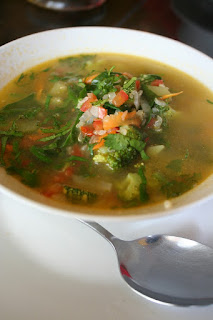
The menu started with a broccoli soup that hid a hint of ginger, and hinted at the Asian fusion flavours favoured by the kitchen. Fittingly, K's main course was arroz chaufa (Chinese fried rice), while my falafel burger fell into neither Peruvian nor Chinese camps, but was tasty nonetheless.

Undone by greed

After lunch, we took a chance on a couple of museums reported by many to be slightly disappointing, but whose entrance was covered by our boleto turístico.

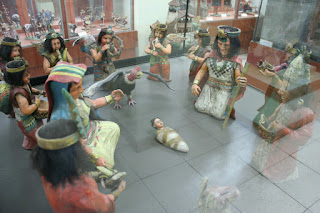
The museum of popular art turned out to be a trove of colourful figures and fascinating sculptures, many of which displayed characteristics of syncretism - the mix of Andean traditions with imported Catholic iconography.

Sculptured scenes

With the arrival of the Spanish, Inca festivities such as Inti Raymi were replaced with Catholic celebrations - a procession of saints' effigies at Corpus Christi took the place of an annual parade of ancestral mummies. Even ancient traditions took on Christian elements, such as the Q'oyllur Riti pilgrimage to the sacred mountains, thought to be gods or divine spirits (apus), but which in the 18th century gained new symbolism. A boy appeared to a poor shepherd, bringing bread each day and wearing rags of material similar to that used to dress images of saints in the nearby monetary. However, when the bishop visited to discover the identity of the boy, he disappeared, leaving a cross and an image of Christ on a rock. The pilgrimage of the "Lord of the Star Snow" mixes pre-Inca beliefs with such modern miracles.

Q'oyllur Riti pilgrimage

Even such iconic images as the Nativity (nacimiento) have an Incan slant, with Andean musicians serenading the baby Jesus with panpipes, surrounded by llamas and condors, while the Kings bring offerings of corn. Corn also makes an appearance in images of the Last Supper (última cena), where accompanies cuy (guinea pig) on the apostles' plates.

A very native Natuvity

After the popular art, the museum of contemporary art was a bit of a disappointment, with only a couple of rooms of stone sculptures, such as the iconic otorongo (jaguar) wrestling an amaru (serpent) while a condor claws at its back. These three animals are considered 'magical' in the Andean cosmovision.

After this cultural nourishment, I insisted that we stop at La Bodega 138. Although ostensibly an Italian restaurant, with what look to be excellent wood-fired pizzas, I was interested in their comprehensive range of Peruvian craft beer.

#Craft

From a list covering principally Lima-based breweries - Cumbres, Maddock, Barbarian, Nuevo Mundo - as well as relative locals Cervecería del Valle Sagrado, from Cusco's Sacred Valley. I opted for a pair from Cumbres' Gourmet label: an IPA given a distinctive purple-red colour from the maíz morada, but which delivered on hoppiness in a way that no other South American beer has, and "Café", a barley wine brewed with coffee, which tasted more like a porter, lacking the syrupy booziness of its style.

Purple corn IPA

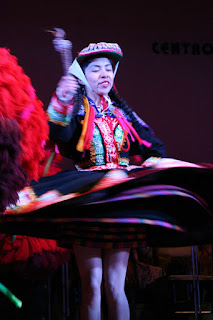
After the libations, it was on to the Centro Qosqo de Arte Nativo for some folk and traditional dance from the region. A selection of regional dances - each necessitating a new, more elaborate costume - were performed with style, energy, and vigour from both the women and men.


Dancing folk

The purposes of the dances were understandable: a celebration of the arrival of rain, a courting dance, and a bizarre war dance in which a comic relief character - very possibly representing the Europeans with his silly pink face and pronounced nose - interrupts the performance with his pranking.

Wednesday, 24 June 2015

Beer from Stier

I spent this morning wandering  around La Cancha taking photos of the colourful and busy marketplace.

Arriving home, I prepared our own version of an almuerzo completo, comprising salad, a soup, and a slightly weird segundo of veggie meat, roast potatoes and green beans. I am far from being an expert in preparing fake meat and miss the tasty simulacra of SE Asia - what is their secret?

Colourful salad

Soup looks a bit grey

Faux meat fail

Of course, being in Bolivia, there had to be cake.

It didn't survive the journey home well

In the afternoon, we caught up with some friends from home via Skype and shared a virtual beer. Being in the UK, their variety and selection of craft beer caused great envy in us, but we did manage a reasonable range from local Cochabamba brewery, Stier.

Stier's beers

From strawberry to honey, via a wheat, an IPA, and a stout brewed with quinoa, the quality was good by Bolivian standards, but lacked the refinement of international beers available in North America, Europe, Australia or New Zealand.