Showing posts with label Peru. Show all posts

Wednesday, 29 July 2015

Quito Time!

Regretfully, it was time to move on from Cusco today. We woke before 5am and were met by Maestro Florencio, who helped us with our bags to the taxi. The sky was already lightening as we made our way the short distance to the city's airport, where it seemed that every other passenger was a British teenager, whose mouths loud as their trousers.

We quietly ate some pastries we had picked up and pretended not to be British, until it was time board the LAN flight to Lima. On the aircraft, we were treated to some chirpy 'elevator-style' bossa nova, until we took off and got an eyeful of the wrinkly ground surrounding Cusco, small white lines zig-zagging over its surface denoting paths to remote hilltop locations.

Lima, where military parades for the fiestas patrias were taking place, was covered in a grey pall of cloud. The view in, unlike the splendid aerial vista of Cusco, showed little to recommend the city. We spent what little time we had between flights relaxing in the airport's Sumaq lounge, where we enjoyed a pisco sour from the bar - it was 10:30am but the last opportunity for a genuine Peruvian cocktail - an orange juicing machine, and a coffee maker that played a blast of music every time it dispensed a cup and serenaded me with a snippet of Mas Que Nada while it vended a cappuccino. With such a wealth of drinks from which to choose, I happily bypassed the Inca Kola, which I had tried preciously, and which is apparently flavoured with lemongrass, but instead looks and tastes like diabetic's urine.

Inca Kola

To complement the liquid servings, a selection of salad ingredients was laid out, with no appearance from the classic 'salad trinity', lettuce, tomato, and cucumber - why do we in Britain think these are required features of a salad? - and a healthy(!) selection of cakes, which more than made up for the desultory sandwich offered onboard the onward Quito-bound flight with LAN, which of course turned out to contain chicken.

After the two hops, we arrived in Quito airport. Not quite so conveniently situated - the old airport within the city is now a park - we organised to be met by our young host, Alejandro, to take us to our accommodation, the Blue Door. Once again, we found ourselves on top of a hill, this time in Quito's San Juan district. Although only 2,900m elevation - contrast Cusco's 3,400m - we still had a good view over the town in a pleasant neighbourhood near a stunning basilica. The house itself is a collection of rooms facing onto an open courtyard, much as a Moroccan-style riad.
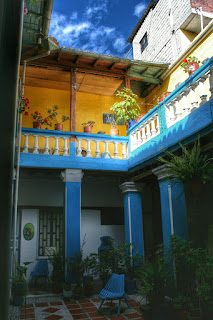
Blue Door

Having arrived close to evening, we settled only briefly before exiting and navigating our way to La Mariscal area of town, which is replete with restaurants but also tourists. Hoping for a tofu and SE Asian fix, we went straight to Uncle Ho's, whose walls are plastered with pictures of the venerated Vietnamese leader. The menu presented an unprepossessing mix of Ecuadorian, Thai, and Vietnamese cuisine, but an initial cà phê sữa đá (iced coffee) was surprisingly authentic, albeit less strong than we had tasted on the other side of the planet. Summer rolls were familiar, even if the peanut sauce lacked any kind if spice. In fact, the quintessential Thai spice and Vietnamese flavour was largely absent from the tofu green curry (which came with some incongruous Mediterranean vegetables) and a weird tofu and mushroom skewer braised in a soy-based sauce, which were both relatively bland. I suppose it is unfair to expect authentic cuisine outside of the country of origin, and Uncle Ho's presented a frankly unexciting fusion of Asian and Latin American flavours.

Vietnamese food, Ecuador style

Despite being a capital city, Quito feels relatively safe, so we decided to make the return journey on foot. This would have been fine, apart from an unnecessary detour onto Av. 6 Deciembre*, which precipitated a close encounter with a large man kicking off in a local café and turning over the counter in spectacular, if fearsome, style. This was an inauspicious introduction to Quito and we quickened our pace home after that with mixed emotions about leaving the safe haven of Cusco for the (apparently) mean streets of Quito.

* The street names of Quito are, like many places in South America, a mixture of place names (Venezuela, Uruguay, Mexico, Canada), historical dates (9th October, 10th August, 6th December, 12th October) and important figures (José Mejía, José Olmeda, José Sucre, Juan Montúfar, Juan Larrea**).

** It's odd just how many people are called either Juan or José - one chap (fittingly the first president of Ecuador) even managed a double whammy with Juan José Flores.

Tuesday, 28 July 2015

Independence Day Peru

Today is the official day of independence during this period of Peru's fiestas patrias. Independence from the Spanish was won by Argentine José de San Martín and declared on this day in 1821. Throughout the month of July, the towns and cities of Peru are festooned with the red-and-white bicolour. However, much of today's celebrations are focused on the capital, Lima, with the continuing tradition of the presidential address.

As this was our last day in Cusco before leaving Peru, we spent the morning packing up the items that we have managed to spread all over the bungalow we have been renting and which, miraculously, seem to fit back into our bags. Having cleaned and tidied away much of the evidence of our month-long stay, we walked into town for the last time to see what independence day in Cusco would look like.

Viewed from above on the downhill path, the city seemed eerily quiet. Normally there is some noise, whether it be cheers from the crowds at the football stadium, or a parade in the main square, but I imagine today arriving into empty streets with shuttered shops. Indeed, many of the small tiendas in upper San Blas were closed up for the feriado, but as we approached the centre of town, we were greeted by the same scene of tourists clammering for a photo in front of the infamous "twelve-angle stone" or with a cute lamb carried by a lady in traditional dress, or being propositioned by the army of ladies offering "masajes".

The 12-angle stone: who can fathom its power?

Despite the central shops, bars, and restaurants doing the same amount of trade as any other day, the Plaza de Armas remained resolutely free of dancing, parades, or music. As with many 'national days' in countries we have visited, celebrations tend to precede the official date, while the holiday itself is time to recover or, in the most extreme case of Bali's Nyepi, a day of absolute, enforced silence following the preceding day's Ogo Ogo festivities. This should come as little surprise, as New Year in many countries is celebrated fervently on its eve, while a day of rest follows.

Just in case celebrations spontaneously kicked off in the square - as is their wont - we took up position at Papacho's overlooking the potential proceedings. While the darkened, neon-lit burger joint served up temping platters of fried and grilled dishes, their tempting aromas wafting in our direction, we were saving ourselves for a final crack at Green Point's menu. We settled, instead, on a frothing glass of Cusqueña (or two) out of a kind of vicarious patriotism. In actual fact, the wheat (trigo) and dark (negra) versions of the local beer are both inoffensively quaffable.
With no apparent show forthcoming on the square, we repaired happily to our second home in Cusco, Green Point. After yesterday's vain hunt for the elusive Peruvian delicacy, causa - a layered potato, avocado, and chicken dush - in vegetarian form, we stumbled upon it hidden in plain sight, albeit under the name "papas enrolladas", on Green Point's menu. The presentation was slightly different, with the yellow, lime and ají amarillo-seasoned potato rolled around the filling and wrapped in thinly sliced cucumber, but its was unmistakably the same dish.

Causita

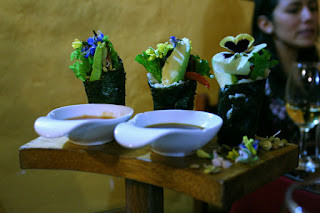
Sadly, after the build-up, the causita bites were overshadowed by the other appetiser, both in presentation and taste, of vegan temaki sushi cones. Presented in a wooden stand, which could well have been plucked from a chemistry lab, the nori rolls reminded us just how much we like and miss Asian cuisine.

Temaki

How to follow these starters? With another modern classic, lomo saltado, which fuses the Andean penchant for rice, potatoes and meat (in this case strips of seitan), with the Chinese stir-fry style of cooking and soy sauce seasoning. The saltado (meaning sautéed) was served in the pan, with the 'meat', onions and peppers soaking in the soy broth, while the fried potatoes were layered on top. With a Green Point 'house' salad on the side, featuring avocado and smoked aubergine (berenjena ahumada) 'bruschetta', conspired to defeat us, but meant that we had plenty to box up and take away for supper.

Green Point house salad
As the sun set we walked home, watching marching bands distribute themselves among the local churches. It seems that festivities are not centralised on these days; rather, each community finds its own way to celebrate.

He marched them up to the top of the hill...

The sun sets on independence day

Monday, 27 July 2015

San Cristóbal

We treated ourselves this morning to breakfast out at Café Punchay. This was more an excuse to use the WiFi and sit in the peaceful courtyard for the morning, but the desayuno set was a simple combination of scrambled eggs (I snigger immaturely whenever saying huevos revueltos, imagining ordering revolting eggs) and some of the best ciabatta bread I have tasted, with coffee and banana-mango juice.

The eggs are revolting

Having whiled away a few hours there, we segued directly to lunch at Café Morena. While by no means expensive, this restaurant is by far the most expensive place we have eaten in during our stay in Cusco. However, we came to try the causa (or causita) - a classic Peruvian cold dish of layers of yellow potato flavoured with lime and yellow pepper, filled with avocado and (in some cases) tuna or chicken mayonnaise. Morena's menu promised a vegetarian version, but today there was none. Disappointed, I settled on a portobello mushroom 'sandwich', which was good but nothing terribly special.

Fancy serving comes to Peru

K opted for quinoa chaufa - a fusion of Asian flavours with the quintessential Andean grain. A couple of pisco sours - one flavoured with chicha morada, the other with passion fruit - were colourful, flavoursome, and wonderfully presented.

Chicha morada pisco sour

As yesterday was the festival of Santa Ana, so today was a similar celebration of the patron saint of travellers, Saint Christopher (San Cristóbal). Climbing yet another of Cusco's near-vertical streets, we arrive at the church of the same name. Offering a superb view over the city centre, the square in front of the church was home to a collection of cusqueños in an already advanced state of revelry. There was, as yesterday, plenty of drinking (Cusqueña: "La cerveza de los Puruanos"), eating of roast guinea pig and other fatty foods, and dancing.

View over Plaza de Armas

Festivities at San Cristóbal

Unlike yesterday's festivities, there were no dancing troupes - although plenty of locals were dancing and waving handkerchiefs in the air, while several bands and sound systems competed with one another from all corners of the plaza. Today is the start of several days of celebrations that will culminate on 4th August with a procession. However, for now the icon remained resolutely within the confines of the church. The image of Saint Christopher is awesome icon, his face wracked with anguish, a palm tree in one hand, baby Jesus on the other shoulder, flanked by small Andean figures with full-face balaclava and long-nosed mask we saw yesterday. In another image on the church, a small aeroplane accompanies the saint, underlining his important role in keeping people safe during travel, which also includes drivers and might explain the attitude to road safety in South America. As we were about to leave, another band appeared out of nowhere - sheet music attached to the shoulders of the player in front - marched directly into the, until then, contemplative silence of the church's nave and burst into a rendition of 'Happy Birthday'. Well, I suppose this is a fitting tribute for the saint's anniversary, if a little incongruous with the surroundings. Peruvian festivities are certainly a lot more festive than at home.

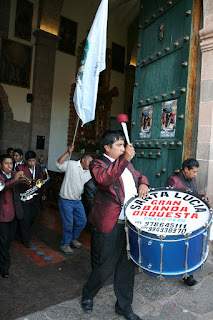
Banging the drum for the Saint's birthday

Dancing at San Cristóbal

As the festivities got rowdier and we were entreated to join the drinking, dancing, or both, we made a move home. We searched vainly for somewhere to sell us vegetarian causa, but discovered that Peru is as in love with chicken as everywhere else we have been in South America. Pollo features as an undisclosed ingredient in just about every dish. As a close second, we bought papa rellena - a fried potato encasing a filling normally comprising beef - from a hole-in-the-wall vegetarian shop on Plaza San Francisco.

Papa rellena

As a distinct bonus, we passed a small picarones shop (Picarones Ruínas) that we had assumed would be closed - its unmarked door remaining resolutely closed all day with no posted opening hours - only to find it open for business.

Picarones

A pan of hot oil in the doorway was being tended by a young girl who slid circles of pumpkin dough into it to create the delectably crunchy picarones 'doughnuts' that are served with a sweet syrup. With very sticky fingers, we returned home.

Sunday, 26 July 2015

Santa Ana

Not a few hundred yards from where we are staying in Tambillo is the Inca Templo de la Luna (Temple of the Moon). Some adventurous tourists make the pilgrimage up the steep Inca path from town that leads to these ruins, which we pass every day in the opposite direction. As with many things on one's doorstep, we have neglected the temple, carved directly into a mound of rock protruding from the hillside. Today, we ventured inside, investigating the natural fissures that were refined by the Inca stonemasons for who-knows-what purpose.

Temple of the Moon and Ausangate

At midday, we had an appointment at the bootmaker for a pair of boots to K's design. The bootmaker had turned them out astonishingly quickly, although they were supposed to be ready yesterday evening. However, when we dropped by to pick them up last night, we found the usually empty little shop full of people, each perched on a stool and holding a bottle of Cusqueña. The owner apologised for the delay.

Having picked up the boots, we didn't even attempt to buck our established convention and segued immediately to Green Point for lunch. I had the set menu, which came with chicharron de champiñones (battered mushrooms to you and me), while K ordered á la carte and received an enormous and delicious-looking ensalada grillada that stretched the definition of the word 'salad'.

"Salad"

Today was apparently the Festividad de Santa Ana. It is notoriously hard to get reliable information on local festivals, especially religious festivities, many of which are literally moveable feasts or last for multiple days. When questioned, the people at the tourist information office seemed unaware of the calendar of events they advertised and were not especially forthcoming with details of the schedule. However, we decided to see what might happen at such an event. We wavered a little when we realised that the small Templo de Santa Ana is at the top of Cuesta de Santa Ana - one of the many steep roads leading out of Cusco's town centre that have helpful steps up each side owing to the sheer angle.

Cuesta Santa Ana

It was fortunate that we took a chance as, on surmounting the hill, we were greeted by a jubilant atmosphere and crowds of cusqueños tucking into plates of roast cuy, chicharron of pork, and other fried foodstuffs outside the church. They were also consuming a large amount of beer. The sacred nature of the festival, which focuses on a parade of an image of Santa Ana, said to be Mary's mother, carrying the baby Jesus, is apparently no impediment to the participants' inebriation. In fact, it seems traditional.


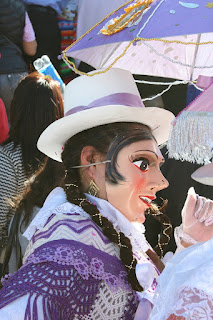
Dancing and masks at Santa Ana

Among the throng of onlookers were many people in costume and several bands, each processing into the tiny square in front of the church. Some wore full-face balaclavas and square lampshade-style hats and proceeded to whip each other in a display that was largely comic but nevertheless had the crowd gasping in vicarious pain.


The whipping dance

Having announced the arrival of yet more costumed and masked celebrators, the band peeled off to seek shade and a few beers. However, they could not rest long before the main event - the processing of the icons. An enormous effigy of Santa Ana carrying a child emerged from the church doors atop a solid wooden frame, which was hoisted by at least two dozen men down the steps and onto the street. This was shortly followed by a the beatific figure of Jesus Christ (as a man), and the two images were followed down the street by dancing troupes and marching bands.


Religious icons and, err... men dressed as gorillas

On arriving back in the main square, yet more dancing was taking place. This time, children and young adults were entertaining the crowds with street dance, presumably as part of the lead up to Peruvian independence day.

Saturday, 25 July 2015

Hello Chocolate, Meet Beer

This morning started well meaningly enough with an avocado shake and a session of yoga on the lawn. Thus ended the healthy and virtuous activities of the day.

We proceeded to have lunch at Prasada vegetarian café, which serves one of the best lentil burger sandwiches I have ever tasted, loaded with chimchurri (a parsley and oregano pesto of Argentine origin), cheese, spicy cream, guacamole, and caramelised onions. Unusually it came with thin strips of fried pastry instead of chips.

Chimichurri lentil burger

After this indulgence and a veritable vat of lassi, which must have measured at least a pint, we rolled fatly along to the municipal theatre hoping to catch another in the programme of free concerts put on in honour of Peru's celebration of independence. Sadly, the time we had been given was a couple of hours earlier than the actual schedule for the Festival of Tunas (apparently a minstrel band playing folk songs and not a celebration of the saltwater fish) and so we found ourselves at a loose end.

With little specific to do or see in Cusco, we found ourselves having a beer in the Irish bar on the main square with the quintessential name Paddy Flaherty's. I would normally avoid such ubiquitous cultural anomalies as Irish pubs - this one having the dubious honour of being the highest Irish-owned bar in the world - but among the cultivated dim environment and dark wood, Paddy's serves great local beer on draught. Interestingly, a notice warned us that, owing to low demand, Guinness refuses to ship kegs of their stout to Peru for the foreseeable future. This I did not mind, as the Cervecería del Valle Sagrado was well represented by its superlatively tropical fruit-flavoured IPA and chocolate coffee liqueur Café Stout. The latter was a perfect aperitif for the evening's "noche de cervezas y chocolate" organised between ChocoMuseo and Nuevo Mundo brewery.

Chocolate

This event was the second outing for beer and chocolate pairings, and was an especially well organised guide through the craft of both organisations. While being a fan of both products in isolation, I was sceptical of combining the two, preferring savoury food to accompany my ale. However, each station paired one of the brewery's offerings with one or more flavoured chocolate. Thus, the Cabo Blanco blonde ale was offered alongside 42% milk chocolate studded with whole coffee beans. The effect was surprising, juxtaposing the lime tartness of the beer with the chalky richness of the coffee. Next was the Panam pale ale and milk chocolate with dried mango, attempting to complement the tropical fruit notes imbued by the hops, but not quite hitting the mark on my palate. Far more successful were the richer beers, such as the Pampa porter paired with 70% dark chocolate with salt from Maras, combining to become a decadent mouthful. Similarly, the "Premium" Belgian triple ale's caramel and banana spice flavours complemented wonderfully the subtle spiciness of the ají (chilli) milk chocolate. Finally, the "Barry White" barley wine - the strongest at 9.5% abv - offered dried fruit notes which were underlined by milk chocolate filled with dried aguaymanto (physalis).

Beer

After sampling a few beers, we were considerately offered a small snack of causita to assuage our hunger.

Causita

K and I filled a basket with a selection of the Nuevo Mundo beers and headed home to continue sampling by the fireside.

Friday, 24 July 2015

Peruvian Rhapsody

This morning we took a taxi down to the end of town populated by medical clinics and farmacies for K's appointment with the specialist. We added a new word to our slowly growing Spanish vocabulary: otorrinolaringólogo, which apparently means ear, nose and throat doctor. This particular ENT doctor turned out to be a consultant from another practice across the road, where we had previously refused to wait until she came on duty at 6pm. A quick syringe was all it took to return K's ear to working order and the mystery of the, possibly phantom, infection was never solved.

Pan...tástico

In celebration, we had a quick breakfast at the San Blas bakery, Pantástico, which serves up delicious sweet and savoury items in a diminutive café off the cobbled streets of Tandapata. We breakfasted lightly as we were anticipating a large lunch in celebration of nine years of being a couple. However, we needed some sustenance for an indulgent shopping spree.

Returning to the many shops, boutiques and market stalls that abound in Cusco, we hoovered up small gifts for friends and family, as well as a couple of more lavish purchases for ourselves, including a painted bull (torito), usually fixed on the roof for luck, and an exquisitely crafted scene of Peruvian life, known as a retablo, made by the family Jímenez. As Peru is the penultimate country on our world trip, we appear to have lost all restraint in both the size and expense of the souvenirs we are acquiring, reasoning that we only have a few flights left to get them home.

Toritos on the roof

Peruvian independence day is next week and festivities are already starting to warm up. In the Plaza de Armas - the focal point for all celebrations - school marching bands congregated today for a display of patriotic pride, and the whole city is festooned in the national colours, red and white.

Independence Day festivities begin

After we had concluded our spree, we still had some time to kill to avoid the lunchtime rush, so we settled into the peaceful outdoor area at Café Punchay for a pre-meal cocktail.

Once the lunch crowds had dissipated, we sat down for a blow-out lunch at our favourite vegetarian restaurant, Green Point. Despite coming many times for their always superb set lunch, this time we ordered an unnecessarily gluttonous selection à la carte.

To start, we chose from the 'raw' foods a selection of raw sushi with ground nuts in place of rice, and a juicy ceviche of avocado, mango, and red onion in a tangy lime and parsley sauce.

Vegan ceviche

While K continued her current soup obsession with a creole version featuring noodles, I had a 'lomo' (beef seitan) sandwich with sweet potato chips.

Vegan 'lomo' sandwich

As if this weren't enough, we both concluded with dessert. Typically, on the set menu, this is a mouthful or two to finish the meal on a sweet note. However, I was presented with a gout-inducingly enormous portion of torta de chocolate, while K managed to finish off a slightly less egregiously large glass of chocolate parfait.

"Oh my" torta de chocolate

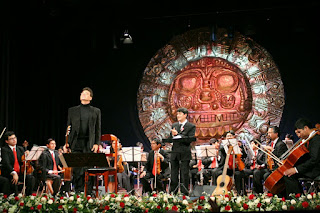
Bursting a little at the seams, we segued to the teatro municipal, where the Orquesta Sinfónica del Cusco was presenting a free concert in honour of Independence Day. Beginning with el rapsodie peruano, the orchestra was then joined by composer and virtuoso on classical guitar, Javier Echecopar, who treated us to variations on Andean classics, including a tocata, sonanta, and fandango (needs more castanets). The evening finished with the Peruvian national anthem, which, although it was the first time I had consciously listened to the 'hymn', sounded very familiar, beginning not unlike Howard Goodall's theme to Blackadder before transforming into something vaguely reminiscent of a Mozart concerto.

Javier Echecopar and the Cusco Symphonic Orchestra

To conclude the day's indulgence, we slid by Cholo's bar to sample an excellent red ale from the local Cervecería del Valle Sagrado, whose brewery we had sadly no time to visit on the way to and from Machu Picchu.

Thursday, 23 July 2015

Ccochahuasi Animal Sanctuary

Our plan for today was to make the short trip out of Cusco in the direction of the ruins of Pisaq, but to stop at an animal sanctuary called Ccochahuasi.

After fuelling ourselves on an avocado smoothie I made in the morning, we  found room for a vegetable empanada from the excellent Pantástico bakery. Eventually, we alighted on the correct bus terminal (incorrectly marked on the map) for buses to Calca.

A mere half an hour's drive back up the hill we had descended into town brought us to the animal sanctuary, where we were greeted by an Andean deer, a large tortoise and a beaming man who would show us the refuge for rescued animals. The tortoise, he told us, had been discarded by someone who once owned him as a pet. He proceeded to introduce us to the familiar faces of llamas, alpacas, and vicuñas. These were not rescued, but belonged to the family that owns the sancturat. Among them was the, until now, unfamiliar shape of the Dougal-like Alpaca suri with a hugely long shaggy coat.

Alpaca suri

Farther into the sanctuary were to be found birds of all kinds, including a pair of macaw parrots in contrasting primary colours, as well as peregrine falcons, and the astonishing sight of condors that swooped down on us, their three-metre wings outstretched, while a small (!) brown baby condor sat implacably to the side.

Baby condor

In amongst the menagerie were sibling (and motherless) Andean cats, a family of pumas (apparently rescued from a disco!), and a selection of mischievous monkeys.


Animal families

The sanctuary is just that, housing rescued and vulnerable animals and releasing them or their offspring back into the wild.

Having caught a lift back into town, we lunched at the Shaman vegan restaurant. K tucked into a bowl of quinoa soup which has become her staple, while I attacked the set menu of, by now familiar but no less tasty, salad, soup (a thick potato potage today), and vegetable stew plus broccoli fritter.

Shamanic meal

After lunch we made the unwelcome but necessary return to the medical clinic to further investigate K's ear infection, which has wholly failed to respond to antibiotics. The ear, nose, and throat expert scheduled us to return tomorrow morning. Hooray.

We walked back home for yet more homemade soup in front of the (once we got it going) raging fire.

Fireside soup

Wednesday, 22 July 2015

Precolombino

Today we rose and ventured out to the Museo de Arte precolombino on the picturesque Plaza de las Nazarenas.

Museum courtyard

In a 15th century building, surrounding a pretty courtyard, the museum houses a small collection of artefacts from times before its own creation belonging to people inhabiting the coastal area of modern Peru, including tribes from the "formative period", the Chavín, Vicus, Virú, and Paracus, as well as their successors, the Nasca, Mochica, Chimú, Huari, and finally, the Inca.

Hefty gold Chimú earrings

I feared the collection would comprise yet another succession of pots, jars, bottles, and arrowheads from ancient civilisations, bearing bland descriptions of their materials and assumed date of manufacture. Happily, the selection and presentation had been made with an artist's eye to the aesthetic aspect of the pieces, and included considered and insightful descriptions of the merit (religious or customary) as well as the functional purpose of each item. Granted, some of the text was a little overwritten and highfalutin, threatening to alienate the audience that it tried to engage, but quotations from modern artists, such as Picasso and Gaugin, grounded the appreciation of the "antiquities" as art in addition to utilitarian objects. It was the description on the museum restaurant's menu took the real biscuit.

Remarkable Mochica pottery

Slightly out of the way of the town centre, part way up a hill leading to the Sacsayhuamán ruins, is a charming little garden restaurant attached to a museum of medicinal plants.

Quinoa croquettes and caramelised camote

At "D'gustos y preferencias", we enjoyed a view over the rooftops of Cusco as well as their set menu of the day, caramelised sweet potato and quinoa croquettes, followed by a cauliflower "broaster" with fried potatoes and a salad, dressed up with a passion fruit vinaigrette.

Cauli broaster

Back at home, I felt the urge to practise some of the yoga asanas. While this should be a daily routine, in reality it is not something I have done in earnest since we left Thailand and probably the last attempt was in the jungle retreat in Langkawi back in February. My excuses range from the weather (too hot or too cold) to space (not enough, too overlooked), but I finally got back to it this afternoon despite the very plausible get-out of the altitude in Cusco (too high).

At over 3,600m, any kind of physical exertion takes its toll, so yoga breathing after many months was difficult. Nevertheless, a quick run through of the basic postures was a tonic.

More of a tonic, but less virtuous I suspect, were the post-session beers that followed. The garden of our bungalow here is in fact the perfect tranquil space not only for yoga practice, but also for a drink in the sun.

Yet more Peruvian cervezas artesenales

I have become adept at sniffing out the locales that sell beers beyond the usual Cusqueña range, but was still surprised to see a selection of cervezas artesenales available at the excellently named "Pan...tástico" B&B and bakery on Carmen Bajo.

The Shaman IPA, while not as hoppy an ale as Barbarian's 174, was balanced and hid the whopping 8% abv well. Cumbres interesting take on a fruit-based pale ale incorporates passion fruit (maracuya) and physalis (aguaymanto) into the mix, hence the port-manteau "Maracumanto".