Thursday, 7 May 2015

Full Immersion: Vino, Spanglish and Pisco Sours

As well as the imposing sight of the Andean mountains forming a backdrop to Santiago, Chile is also famed for its cerro - small hills that rise out of the streets.

Castle on Santa Lucía

This morning we climbed nearby Santa Lucía, popular for a couples' stroll at dusk, and topped with the slightly odd-looking, red-painted castle ramparts of Castell Hidalgo.

Defending the hill

Albeit small, the summit provided good views of the city and the orange smog-covered Andes.

Smoggy San Cristóbal hill

Descending from the mountain, we stopped by a small vegetarian- and vegan-friendly café, Girasol*, for an empanada - a savoury pastry a bit like a pasty. As well as having veggie credentials, the owner upped the stakes by using wholemeal flour for a dense and 'healthy' snack.

* I'm not sure what it is with sunflowers (girasol) and vegetarianism, but I have seen the two connected in several countries.

The language school, at which we will be starting a course next week, organises many cultural activities throughout the week. We thought it would be good to immerse ourselves in these ahead of the classes, both to meet people and to get an initial grip on the language. The empanada lined our stomachs for today's activities, which included a winery tour and a pisco sour tasting evening. I'm not sure how 'cultural' either of these activities are, but they were certainly a baptism of fire into the Spanish language.

We found ourselves in a minibus full of students who had been learning Spanish for anywhere between six months and six years. For all intents and purposes, they seemed fluent to our ears. The  native-speaking teacher wasn't taking any hostages either, as she addressed us and the rest of the group in no-holds-barred Spanish. At the vineyard, Cousiño-Mucal, just thirty minutes outside of Santiago centre, she instructed the guide to do the same, so we understood little of the tour, but filled in the blanks from our recent trip to New Zealand's Marlborough and Central Otago regions.

Family vines at Cousiño-Mucal

Unlike the modern metal containers of NZ, the Chilean grapes are fermented in enormous 100,000 litre barrels fashioned from mighty Californian redwoods. Two of these giant vessels are solely for "the family's" use.

Just hook it to my veins

After the tour, we tasted three wines - a Sauvignon blanc, a Cabernet Sauvignon, and a Syrah.

Degustación

None set my world alight but the latter was poured with a handy little aerating gizmo, which may or may not have contributed to its round and smooth character.

I can see this going wrong after a glass or two

Back in the city, there was little time before it was pisco'clock. Pisco is a spirit made from distilled grape wine, akin to brandy, and this evening was a masterclass in its various preparations. In anticipation, we bolted a horrible sandwich from a comida rápida (fast food) restaurant, ironically named 'Sandwich Master'. It turns out that if you take the carne out of a charrasco italiano, it's a wholly unsatisfying sloppy mess of avocado and mayonnaise in a bun. No me gusta.

Pisco sour is normally blended from the spirit itself, plus lemon juice, sugar syrup, and ice.

The indomitable Jaqui makes pisco sours

Over an array of traditional sours, as well as those containing fresh basil, mango purée, and raspberry purée, we attempted a few faltering Spanglish conversations, and resolved to get much better, muy rápidemente.

Wednesday, 6 May 2015

Circadian Disrhythmia and a Chilean Coup d'Etat

For the first time since starting this trip, both K and I have found that our circadian rhythms are bang out of whack with everyone else. We have jet lag. When midnight hits, our bodies think its 9am and helpfully bring us out of the slumber we have just fallen into, in order to start the day. On very little sleep last night, it was a slow start this morning. We would need every ounce of groggy concentration to help us with our chosen activity for the day.

Museum of Human Rights

As seems to have been customary when visiting a new country, we today visited a museum to the human rights violations perpetrated against its people. It is disheartening to find so easily such memorials in each country, each one of which tries to draw salutary lessons from a troubled past, so that similar mistakes are never allowed to happen again.

Chile's tragic history is one of the most recent, covering the rule of the military junta under Augusto Pinochet from 1973 until 1990. Long before the date 11th September again created resonance in the public consciousness, it was a day of great significance to Chile; the day on which representatives of the army, navy, air force, and police combined to overthrow the socialist government. They stormed the government palace in Santiago, La Moneda, whereupon the incumbent, Salvador Allende, took his own life.

In their first televised address to the nation, the heads of the freshly installed dictatorship expressed regret at the undemocratic process by which they came to be there, but paternalistically assured the Chilean people that the country, until then under a 'Marxist tyranny' would soon be restored to political, economic and moral order. However, it was soon revealed that such reform came in the form of book burning, censorship, restriction of freedoms, and a 17-year long campaign of intimidation and torture.

Seahorse - a symbol of freedom

In a story that is by now all too familiar, objectors to the junta and defenders of the 'old regime', were quickly 'disappeared'. Many were sent for torture (mostly by electrocution), but many unluckier found themselves shot, burned to death, or weighted and thrown into the ocean. Control of the national press meant that these stories were suppressed, but the propaganda machine even went so far as to collude with foreign press agencies to create fake periodicals outside of Chile. These published articles claiming that the disappeared had died abroad; these reports were then quoted by domestic press as legitimate sources. It takes an evil sort of PR to cover up the horrific truth in such an ingenious manner.

The museum's exhibition was an excellent, if horrifying, chronological description of the 17 years under Pinochet and the junta. Televisual reportage from the time shows beatings, shootings and immolation of 'Marxist' rebels and protestors. However, the most arresting image was the papal visit in 1987, which juxtaposes Pope John-Paul's mass to the assembled crowd with scenes of the same congregation being corralled and fired upon by police water cannons in front of the powerless pontiff.

At this time, the Pope told the people that "love is stronger" - presumably stronger than the military might of the junta. I doubt this to be true, but the Chilean people did demonstrate an indomitable spirit, even when threatened with surprise house raids, kidnapping and murder. They protested, marched and demonstrated until the end.

Despite the acquisition of power by force, the junta's rule was quickly presented as a democracy, with plebiscites organised to justify its ongoing existence. The first two of these showed overwhelming support for Pinochet. Fortunately, the story has a happy ending, as the final referendum - surprisingly for a dictatorship - voted 'No' to the continuation of status quo. True democracy returned to Chile.

We attempted to reconcile the images we had seen with other questions we had on our walk back to the centre of town. How does a country become unable to feed itself such that soup kitchens are required? How does a dictatorship allow itself to be deposed under a fair election process? To what extent were foreign powers involved in supporting or funding the coup (or did they stand idly by while the dictatorship tortured its people)?

We mulled these and other questions over dinner at a surprisingly popular vegetarian restaurant we stumbled by in an arcade.

Ensalad "Soju"

While K enjoyed a huge and thoroughly laden salad - complete with marinated tofu, orange slices, artichoke, hearts of palm, and potatoes - I savoured a Chilean specialty in its vegetarianised form.

Corn pie

Pastel de choclo feels like a hearty winter dish, comprising layers of minced beef (in this case soya mince), seasoned and combined with black olives and dried raisins, topped with mashed sweetcorn (choclo). The dish is typically baked and served in individual paila dishes and ends up like a shepherd's pie. It was surprising enough to find a vegetarian (and vegan!) restaurant, but even more to discover that it serves beer from a local 'microcervecería'. I enjoyed a nice glass of Kross golden ale. I think we will be coming back to Soju.

Tuesday, 5 May 2015

Santiago

Our first full day in Chile kicked off with breakfast provided by our hostel accommodation. Toast, jam, cereal and fruit were accompanied by a platter of biscuits and cookies. This dedication to sweet treats is a tradition that we would see continue throughout the day.

The kick-off was slightly delayed owing to jet lag. Having moved from GMT+12 to GMT-3, we are technically only 9 hours 'out of sync' but the dislocation feels as though it has taken the full 15 hours' toll implied by the shift in timezones. Actually, Chile should currently be GMT-4, but the president recently decreed that the clocks wouldn't be going back for daylight savings this year!

We dropped into the language school where we will hopefully start to improve our Spanish beyond the bare minimum next week. After that, we exercised our existing competencies in the pretty La Starria area of town by ordering coffee. After observing that Chileans have a lunchtime eating culture, taking their main meal in the middle of the day, we also settled on pasta from the menú del día.

Mushroom and spinach spaghetti

Presenting a meat, fish, and vegetarian option, the daily menu at El Mulato and other restaurants is a reasonably priced way to enjoy a two- or three-course meal with a glass of crisp Chilean wine.

After lunch, we convened with a group of other tourists in the main square, Plaza de Armas, for a four-hour tour of the city.

Santiago was founded in 1541 by the Spanish conquistador, Pedro de Valdivia, and was named by him after "Sanctu Iacobu", Saint James, the patron saint of Spain, whose image appears in the cathedral on the square. The square is named after the armas (weapons) that the Spanish held there. These they needed to protect the settlement from aggressors, principally the local Mapuche people who opposed the Spanish presence.

Mapuche statue in Plaza de Armas

Unfortunately for Pedro de Valdivia, the Mapuche became even less well disposed towards him when he started taking their children as slaves. He went on to settle other parts of southern Chile amidst an increasingly hostile environment. According to our guide and other accounts, he met a bloody end at the hands of the Mapuche, who apparently flayed, dismembered, and (if some accounts are to be believed) cannibalised him while still alive.

Guarding de Valdivia

De Valdivia chose the settlement location in a valley, protected on either side by mountains and the sea. This area also proved excellent for cultivating vines. In fact, in later years the grapes did not succumb to phyloxerra, which wiped out much of Europe's crops. However, the valley also has the effect of holding in the city's pollution, casting a pall over the snowcapped Andes.

Our genial guide

Our guide, Nicholas, when not leading tour groups, studies gastronomy. This bias was obvious in his patter, as we first took a tour of the fast food available - its popularity among Chileans apparently visible on their waistline - chief among which is the hot dog (completo), which comes with a wide variety of toppings, closely followed by hamburguesa, and charrasco - a kind of steak sandwich topped with green beans.

There is a surprising unpopularity of coffee in Chile. They are apparently mostly tea drinkers until an enterprising businessmen opened a cafe where the tall waitresses serve the predominantly male clientele while wearing short skirts - known locally as 'café con piernas', coffee with legs. An even more ruthlessly enterprising businessmen topped this by, behind tinted windows, paring down the waitresses' uniform further still and introducing an occasional "happy minute", during which they remove the top half of what little they are wearing.

La Moneda

Our next stop was La Moneda - originally the Mint, as its name suggests, but later the seat of government. The grey edifice is not apparently noteworthy, until one remembers (or is informed) that it was stormed in 1973 under a military coup led by Augusto Pinochet against the socialist government under Savlador Allende. Allende's efforts to narrow the poverty gap by redistributing wealth and nationalising many Chilean industries (including valuable copper trade) had upset some powerful people. So began Pinochet's 17-year dictatorship and a period of fear and suffering for the people of Chile. We would find out more about this terrible history at the Museum of Human Rights tomorrow.

Statue to Salvador Allende

Meanwhile, on the tour, we wound our way northwards around Santa Lucía hill, stopping coincidentally at our lunchtime venue, El Mulato, for a break. It seems that we had independently sniffed our guide's recommendations, as he also singled out El Naturista in passing, which we visited yesterday evening. Rather than return to a restaurant where we had - owing to a miscalculation with the as yet unfamiliar currency - tipped an order of magnitude too low, I chose to wander a few doors down to one of the "25 best gelaterias in the world" and enjoyed a rather nice dulce de leche.

Santiago's Wall Street

As we rounded each corner to a new street, a dog would present itself, as though to welcome us to its domain. On the busier streets, the dog was often passed out, no doubt exhausted from greeting all the passers-by, but the livelier ones often accompanied us to the next intersection, handing us off to his colleague over the road. The reason for the high canine population is that they are often turfed out of homes unneutered and allowed to reproduce and live as strays. Coincidentally, we saw very few street cats, who must have been making themselves scarce.
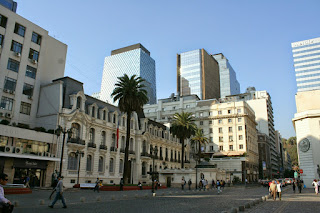
Santiago's old and new

In the Parque Forestal, there is an incongruous bust of Abraham Lincoln. This was a gift from the USA in 1985 and, according to the plaque, seems to have been pointedly given in the spirit of freedom and democracy - "values which the two nations share" - during the Pinochet regime. There is no love lost between the US and Chile, and the statue is heavy in graffiti. This attitude sits uncomfortably with the fact that we had just passed a restaurant that had changed its name and decoration overnight following an impromptu visit from President Clinton.

Mopoche River and St Cristóbal hill

Crossing over the distinctly unmighty Mopoche River - a tiny trickle at the bottom of the brown riverbed, as there has been no rain to speak of since last year - we reached the Bellavista area of town. We ended at the former house of esteemed Chilean poet, Pablo Naruda, and bade farewell to our guide.

'Cellphone' tower

Having eaten at lunchtime, we embraced the Chilean culture of 'once' (teatime) and enjoyed a pisco sour at El Biógrafo in La Starria, as the dusk fell and the musicians struck up on the pavements. The drink was mouth-puckeringly sour despite our guide's insistence that most alcohol in Chile is served sweetened so as to disguise the poor quality - pisco and Coco-Cola (piscola), beer and Fanta (fanschop), and, the most frightening of all, white wine and pineapple ice cream (terremoto, meaning earthquake). Despite deriving its name from the eleven (once) letters of the spirit 'aguardiente', apparently to take 'las onces' does not necessarily, nor even in the majority of cases, involved alcohol. In fact, it is normally taken between 5 and 7pm, and involves a cup of tea, some bread and toppings and perhaps a piece of cake.

Monday, 4 May 2015

The Longest Day

Today was a weird day. We were up around 8am in Auckland, where our flight to Santiago, Chile was scheduled for 16:05. The route took us across the international date line, effectively throwing us back into Sunday for a brief period, and meaning that we had to wind our watches back by fifteen hours - longer than the twelve hour flight, meaning that we landed before we took off.

I tried to put this time travel out of my mind and enjoyed the unseasonally sunny and warm weather that graced northern New Zealand this morning. We took a walk along the Viaduct Harbour, reprising our initial foray into the city on our arrival six weeks ago. We stopped at Natural Café for a final 'eggs and avocado' breakfast and an obligatory flat white.

Nature's goodness

We ate outside in the sunshine and 19°C temperature. According to many tourism activities - our van rental included - the beginning of May signals the arrival of winter. However, in practice it won't get cold in Auckland until June or July and the season is relatively short lived.

Winter is coming

We took a post-prandial walk in Albert Park, where the recent batch of graduates were having photographs taken against the stunning autumn colours wearing their uniquely dashing robes featuring pink lining and a fur-lined hood.

Can you feel the power... of the graduators

The park was charming, and gardeners tended the vegetable patches, which took the place of traditional flower beds with decorative edibles, such as red and yellow chard, pinky purple kale, and curly parsley. A most unusual sight.

Tending the veg patch

By this time, the airport called, so we picked up our bags and made our way by bus to the international terminal. After check-in, we settled into the Qantas lounge, only to be told that the inbound aircraft from Sydney would be arriving late, so our take-off was delayed by nearly two hours. This gave us plenty of opportunity to sample the excellent NZ wines, which outshone the poor selection of beers. Despite the availability of an excellent range of home-grown craft beers, the best the fridge could muster was a Fat Yak from NZ's larger West Island (yes, Australia). Boo.

Pre-flight snack

Once in the air, the LAN Chile flight was largely uneventful. The lengthy flight time (almost 12 hours) allowed for plenty of film viewing, including the incomprehensible and unconscionable events depicted in Selma, the masterful cinematography of Birdman, and the Moebius-like plotline of Interstellar. The latter's bending of time and space added to the impression of our apparent feat of going back in time.

On our descent into Santiago, the Andes range was prominently visible, separating Chile from Argentina, but as we reached ground level, the peaks were shrouded by a cloud of dust or smog - it was hard to tell which.

A trip on the Cuentropunto airport bus followed by a short hop on the Metro brought us to our destination - the Ecohostel on General Jofré.

Colourful frontage of Ecohostel

Dropping our bags, we got a steer to a vegetarian restaurant from the hostel, which took us the short distance to the centre of town.

Veggie burrito
At El Naturista, the menu was entirely in Spanish and so picked something relatively familiar.  The veggie burrito was not bad, but a little uninspired. Before the food arrived, we we were plied with ample bread and a salsa-like dip, known as pebre.

Sunday, 3 May 2015

The Little Van That Could

Today was an emotional day of saying goodbye to the little camper van that has been our home for the past six weeks. After a final breakfast of poached egg and aioli on toast, fixed up in the campsite kitchen and eaten cross-legged on the van's wooden boards, which cover its stowaway compartments. we set off north to Auckland.

To be honest, the van is starting to smell a little musty and 'lived in', despite our best efforts, but it has been a great experience to travel the length of New Zealand's two major islands and return to the point from which we first started.

Returning on the main artery, SH1, we made a brief stop at the village of Pokeno, which has made a name for itself by selling enormous ice creams. The local shop sells 7 scoops for a measly $8NZ. We settled on a paltry two scoops of "Tip Top" ("Kiwi for ice cream") and slurped them eagerly in the sun that deigned to appear as we wandered the Sunday market.

Despite being officially 'winter', the weather today was muggy and the sun burningly hot when it appeared from behind the extensive cloud cover. Compared to the lengthy journeys we have previously made on the island, today's route was a tiny distance. Still, we broke it at Auckland's regional botanic gardens, alighting unexpectedly at the dog walker's entrance at the rear of the park.

Meta-photography

The roses were hanging in, but the gardens were not as impressive as others we have seen. Nevertheless, they made a good stop to eat our picnic of sandwiches in the sunshine.

Auckland botanic gardens

Having become accustomed to single track roads wherever we go, the route into Auckland was confusing and poorly signposted. We eventually managed to navigate our way back to the Escape depot, where we unceremoniously handed over the keys to the little van and watched it rejoin its brethren in the garage.

Back in the fold

Lugging our heavy bags that the van had tirelessly borne for us, we made our way to the Nomads Fat Camel hostel to drop them again. Divested of our baggage and back in the same city we started in, we made our way to the Toi O Tamaki art gallery.

With only a brief while to explore its contents, we alighted on the very new video installation by Lisa Reihana: In Pursuit of Venus (infected). This five-projector screening takes Joseph Dufour's depiction of European/Polynesian encounter 'Les Sauvages de la Mer Pacifique' and reimagines it with speculative, but arguably more accurate depictions of the early 19th century encounters.

Colonialism  (reimagined)

The original characterisation reflects the exotic and unknown people in classical Greek dress (togas?), poses and dance. The reimagining uses moving images to reflect the engagement of Cook and the other settlers with the Maori, which often erupts into violence resulting from cultural expectations and misinterpretations.

Afterwards, we decided to pay homage at the same establishment we visited six weeks ago - Brothers Beer, which was recently voted the best bar in New Zealand. We concluded with a selection of Auckland's own Liberty brewery ales, including a juicy Knife Party IPA, a rich Yakima Scarlet, and a dark, coffee-roasted Darkest Days stout, which is getting the Aucklanders ready for winter.

My new front room

For a filling feed that departed from the western staples of burgers and pizza, we dropped into Japanese noodle shop Mentatz, which we had scouted near to the gallery earlier. We barely managed to squeeze in among the predominantly Japanese local crowd and ordered two steaming bowls of rice and toppings - known in Japanese as 'don' (丼, meaning 'bowl').

The don of all rice bowls

Teriyaki tofu don was a comforting bowl of carbs for me, while K went with the egg tofu don. We left happy customers and ventured on to Vulcan Lane to Vulture's Lane for a nightcap. The bar's name is an old nickname, given to the alleyway when men of the area were preyed on by local unsavoury types, ranging from prostitutes to bookmakers. Fortunately the area is much more salubrious today and the range of beer was excellent in the bar - the televised rugby was the only thing to detract from the otherwise cosy atmosphere.

Saturday, 2 May 2015

Lake Hakanoa

Today was our last full day with the van before we return it in Auckland tomorrow. Ironically, it stood still all day at Lake Hakanoa, where we parked it yesterday, while we circumnavigated the small lake on foot.

A menagerie at Lake Hakanoa

This was a pleasant walk, taking in an outdoor 'Green Cathedral' - a popular spot for local weddings, which can seat up to 170 people - and plenty of wildlife, including black swans, Canada geese, silver shags, and a confused looking hedgehog that was out snuffling in the grass well after its bedtime.

A pair of shags

After a brief spell of sunshine, which allowed us to enjoy a hastily concocted potato salad with a ginger beer, we began the task for which neither of us had much relish: packing up and clearing out the camper van. Much of the rest of the day was spent uncovering items from the deepest recesses of the van's internal compartments, separating the vital from that which we have carried with us for the past six weeks (often longer) without using, and repacking our rucksacks.

With the van returned to the order in which we received it, we relaxed with a beer or two (Garage Project's superb Aro Noir stout and Moa's surprisingly sour rum-aged Belgian 'quad'). Dinner was the vegetarian staple, lentil pasta bolognese, which was hearty and filling.

Friday, 1 May 2015

Huntly

We awoke to clear blue skies this morning, but the cloudless skies had caused the temperature to plummet over night to a biting cold. Our breath fogged in the confines of the van and there was more than the usual amount of condensation on the windows and ceiling.

Little Waipa is an idyllic setting with few other people, but without power there is no way to heat the van and we quickly ran out of water after this morning's cup of tea. We decided to move to a site with a few more amenities. Wishing to continue on the route to Auckland, we rejoined SH1, sped through Cambridge - which we had previously visited - and Hamilton, to arrive on the shores of Lake Hakanoa at the Motor Van Park.

Naughty pukeko

The sun still shone, so I took a walk through Huntly town centre (one road) to procure us some drinks for the unseasonally hot day. Sandwiches and beer (ginger for some) by the lake were how we spent the lazy afternoon.

Given that we only have a few days left in New Zealand, it seems odd not to be charging about seeing as much of it as we can possibly fit into our remaining time. However, we have already had so many great experiences, including travelling the full length of both North and South Islands, that we were content to stay a couple of nights just remaining stationary.

The other thing about wrapping up our time here is having a strange assortment of food left from which to cobble nutritious and hopefully tasty meals. Tonight's effort used up the remaining noodles (udon and bean thread) in an unusual combination with some mushrooms and green beans.