Thursday, 14 May 2015

The Meaning of Water

Jueves. Thursday. The school day followed the same pattern as yesterday and the day before. My concentration was improved with respect to Wednesday and we set about learning the little words and phrases that allow one to talk about the world and its topology. Near to, far away, underneath, in front of. These phrases are sometimes critical to be being able to get a message across regarding something's relation to another thing in a physical space. However, contriving a series of examples of their use always brings to mind the canonical French sentence taught to all schoolchildren, "où est la plume de ma tante?", as well as Eddie Izzard's sketch involving this same phrase and an errant monkey. So, we spent the morning forming utterances along the lines of "el mono está debajo de la mesa" (the monkey is under the table).

The course comprises all-Spanish instruction, both written and spoken. When starting from a base vocabulary of nothing more than a handful of words, this is akin to learning as a child does, intuiting words and meaning from context and gestures. Sometimes this goes wrong and we present a row of blank faces to our indefatigable profesora.

The trouble with not immediately understanding everything is not knowing what can safely be ignored. Today was a case in point, as we were distracted for quite a while in an attempt to grasp the finer points of an arcane decision by the R.A.E. - Real Academia Española, the Madrid-based arbiters of the Spanish language - to remove an accent from a group of words.

Aside:
Aside from the tilde above ñ and the odd diaresis (e.g. ambigüedad), Spanish uses mostly one kind of accent (technically a diacritical mark), the acute. The primary use of this is to indicate the syllable on which spoken emphasis should be placed, if it differs from the usual rules (on the penultimate syllable if it ends in a vowel, 'n' or 's', and on the final syllable if it ends in any other consonant). So, ajo (garlic) is stressed on the 'a', while in ají (chilli) it falls on the 'i'. The second use is purely cosmetic, as it distinguishes two otherwise identical words from one another. So, el is 'the', while él means 'he'. In some cases, the words have broadly the same meaning but a different function in the sentence. When used as an interrogative ("who is it?"), 'who' is written quién, but when used as a relative pronoun (the man whom I told you about") it appears as quien, without the accent.

With that aside aside, the case of the disappearing tilde becomes a little clearer. Compare the sentences "este libro es bueno" (this book is good) and "compro éste" (I will buy this one, i.e. this book I just mentioned). In the latter, éste stands alone, referring to the book just indicated, and appears with an accent to distinguish it from the former este, which modifies the word 'libro'. The R.A.E. abolished the tilde on the latter, as this apparently caused confusion. However, its use is still recommended when it can help resolve ambiguity in meaning. For example, ¿por que compraste éste libro usado? "why did you buy this used book? (out of all the books you could have bought) and ¿por que compraste este libro usado? "why did you buy this used book?" (I thought you went out for milk).

Fortunately, the lesson ended on a less academically serious note as we teamed up to write descriptions of various rooms in the school. Being tasked with el baño (the WC), we soon discovered that baño does not in fact refer to the toilets themselves, only to the room. Standard Spanish apparently uses el retrete or el inodoro, while some people like to use la taza, but since this literally means 'cup', some find the concept a bit odd. However, in Chile, they appear to have adopted and repurposed the English word 'water' to refer to the ceramic throne. Said with a Chilean Spanish accent, this just doesn't sound right at all. I'm also pretty sure the R.A.E doesn't approve.
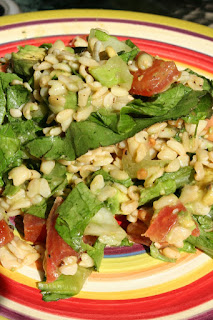
Salad of mote de trigo (husked wheat)

After another glorious salad lunch put together by K and enjoyed in the sun on la terraza, it was time for our private lessons. Conversation class in the afternoon bounced around a few topics, some grammatical - such as the subtle and tricky distinction between the prepositions por and para - as well as weightier social discussion. The social reform that Salvador Allende put into motion before the 1973 coup was entirely undone and reversed under the Pinochet regime. This has had long-lasting effects on the country, as the constitution written by the junta in 1980 is still in effect and few are willing to change it. Abortion was made (and remains) illegal, education is not free (there are no public universities), and the country's infrastructure and natural resources are all privately owned (often by foreign investors). It is a country that is simultaneously extremely rich and abjectly poor. Protests, such as the one that blocked off the street to the school today, are commonplace. Today's was about higher education reform. We later discovered that two people were killed in a similar protest in Valparaíso today.

At the end of the day, we had a very non-Chilean dinner of couscous and vegetables. In a country replete with corn/maize and rice, we eventually found couscous in the specialty section of the supermarket.

Our 'immersion' ostensibly continued at the school-organised pisco sour evening, which we attended last week. This week's cocktail concoctions involved basil (albahaca), mango, and forest fruits. Shamefully, we abandoned Spanish after a while, so as to get past superficial conversation and into deeper, more interesting areas of discussion with people. We also marvelled that even in a hostel in Chile, you can get good (and very reasonable) red wine.

Wednesday, 13 May 2015

Puta la Huevada, Huevón

Spanish immersion, day three. Having delivered all our clothes and towels to the local launderette, who seemed very relaxed about when they would be ready for collection - using the word 'mañana' repeatedly and a issuing slew of times which got later with each repetition - we had no choice than to go to class in yesterday's clothes without a shower. Disgraceful as this is, it bought us some extra time to sleep in. Despite the lie-in, focusing our attention was muy dificil this morning.

Today we covered adjectives, their agreement with the number and gender of nouns. As with many European languages - in contrast to English - the modifying adjective most often comes after the noun that it is describing, e.g. el lápiz azul (blue pen), la manzana rica (delicious apple). However, the flexibility of the language means, once again, that a reordering of the words can avoid the ambiguity inherent in English. For example, to describe someone as an "old friend", we might say compañero antiguo (stressing their age), or antiguo compañero (if you have known them for a long time). Similarly un auto nuevo is fresh out of the factory, while mi nuevo auto is new to me, but might in fact be secondhand.

Naming and describing things is all well and good, but the frustrating thing about learning a new language is being stuck having a conversation solely in the present tense for the first week or so. Until we become familiar with more advanced conjugations, this limits the complexity of what can be talked about. Until then, we say things like "yesterday I go to the shops", which causes confusion about the time frame of any activity under discussion.

In the afternoon conversation class, I asked innocently about a slang term I picked up last night. The teacher seemingly took great relish in launching into a comprehensive and academic description of the etymology of this - it turns out vulgar - term.

Much like the word 'cosa', meaning 'thing', those of limited vocabulary (or poor memory) can substitute weyá (written huevada) for unknown things and weyón (huevon) for unknown people in conversation. These two terms originally have a pejorative meaning, as they derive from huevo - literally meaning 'egg' but signifying the male anatomical parts of the same shape - and hence wouldn't be used in polite conversation. And so, this allows to construct such elegant and articulate sentences as puta la weyón weyón, weyón ("screw that stupid jerk, man"). These terms even feature in the formal dictionary of Chilean slang and has found favour all over Latin America.  It has even spawned an equivalent verb, huevear, which can be conjugated just like any other verb, and means to waste time or to party.

After this fascinating diversion into Chilean vernacular, we signed off the lesson with the rather more formal "que tengas un bueñ día" (have a nice day). This set phrase goes far beyond our knowledge of the (indicative) present tense, in that it uses the subjunctive, as there is doubt over whether the person will indeed have a nice day!

Despite two invitations to go out this evening - both to speak yet more Spanish and at least one to dance - we opted for a quiet evening for 'the hump' day of the week. This meant we could consolidate a bit of study and make a home-cooked meal. With the small amount of ingredients we have, I decided to ring the changes and assemble them in a slightly different configuration.

Hostel fare

Frying the large courgette using some cornmeal snaffled from the box of leftover food, I put them with our pasta bows in a creamy sauce with mushrooms and fresh, chewy corn. With a glass of Carmenere from the Cousiño-Macul vineyard we visited last week, it was good to have some midweek downtime before Thursday and Friday's onslaught.

Tuesday, 12 May 2015

Spanglish

Second day of class today. The topic of the group lesson was the agreement between the gender and number of nouns with their definite and indefinite articles, and with descriptive adjectives. Having learned both French and German, the theory is well known to me, but is anathema to those English people who have never studied another foreign language. Long ago, we simplified out any difficult declension, requiring us only to use one form of 'the' and 'a', and the odd 's' on the end of words to indicate more than one of anything.

Spanish still clings onto the fact that every single object (as well as less tangible things) has to be either male (el lápiz, the pencil) or female (la mesa, the table). This leads to a never-ending list of nouns that have to memorised and classified into two camps. Fortunately there are some rules governing which gender things might have. Nouns ending in 'o' are largely masculine, while those with 'a' are feminine. Of course, where there are rules, there have to be exceptions - la mano (the hand) is feminine, while el día (the day) is masculine. And, if you have managed to get your head around this, aesthetics comes to mess things up for you. While agua (water) is, as you have every right to expect from the last letter, feminine, nobody in their right mind would say "la agua", because the extended vowel sound from the combined a's is offensive to the ears of sensitive people. So, it is rendered as the gender-swapping "el agua", but don't forget that any adjectives have to agree with the real gender, resulting in the following confusing juxtaposition: "el agua fría" (cold water).

Despite the exceptions - goodness knows English has enough - the theory is simple to grasp and the lesson was a good chance to get to know a stack of vocabulary. I tend to prefer learning the structure of a language, and so spend more time absorbing the grammatical rules and patterns, while being lazy about reading word lists and using the language in practice.

Fortunately, our course includes a private conversation class each day, solely for the purpose of getting me to open my mouth and think on the spot. However, with a currently limited vocabulary, this quickly turned into a cultural lesson covering la gente indígena (indigenous people), the benefits of being united by a common language throughout Latin America, as well as the differences in pronunciation between the countries (Peruvians apparently enunciate, while Chileans gabble).

For making it through the day, we rewarded ourselves with a visit to the tucked-away vegetarian restaurant, Soju, in el centro histórico. While the location is not the best - stuck inside an arcade/gallery, like a miniature mall, of the sort that seem quite popular in Santiago - this cosy place serves up Chilean 'specialties', such as hamburguesa a la pobre ("poor man's hamburger", with a fried egg on top) and chorrillana (a heart-stopping plate of chips topped with cheese, fried onions, faux meat, and a pair of fried eggs). After the ubiquitous bread and pebre (a very fine salsa), we were served an unusual mushroom, tofu, and onion ceviche. This vegan version of the traditional dish involving raw fish cured in lemon juice was a much welcome flavour bomb.

El sandwich

To eat, I plumped for "El Chorizo", a mock meat hamburger flavoured with the eponymous sausage spices, in an enormous bun. K went for slices of 'beef gluten' (known elsewhere as seitan) with rice. Both were tasty but felt a little nutritionally deficient. This kind of food is all too easy to find in Chile, which is a shame, as the fresh produce is fantastic, including enormous and tasty tomatoes and avocadoes.

Mock beef and rice

The immersion continued as we plucked up the courage to join the weekly 'Spanglish' party at Le Pub 36½ in the trendy Providencia area of town. Just half an hour's walk brought us to an area buzzing with people, bars, and restaurants. As is commensurate with our British reticence, we hung in the doorway for a good while, wondering whether we had arrived at the correct venue. Fortunately, the host soon approached us, greeting us with the exuberantly continental 'air kiss' that seems to permeate all countries that speak a Romance language. We were immediately introduced to a group of girls from Argentina and Mexico, studying in Santiago, and keen to improve their English. Judging that their competence significantly outweighed ours, we switched between hesitant Spanish and a rather more fluid conversation in English. Part way through, a native 'Santiaguino' burst into the group, announcing himself, barely able to contain his energy. The conversation negotiated the usual territory between foreigners, through respective travel plans, slang, to cultural differences. The Mexicans maintained that the people of Chile were cold and Mexicans were more friendly and looked out for each other far more, while the born-and-raised Santiaguino thought that the problem was one endemic in large and capital cities across the world. I must say that the people we have met so far in Santiago have been muy simpático.

Monday, 11 May 2015

Terremoto

At 8:30 this morning I was taking a test. It has been quite a while since I have sat any kind of exam. The exam conditions were not strictly monitored, as this paper was intended only to determine placement for K and me in the Spanish classes that we started today.

The short paper was clearly organised to test knowledge of the language in order of increasing complexity. Starting with the basics of agreement of adjectives according to the number and gender of the noun, the test quickly progressed through conjugation of verbs in the present tense, past tenses, future and conditional. I coasted as far as I could on the similarities between Spanish and French and the little I had managed to glean from self-study before the course. However, any points I had managed to gain on the written test were quickly lost in the oral, as the examiner opened his mouth and emitted an entirely incomprehensible string of sounds. One question I did not manage to discern immediately concerned my 'status': "soltero o casado?", "single or married?". Neither of these words had I heard previously - soltero I probably should have guessed from 'solitary', but casado (from casar) invoked a memory of 'casser/cassé', French for 'break/broken'*. I faltered and mumbled a few words. It was clear where I was destined: A1, the beginner's class.

* Of course, casar comes from casa, for 'house', so it basically means 'shack up with'.

Even though these were simple questions directed at a foreign listener, it is said that Chile is one of the most difficult places to learn Spanish, as the Chilenos tend to speak fast, use slang, and drop many of the words and syllables they use in pronunciation. The 's' is the first to go, rendering even 'español' sounding more like 'epañol'. However, if you can understand a Chilean speaker, you can probably get by in any Spanish-speaking country.

Hogwarts - where the magic happens

The school is in an old stone building, which means it has character in its winding staircases and tall ceilings, but manages to keep the heat of the Santiago sun outside and the cold night air in throughout the day. The chilly classroom was warmed up with an electric heater (estufa) and brought me back to schooldays.

In other ways, the school is much more warm and welcoming than any educational institution for children that I have attended. An aphorism is emblazoned on the red wall (a colour that features heavily in the decoration), which exhorts the students to make the most of life - "if lived well, once is enough".

Spanish aphorism

Heartened by my ability to translate this phrase without any lessons, I was confident that I would be able to pick things up fairly rapidly, at least where written Spanish is concerned. However, the first class centred on the grammatical peculiarity that has been tripping up learners of the language since time immemorial: the difference between ser (to be) and estar (to be).

Unlike many other languages, Spanish distinguishes between 'I am happy' (estoy feliz) and 'I am English' (soy inglés) - the former thought to be a state more transitory than the latter. The general distinction is made - with two counterintuitive exceptions - between permanent states (es simpático / he is nice) and temporary ones (está sucio / it is dirty). The exception to permanent states is when talking about an event (la fiesta es en mi casa, the party is at my house), while the exception to temporary states is, again ironically, when describing a location (el correo está en el centro, the post office is in the town centre).

Of course, discussions on the nature of permanence can rapidly turn philosophical, and we discussed the nuances of describing transitory aspects of someone's character (happy, sad) versus more deep-seated attributes (loyal, lazy etc.). Changing the verb can radically alter the meaning of a sentence. Witness 'estoy borracho' (I am drunk) versus 'soy borracho' (I am a drunk).

Oddly there are some conditions that, despite their obvious impermanence, are treated as though they will last forever - él es joven, he is young - while others follow the pattern one would expect - ella está embarazada, she is pregnant. Perhaps this reveals something about the Spanish mindset; that youth can be maintained but that pregnancy is but a fleeting affliction. Along similar lines, contention in the class arose regarding romantic matters. 'Officially' (on documents and such) one is permanently married (soy casado) but sentimentally it is treated as a temporary arrangement (estoy casado con..., I am married to...). More cut-and-dried was the apparent ambiguity about the head of the Catholic church and a popular starchy vegetable*.

El Papa ≠ la papa (from Gianni)

* Spain obviates this confusion by using patata for potato.

A welcome lunch was held for the new students at which we received orientation and a pedagogical vision from the academic coordinator, while munching on freshly baked empanadas.

Empanadas al horno

There followed in the afternoon a tour of Santiago. We had previously taken a tour organised outside of class and, having been here a week, were familiar with many of the areas of the city. Nevertheless, this tour was led in Spanish, in keeping with the objectives of 'immersion'. Technically, I should be writing this in Spanish, but it would be shorter, more boring, and full of more fundamental errors of language than it already is. K and I have sporadically been trying to maintain conversation between ourselves in Spanish, but that too rapidly descends into frantic gestures and an inability to complete even the most trivial task. We revert to English for the sake of our marriage.

Unusual art on the streets of Santiago

Unlike our previous tour, which ended with our guide abandoning us in an area of town, with which we were not familiar - save for the map he had just produced - today's tour terminated at the bar. Café 202, to be precise, which has four taps of 'cerveza artesenal' from local microcervezería, Kross. I selected the Kross 5, which revealed itself to be a rather tasty Belgian number. I'm not sure what the 5 stands for - certainly not the abv, as the ale weighs in at a hefty 7.2%.

Cerveza Kross

As part of the 'cultural activities' organised by the school, tonight saw the introduction of the attendant foreigners to the Chilean specialty, terremoto. Named after the earthquake that apparently occurs after drinking too many, this cocktail is an odd blend of piñon (a type of cheap white wine akin to retsina that comes in gallon drums), Fernet, and grenadine, and is topped off with helado de piña (pineapple ice cream). It tastes exactly like a boiled sweet and slips down far too easily. It lubricated a few halting conversations with the other language students, many of whom have a disgracefully unfair advantage of already speaking Portuguese (being from Brazil) and therefore grasping Spanish at a hugely accelerated rate with respect to the other novices present.


Expending our limited vocabulary brought the evening to an end, rather than the (apparently limitless) availability of jugs of terremoto. Having not eaten anything other than an empanada, we cooked up a simple pasta dish with courgette, mushroom, and tomato back at the hostel.

Sunday, 10 May 2015

El Plan y Los Cerros

Valparaíso (or 'Valpo') has two parts: 'el plan', the flat part of town that extends out into the sea by way of reclaimed land, and 'los cerros', the steep hills up which the multicoloured houses climb higgledy-piggledy.

After a huge breakfast of bread (pan), egg (huevo), avocado (palta), fresh cheese (queso fresco), tomato, fruits, and yoghurt, we hauled our full bellies up the hill to join Avenida de Alemania.

View from Av. de Alemania

This flat road skirts along a cutting in the hills and offers a wonderful view down to the port, the sparkling sea, and out to neighbouring Viña del Mar.

Naruda

We passed the house (now museum) in which Pablo Naruda entertained guests to the rather more ill-defined 'museo del ciel abierto' (museum of the open sky) - a selection of outside colourful murals on the sloping streets of Av. Héctor Calvo.

Art nouveau garage door

Up here, where the dogs fear to climb, is where the cats hang out.

Valpo cat

Descending from the hill, we found ourselves back among the sailors and fishermen of el plan, who our guide yesterday told us speak an incomprehensible combination of fast Chilean Spanish and port slang. We queued and took a 'colectivo' boat ride along the harbour front, slipping out between the container ships and frigates to get a panoramic view of the hills.

Valparaíso from the sea

The small boat was crammed to capacity (42) and the boat operator maintained an impassioned patter for the entire journey, of which I understood approximately 0.01%, but which got a few laughs from the Spanish-speaking crowd.

Cobra pose... begin

In the afternoon, we took the bus back to Santiago for the princely sum of 4000 Chilean pesos. Arriving a couple of hours later, we found everything shuttered - restaurants, cafés and shops. Sunday closing must be strictly observed here, but we wondered how anyone managed to take their mothers out for dinner on this, el día de la madre.

La Starria area came once again to our aid, as all the businesses there were not only open but doing a roaring trade, and a number of street performers and artesans were hawking their wares. Choices were limited for vegetarians at El Biógrafo, but we managed to tease a pizza and salad out of the kitchen to accompany a couple of decent beers from local 'microcervezería', Kross - a Maibock and Lupulus (an ESB).

Lúpulo: Spanish for hops

Saturday, 9 May 2015

Valparaíso

West of Santiago, at the end of the autopista del pacífico, is the coastal port town of Valparaíso. This was an important town in the second half of the 19th century, as it was a convenient stopping point for many ships making their way around Cape Horn and north to California in order to profit from the gold rush there. 1848 until 1914 was the golden age for the port, in which it expanded rapidly, both into the hills, as people settled there, and into the sea, as land was reclaimed to allow bigger ships to dock in the deeper water. However, this era was abruptly brought to an end as the Panama canal was built, allowing passage from Atlantic to Pacific without navigating the treacherous cape.

Valparaíso's cerros
Nowadays, Valparaíso is a thriving container port, yet is deriving more and more revenue from tourism. Its rapid expansion and unusually hilly terrain led to a higgledy-piggledy assortment of buildings atop the many 'cerros' (hills).

The Ship

Each building is unique as it was built on whichever piece of land was available. This resulted in thin slices of building such as the above ship-shaped house. The mismatching colours were a product of using leftover paint from ships. Similarly, the delicate adobe walls of the houses are protected with corrugated iron, since this was used by ships as ballast and packaging and was repurposed as a building material.

Yellow house

Graffiti is technically illegal in Valparaíso, but is still prominent in two forms: tags and murals. Would-be artists approach the owners of buildings with freshly painted outsides in order to fill the space with their work. The alternative is that the wall would be almost immediately filled with an assortment of unsightly tags. The far more aesthetically pleasing murals are allowed to remain. The more prestigious the artist, the less likely the mural is to be defaced.

Illegal art

Valparaíso presents a challenge in terms of protecting its heritage. Two of the principal hills - Cerro Concepción and Cerro Alegre - as well as the town centre are protected by UNESCO. This order was motivated by the contentious  extension of an historic building with a modern glass tower. Ironically, the composite building, including its newer parts, is now protected under the order and cannot be changed.

The offending building

The downside of the protection order is that buildings that have been destroyed beyond repair (such as by fire) are prohibitively expensive for their owners to rebuild according to their original plans and now lie in ruin.

Valparaíso's main square

We learned all of the above and more from a very enthusiastic and informative guide on a Tours4Tips tour of the city.

Where's Wall... I mean Ignacio?

He took us away from the shady port area up to the top of Cerro Alegre via an ascensor. These funiculars are the original mode of transport used by residents and now shared by tourists. La Pedal can be ridden to Cerro Alegre for 100CLP and was built in 1902. However, the oldest of the ascensores is on Concepción and was opened in 1883. These were privatised for a while, during which time the price rose beyond the affordability of the residents, but have now been renationalised.

A mural by Charquipunk

The hills serve as residences but also as local businesses. We were stopped outside just one of these by our guide, who rang the bell and implored us to shout out "Buenos días, Don Sergio" in unison, as the door opened. We were greeted by a smiling Don Sergio carrying a basket of foil-wrapped alfajores caseros - a decadent confection of dulce de leche sandwiched between two biscuits and coated in chocolate.

Aside from the houses, many of which have been converted into cafés and restaurants to serve the arriving tourists, there are oddities such as the Palacio Baburizza.

Italian house

This house was constructed in the art deco/nouveau style by Italian architects under the direction of an Italian immigrant, Ottorino Zanelli, for his family. Sadly, he never managed to live in the house as he died in the same year as its completion (1914). The house is named after its second owner, Pascual Baburizza.

Lutheran church

Other oddities are not so much odd because of their architecture but because of their very existence. A 'secret', largely unobtrusive Anglican church was constructed on Cerro Concepción at a time (1858) when freedom of worship was not allowed - the Catholic faith being enshrined in the constitution until 1865. While the latter year saw official recognition of the practice of other faiths, the dominance of Catholicism was (and is) very much apparent. Undeterred, the German immigrant community built a prominent Lutheran church, surmounted by a cross, in 1897. The Catholics countered with a church twice as large at the very top of the hill.

Valparaíso port

Coming back down to sea level, we finished up on what used to be the richest street in the town, and is now ironically the start of the poorest neighbourhood. Here, in a magnificent town house that had seen far better days, we were served a parting drink of chichón. Chicha is an alcoholic drink made by fermenting corn, which when mixed with a white wine known as piñón becomes chichón.

To digest all the cultural and historical information we had received, we repaired to Altamira - the first brewpub in Valparaíso. Commensurate with the area's reliance on immigrant labour and ingenuity for its success, this brewery was set up only steps away from where an Irishman, Andrew (Andrés) Blest founded the first brewery in 1825.

We sampled a range of typical styles of beers from across the world - from English bitter, through American pale ale, to Belgian quad - while eating a mixture of olives, refried beans, aubergine and curried lentils, while listening to a mixture of James Brown and Depeche Mode. It was a real cultural mezcla.

Friday, 8 May 2015

The Years B.C. (Before Columbus)

Having learned something of Chile's recent past, we attempted to delve into its history before European discovery and settlement with a visit to the Museum of Pre-Colombian Art (museo de arte precolombino).

Bodily adornment

The museum is replete with astonishingly well preserved and presented artefacts of functional, decorative, religious, and musical purposes. Their origins come from the earliest known settlements in the areas now known as Central and South America, through the rule of the powerful Incas and Mayans, up until the ancestors of the modern Quecha and Mapuche people.

Funerary stirrup spout

Coca leaves were very important to many races in the Andean region. Coqueros (cultivators of coca) were often depicted with a lump in one cheek, formed by chewing the leaves into a ball. The lump is present even in death masks and in figures of high social status, who are recognisable from their seated position. In fact, there is an Andean tradition of sitting and authority, which even extends to the Incan gods, who had to remain motionless, lest they stand up and destroy the universe.

"Can't stand up. World will end. Can't stand up..."

The Mapuche, who were slaughtered, subjugated and dispossessed of their land by the colonising Spanish, took readily to the horses introduced by the conquistadores. Caballos were integrated with great fervour into Mapuche culture, becoming a symbol of status and prestige, and used in trade and war (often in laying siege to Spanish settlements). Horsemeat was often eaten in preference to beef and at a funeral, the deceased's best steed would be slaughtered for the feast and the remains interred with its owner. Charqui (horsemeat jerky) is still found in today's cuisine.

Figures from Rapa Nui (Easter Island)

Fortunately there was no horsemeat for us today, but there was plenty of other meat at the school-organised evening asado (barbecue). Taking place on the school roof terrace, this gave us the chance to meet some of the other students at the school before starting lessons proper next week. Mercifully, the cohort included several English-speaking people who, after a week of intensive all-Spanish lessons, were gasping to speak in anything other than the language they were learning. We noshed on grilled peppers stuffed with cheese, salad, rice and salsa, while learning what lay in store for us next week.