Thursday, 21 May 2015

The Glorious Navy

Today is a national holiday in Chile in honour of the nation's navy, or more specifically the naval glories, as it is known as El Día de las Glorias Navales.

However, the day chosen, 21st May, commemorates a less-than-glorious event - the Battle of Iquique - on the same day in 1879, in which a Chilean ship blockading the Peruvian port was destroyed.

This battle was among the first of the initial naval campaign in the 4-year-long War of the Pacific between Chile, Bolivia, and Peru.

This battle, and the war of which it was a part, was ostensibly caused by a controversial 10 cents tax hike imposed by Bolivia on Chilean mining operations in territory mutually agreed to belong to Bolivia, but from which it would receive tax revenue. In reality, there were already simmering border disputes around the nitrate-rich Atacama area - nitrate was used both as fertiliser and in explosives - and the treaty-busting tax increase catalysed all-out war.

Peru entered the fray as it was allied with Bolivia through a previously undisclosed treaty and refused to declared its neutrality. This led to Chile occupying the Bolivian mining town of Antofagasta and blockading the  Peruvian port of Iquique to prevent them gaining command of the sea. Despite the losses on 21st May, Chile's subsequent land assault was eventually successful and boundaries between the three countries were redrawn in a peace treaty, allowing dominant Chile to annex both of the above-named towns, leaving Bolivia landlocked - a subject which is sore until this day and which is currently being taken to the World Court by president Morales to once again give Bolivia access to the sea.

In Santiago, all of these skirmishes seemed an age away - the Bolivian corridor to the sea across Chilean land is rarely mentioned. The day was cloudy and rather cooler than of late, but still warmer than most British summer days with a high of 20°C. Still, the local Chileans were duffled up even if they were running or cycling up St Cristóbal hill - the mount that overshadows much of the centre of town.

We joined the well wrapped-up folk on their day off for a jaunt up to the summit. Although rising to 880m above sea level, the climb is only a few hundred metres up a dirt path to the peak. Still, there is a funicular for those not inclined or unable to make the ascent.

View from the top of San Cristóbal

The hill was for a while privately owned, during which time the rock was quarried for construction in Santiago. The highest point is now surmounted by a large statue of the Virgin Mary and an amphitheatre for outdoor ceremonies.

Gran Torre - the tallest building in Latin America

Having 'summited' the small cerro, we attempted a different route down that would lead us to the east side of town, away from the access point in Bellavista. A few unsuccessful attempts led us down steep dirt tracks, which were gleefully being used by local downhill mountain bikers. Eventually we discovered the less trodden Sendero de las Grandes Travesías, which brought us out into the affluent and residential area around the autumnal tree-lined Av. Pedro de Valdivia.

Autumnal avenue

A few streets from here, we found El Huerto - an upscale vegetarian restaurant (commensurate with its surroundings), which was not only open on the public holiday but doing a roaring trade. The waiters and waitresses were run off their feet attending to the flood of customers demanding all-vegetarian dining. I was flabbergasted that this kind of venture could not only survive, but thrive in meat-obsessed Chile.

Middle-class vegetarianism

K and I both plumped for the 'Anatolia' menu of the day, which included a Turkish potato soup, spinach pancake, babaganoush, hummus, olives and roasted carrots, followed by baked pear and a cinnamon-spiced compôte. The food was well presented and reasonably tasty, but slightly overpriced owing to the location.

Wednesday, 20 May 2015

La Prueba

The end of our 2-week Spanish course is in sight. A test (una prueba) usually accompanies the graduation from the course, traditionally taken on the last Thursday. However, since tomorrow is a national holiday (feriado), the test fell today.

The morning started dark, with an unusually overcast sky and light drizzle. I have made it a habit to walk to school wearing a T-shirt, drawing askance looks from the Chilean passers-by, who are muffled up for winter. The temperature at this time of the morning is usually healthily in the teens, but even I donned a jumper in this morning's chill. The streets were also relatively empty, presumably as the exodus for the holiday weekend begins. Thursday is the only official day off, but many will make a four-day weekend and flee the city.

The test proved much more difficult than I had imagined. Instead of testing solely the knowledge we had gained in class, which has largely focused on use of the present tense, the article offered for comprehension and subsequent questioning included constructs unfamiliar from the teaching material.

The subject of the afternoon conversation class was sparked by a newspaper article on how the majority of genes of the average Chilean come from Europeans - versus indigenous Latin American people or from Africa. While the 'discovery' by Chilean geneticists was incidental to their search for a cure to certain diseases suffered by Chileans, my teacher considered the tone of the article (or at least the motivation behind its particular spin) to be symptomatic of deeply entrenched racism in the country. She's radical like that.

I had to agree, even with my shaky grasp of the article's contents, that the subtext behind the headline was, at best, suspect and, at its ugliest, a celebration of the Chilean people's ethnic purity and an attempt to distance the 'average' Chileno from indigenous Americans with associations of poverty and poor education, and, by extension, to align themselves with affluent, developed, white-skinned Europe. It was a nasty window into a world that seemed all too familiar to me from reading the British press and listening to received opinions on immigrants, their doubtful qualities and their apparently deleterious effect on British society.

The subsequent text presented for comprehension revealed a similar set of erroneous beliefs about immigrants and exploded the myths one by one. Immigrants to Chile are predominantly Peruvian, are better educated than many Chileans, and do not seek to burden the public infrastructure, paying for their use of the education and health systems as any other. However, stereotypes and prejudices cause specious logic to take root in the public consciousness. Immigrants from neighbouring countries with a higher percentage of indigenous people and questions over an individual's racial composition co-mingle in a way that leaves a bitter taste in the mouth.

The teacher was surprised to learn of similar, if not identical, concerns from a certain camp in Britain (naming no Ukip voters). She wondered how such negative stereotypes of immigration could persist after decades and centuries of cultural mixing on the island. I conjectured that it was an attitude born of fear of change and difference, in which each new generation of Britons (themselves descended from immigrants) may fear and resent the effect that the newly arriving immigrants will have on their established society.

Inside-out rolls

As if to underline the cross-cultural influences, the area around the school abounds with sushi restaurants. I'm not entirely sure how the archetypal Japanese dish arrived in Chile, as there does not appear to be a large Asian community. I suspect its popularity came by way of California, as the offering is almost exclusively the filled and sliced rolls that have sparked a slew of variations in North America.

A little digging revealed a local enterprise serving up an inventive vegetarian and vegan take on the California rolls. WunjoSushi does not have shop premises - the owner makes and sells the sushi directly from their apartment. Having placed an order (pedido), I arranged to pick it up in the evening. Finding the flat was simple enough, but being buzzed in to exchange cash for sushi felt more like making a shadier exchange and I left wondering whether I would be picked up by the Carabineros to investigate the contents of my bag.

The mixed box contained three varieties of 'inside out' rolls, with the nori on the inside, leaving the outside ready for a variety of treatments. We had palta, tomate envuelta en almendras (avocado and tomato rolled in almonds), sevillana, zanahoria, queso en sésamo mixto (pepper, carrot, cheese in mixed sesame), and champiñón, palmito, queso en ciboulette (mushroom, palm hearts, cheese in chives). Each was delicious and reminded us of how much we miss Asian food.

Tuesday, 19 May 2015

The Sky is Blue, Your Argument is Illogical

There was more thinking about language today as Spanish school continued. Classroom and book learning, in contrast to real-life practice, necessarily leads to absorbing a lot of meta-language - i.e. those words and phrases that are necessary to talk about learning the language. So, among the simple first sentences that we learn ("I want to buy a cake"), we are soon able to talk about the parts and structure of the language, knowing that the ostensibly simple sentence contains a subject and object, a personal pronoun, an indefinite article, and a noun, as well as a periphrasis comprising two verbs, one conjugated into the first person singular form of the indicative present tense and the other in the infinitive.

Given that language teachers have a background in linguistics and, presumably, a love of language, it is easy for them to forget what an additional burden learning these concepts and the Spanish nomenclature (verbo conjugado, etc.) is for the beginner.

Fortunately I share their fascination with grammar and, armed with knowledge of a couple of other foreign languages, many of the concepts are familiar to me. However, others in the class are rightly baffled when asked to conjugate an irregular reflexive verb into the third person plural.

The theme of language as a determining factor in how one interprets the world, constructs a mental model of it, and ultimately interacts with it, continued in the afternoon. My teacher introduced the subject by way of an article claiming that the constructs of the language one uses can have an effect on one's behaviour, such as the propensity to save versus spend money - apparently those people whose mother tongue does not so easily allow them to express desires about the future, tend to hold on to their money. Similarly, simple, regular words for numbers allow for better mental arithmetic, while bad language (garabatos) has been shown to cause a stress response in people, while euphemisms do not.

In Spanish, a clear distinction is drawn between two shades of blue - the light blue of the sky (celeste) and a darker, deeper blue (azul). Both these terms are in common use and, while English has many specific terms for shades of blue - indigo, violet, turquoise, cyan - we tend not to use them in everyday speech. The article claimed that labelling the spectrum of colours in one's mind and speech enriches the direct experience as well as communication with others.

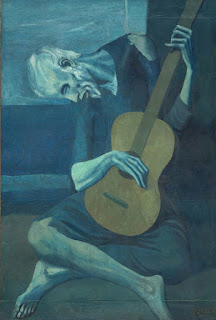
This interaction between world and beholder of the world, in which one's perceptions are filtered through a net of one's memories and experiences, and coloured by the palette of language we have at our disposal with which to express ourselves, reminded me of the Wallace Steven's poem that K is often telling me about. She says that the Blue Guitar is a metaphor for how reality and imagination are inextricably intertwined, the one changing the other in such a way that no one person can ever objectively perceive reality.

Things as they are

Away from such highfalutin concepts as the nature of reality, the Chileans have a charming use of language that seems to defy nutritional logic. A hot dog is locally known as a completo. This is - I am told - because it represents a 'complete' meal, containing, as it does, meat (the dog), bread, and vegetables - tomatoes and chucrut (sauerkraut), or tomatoes, avocado and mayonnaise if you indulge in an 'Italiano'.

I read the free metro newspaper to see how my perception of UK news would be changed when viewed through the veil of Spanish language and reporting.

El periódico

A short article reported on the recent general election result (a surprise Conservative majority) but seemed most concerned that Cameron's government had increased the percentages of women, homosexuals and ethnic minorities. In fact, the statistics show that it will be the 'gayest' government in the whole world. The Queen's opening of Parliament next Wednesday was mentioned, in which the head of state was referred to as Isabel II, which I though was rather sweet. I wondered whether this was a reference to the historical Spanish monarch.

Some naughty beers were had at Café 202 after school, and then on to Bellavista for some food at recommended Restoran Galindo. This turned up a surprise in the form of their own cerveza artesenal among a long list of good brews.

Porotos granados

A Galindo stout went down rather nicely with a bowl of traditional porotos granados - a stew/soup of white beans, corn, pumpkin and basil.

Monday, 18 May 2015

Replica

Spanish week 2 began today. We were granted a brief reprieve, and a lie-in, as lessons didn't start until 10am - after the new cohort had taken their placement test.

With some new joiners in the class - while others had left - I feared that we would end up repeating last week's curriculum and exercises. Fortunately, this was not the case. While last week focused principally on nouns and adjectives, this week was all about the verb.

For such a progressive school, the lesson today bore all the hallmarks of the traditional image of a Latin teacher's drilling verb conjugation, especially given the similarity of Spanish to the dead tongue. At one point we found ourselves reciting the conjugation familiar to many a schoolboy - amo, amas, ama, amamos, amáis*, aman.**

* vosotros form (informal second person plural) not actually used in Chilean Spanish.

** Observe the following Latin conjugation for the similarities to Spanish: amo, amas, amat, amamus, amatis, amant.

The afternoon's conversation class largely revolved around the differences we could expect to find when travelling north to Bolivia and Peru. Chile - especially Santiago - has seemed very familiar and, without being told, we could easily think we were in a Spanish city in Europe. Farther north, we are told, there is a higher concentration of indigenous people and we can expect a much different landscape. Our teacher believes, rightly in some cases, that many Europeans see Latin America as a homogenous culture, a hot-blooded vida loca full of fiestas, tango and salsa dancing. Chile is actually much more understatedly European than its neighbours. While I have heard 'latin' music being played, I haven't seen a single person dancing.

Being Monday, tonight was welcome drinks for the new joiners. This meant terremoto - the odd Chilean pineapple ice cream cocktail named 'earthquake'. Apparently the second round of terremoto is called the replica - 'aftershock'. With replicas in hand, we tried to imagine that our Spanish was any better than a week ago.

Sunday, 17 May 2015

Cordillera de la Costa

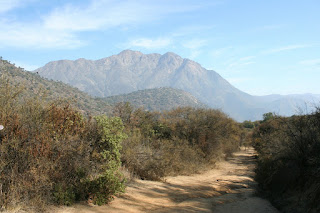
Just an hour or so northwest of Santiago, close to Valparaíso, lies the cordillera de la costa - a tiny mountain range in comparison to the vast, overshadowing silhouette of the Andes to the east. However, in contrast to the arid, snow-capped peaks of the Andes, the Parque Nacional La Campana is a (relatively) lush microclimate, replete with the distinctive Chilean wine palm.

Chilean wine palm

These palms, which at one point were almost rendered extinct, have been reintroduced and flourish in the natural oasis of the national park.

Leg or (tree ) trunk

Their distinctive trunk, grey and with the leathery look and shape of an elephant's leg, dot the hills and valleys of the park, which is overlooked by the eponymous La Campana (climbed by none other than Charles Darwin).

La Campana

Humidity from the sea gets trapped here, allowing the palms, cacti and many other kinds of trees only seen in the south to flourish. The particular microclimate created here brings some of the verdant south to this arid area of Chile. There are no rivers and streams here - the only moisture being brought in from the sea - and yet there is a waterfall.

Microclimate

With a small organised group from the school, led by the indomitable Jacqui, we took an 18km hike across the park, climbing briefly to enjoy the stunning view of the waterfall emerging from the cactus-strewn rocks. The views on our return leg were particular impressive, as an afternoon mist had veiled the distant hills.

Cactus country

Tired, we drove towards home, stopping briefly to recharge our batteries with an enormous and fresh empanada de queso al horno.

Saturday, 16 May 2015

Vamos, Caballitos!

Having spent a largely sedentary week trying to get our Spanish up to scratch, we were pleased to get out of Santiago today and head for the hills. In such a narrow country, with hills and mountain ranges running along both sides, we didn't have far to travel. Forty-five minutes' drive east of Santiago, in the direction of the ski resorts, we were in the Chilean Andes. Having whetted our appetite for horse riding in New Zealand with a small trek, we decided today to attack a much longer and more technically challenging route through the cordillera.

Saddling up

Close to a tiny hamlet called La Ermita, we pulled off onto a dirt track. Here, a leathery-faced man had rounded up several of his caballos (horses) that seem to live freely in the mountains. Already saddled, our driver and guide loaded the mule with lunch, including the ubiquitous and most important feature: a pair of bottles of wine.

Wine mule

The reins were Chilean style - meaning both were held in the right hand, while the left was free to use the attached riding crop. "Are you scary?", asked our guide. I presume by this that he meant 'are you easily scared?' "You must not scream," he said, "it will scare the horses". What would give us cause to scream, I wondered.

We began our journey simply enough, heading out of the hacienda and along a wide dirt path.

No hay baños

We followed the Río Mapocho along a relatively flat path through the trees and vegetation that flourish near the water. Having broken out of the cover, we discovered we were riding directly into the rising sun, which even at this early hour was intense. After a little while, our guide pointed up the dry, rocky slope of the mountain and announced, "Now we will climb this". We laughed, not seeing any obvious path. However, he was serious and his horse confidently scaled the mountain, while ours followed behind. The 'route', such as it was, ascended a sheer slope, covered in loose rubble and dirt. The horses' hooves dug in to the earth and danced nimbly along the narrowest of paths hewn into the side of the mountain. One false step by our mounts would have spelled a rather nasty tumble of both horse and rider back into the valley below. Our journey was accompanied by the sound of sliding hooves and the splintering noise of rock on rock.

The 'path'

Part way up the hill, our guide was concerned that the convoy wasn't tight enough. The horses have to follow nose to tail, so that they take exactly the same path. Wandering off could spell disaster. "It is very important to manage your horse…" he commanded. However, I had spared the crop on my horse, feeling sorry that it had to lug my weight uphill at all, let alone at any great speed. The result was that a large gap had opened up between me and the rider in front. Our guide switched places with the horse wrangler and drove us all from the rear, yelling "Vamos, vamos, caballitos! Yee-haw!"

By the top of the hill, the horses were panting and their fur was matted with sweat, despite a break part way up.

Well-earned rest
They rested as we took an extended Chilean lunch at the side of one of the tributaries to Río Mapocho. Lunch was a typical asado chileno (barbecue) with plenty of carne for the meat-eaters, and some grilled vegetables with bread, rice and corn, and (naturally) avocados for the vegetarians, as well as potatoes baked directly on the hot coals. Good Chilean Carmenere flowed generously, which is a well-received staple of every meal here.

Upstream of the tributary, a little waterfall spilled out into a pool of cooling water, which I can imagine is bliss in the oppressive summer heat.

Return leg

Our route back took us via the Ruta del Cóndor, but we had already seen three of the birds circling high in the sky on the way out. The view gave onto the neighbouring peaks, which are home to the ski resorts of Farellones and El Colorado.

Misty mountains

Slipping and sliding our way back, taking shortcuts across the sinuous path favoured by mountain bikers, we eventually came upon some real cowboys, wrangling the cattle from horseback with much yelling and screaming.

Dusty and tired, we arrived back at the 'ranch'. The horses relieved themselves furiously onto the, until then, dry ground and took a well-deserved break. We were taken home by mechanical horse and collapsed into bed.

Friday, 15 May 2015

¿Cuánto?

At the end of the first week of intensive Spanish lessons, we have only just got round to learning how to count. This is by no means a criticism of the teaching, as numbers can easily be self-taught but, judging from the competency around the table, few had bothered. That includes me. This is because it is boring. I was able to count, roughly, up to around 20, but much higher resulted in errors and guesswork.

However, numbers are important. We already failed to attend a lesson on time earlier this week, as I had misunderstood the times. Prices on the market are similarly tricky, especially once I learned that among the 'exceptions', there is a special word for the often used 'five hundred'. While I had been listening out for 'cinco cientos', in fact the stallholders had been holding out their hands for 'quinientos'.

Being the end of the week, the teachers planned a learning game. The game, "What am I?" (¿Qué soy yo?), is the familiar process of selecting a card bearing an object and attempting to divine its identity solely by asking questions of the other players. This required us to remember and correctly decline nouns and adjectives, as well as differentiate between ser and estar. Amongst cards depicting animals, items of clothing, and furniture, I was landed with describing a rainbow (arco iris) - something with which I would struggle even in English.

In the afternoon's class, we tried to jump start the conversation with an article from the newspaper. The teacher chose one of the free 'metro' papers, principally because it contains short articles on (hopefully) simple topics.

Skipping over the pages of articles on football and the approaching Copa América, much to my teacher's dismay, I selected an article on recycling. This turned out to be a poor choice, as the journalist had chosen to write it in a specifically emotive idiom, which avoided the use of verbs in favour of sentences solely comprising lists of nouns and adjectives. Demonstrating her quick-thinking and great adeptness for teaching even awkward buggers like me, my teacher suggested we try to find the missing subject and verb in order to reformulate the sentence to be grammatically correct. This became tiresome after the first paragraph, so she (equally astutely) proposed that we give it up as a bad job. We ended up discussing an article on Gaspar Noe's film, 'Love', which courted controversy at Cannes and talked generally about explicit and award-winning cinema at the French film festival.

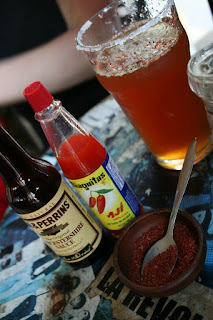
K and I repaired to the excellent Café 202 for some end of the week cervezas artesenales. K opted for a 'Michelado', which is any light beer served in a salt-rimmed glass with the addition of lemon juice, black pepper, Tabasco sauce, and merquén (a smoked, ground chilli pepper).

Spicing up the beer

Similarly indulgently, we proceeded to vegetarian restaurant, Sujo. In recognition, the waiter gave us a friendly smile and indulged our poor Spanish. K went with the heavy but delicious dish of pastel de choclo, while I indulged the Chilean penchant for bread and had another enormous sandwich, this time filled with a pseudo-fish slice of nori-wrapped tofu.