Monday, 6 July 2015

Incan Ingenuity

Today we got out of Cusco itself to visit the nearby examples of Inca ingenuity at Moray and Maras. The former is a supposed agricultural lab used to propagate seeds throughout the empire, but now defunct, whole the latter is a salt mine, still in current use. Both are remarkable specimens of land engineering.

Cusco countryside

From central Cusco, we took a colectivo bus towards the town of Maras, driving into the beautiful and magnificent landscapes of Peru's countryside. From there, we shared a taxi to the two sites with some girls from Argentina.

Moray - Inca lab

Moray is a series of concentric circles set in three natural depressions using stone walls to reinforce the geometry. From above it is a remarkable sight, but climbing down the stone steps, the temperature rises noticeably. The gradation in temperature apparently  allowed the Incas to grow plants that normally thrive at different altitudes.

Landscaping

The salineras de Maras (salt mines) are equally impressive when approached from the winding route descending into the valley. People from the village continue the work that the Incas started by cleverly harnessing the environment.

A whole lot of salt

A large number of 'baths' fashioned in the hillside are fed with streams of salty water from the mountain running between them. Once the sun has evaporate much of the water, men and women sieve out the salty crystals left behind. The approach to the salineras is lined with stalls selling salty products, including snacks, chocolate, bath salts, and of course cooking salt.


Working the salt

The nature of the colectivo is that it leaves when it is full. This means there is no schedule, reliable or otherwise. We waited at the side of the road for a return trip, but took the first vehicle heading towards Cusco. This turned out to be the local bus from Urubamba, which was less than half the price of the colectivo, but made many more stops and had standing room only for much of the journey.

Descending from the craggy snowcapped mountains back into Cusco, we stopped again at Green Point for a late lunch/early dinner. After not much deliberation, we selected the oxymoronic vegan grill for two to share, which turned out to be a blow-out meal.

Vegan is healthy, right?

The sizzling platter included vegan chorizo and pork, aubergine, courgette, tomatoes, potatoes, bananas, oyster mushrooms, and was served with rice, giant white corn and a potent garlic sauce. After the virtuous 'green juice' of pineapple, apple, and spinach, that we knocked back, this was probably the least healthy but most delicious item on the menu.

Sunday, 5 July 2015

Pachacútec

There was a great deal of pomp and ceremony going on this morning in the main square of Cusco, Plaza de Armas. The army and an entire marching band had turned out, as far as we could make out, to hand out gongs to a few dignitaries.

Pomp

Ceremony

The ceremonies made a diverting distraction on our way to the far end of Avenida El Sol, where we found a monument, erected in the 1990s, to influential Inca, Pachacútec. The monument is situated at the top of a tower in the middle of a busy roundabout - presumably the only location which wasn't already occupied by Inca ruins or modern infrastructure.

Pachacútec

Ascending the inside of the tower, each floor told us a little more about the 9th Inca (king), who was a great leader and visionary, and apparently lived until the age of 125. His fight against the expansionist Chankas was apparently a decisive battle and one in which women were said to have played a significant role; however, Pachacutec liked to tell the story of stone warriors that came to life and helped in the fray.

An old soul on an old sol

Having learned a little about the figure that made Cusco such a critical city of the Inca empire, we settled into Green Point 2, the second of the vegan establishments, on Plaza San Francisco. This restaurant is newer than its sibling on Carmen Bajo and benefits from a open courtyard with a distinctly Parisian feel (which may well have been due to the French music playing). We again opted for the set menu of the day, representing astonishing value for money at 10 soles for a four-course meal with a drink. Loading up on fresh salad, we then had a sopa de trigo (wheat) full of vegetables. While I followed with a 'pastel' of sweet potato, lentils, and tomatoes finished with basil leaves, K had a stew of quinoa with 'beet balls'. Quinoa juice washed it all down very nicely.

Sweet potato stack

We attempted a visit to Quorikancha in the afternoon - the 'navel' of the Inca universe and brainchild of the aforementioned Pachqcutec. This magnificent Inca construction was all but obliterated by the conquesting Spanish, who built a church on top of it. The current site was today further obscured by large groups of tourists, so we decided to return on a quieter day and satisfied ourselves with a visit to the small on-site museum. This gave a potted guide to Inca philosophy and sun worship, as well as some fascinating skulls displaying evidence of trepanning and cranial deformation.


"Hold still, this won't hurt a bit"

The latter, with their appearance of oval and bilobular alien heads, perhaps give credence to the theory of ET visitation on the pre-hispanic culture.

Saturday, 4 July 2015

Syncretism

An unseasonable amount of rain fell all throughout the night and persisted through the morning. Given this and the cloud cover, the weather failed to warm up as it had done yesterday. We sheltered inside until the rain abated and, eventually, a lack of provisions forced us outside.

In town, we took a chance on a place offering a vegetarian menu from its upstairs window. The restaurant, Aguaymanto, was accessed via one of the many courtyards covered in artisanal goods. The name of the restaurant translates as physalis or, as I have seen it described, "Sacred Valley gooseberry".

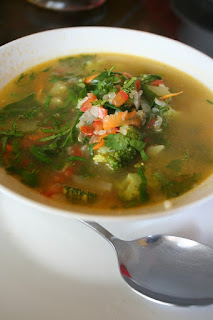
Healthy start

The menu started with a broccoli soup that hid a hint of ginger, and hinted at the Asian fusion flavours favoured by the kitchen. Fittingly, K's main course was arroz chaufa (Chinese fried rice), while my falafel burger fell into neither Peruvian nor Chinese camps, but was tasty nonetheless.

Undone by greed

After lunch, we took a chance on a couple of museums reported by many to be slightly disappointing, but whose entrance was covered by our boleto turístico.

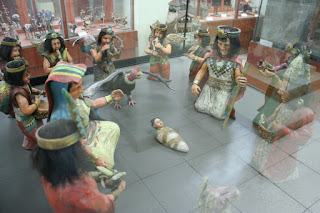
The museum of popular art turned out to be a trove of colourful figures and fascinating sculptures, many of which displayed characteristics of syncretism - the mix of Andean traditions with imported Catholic iconography.

Sculptured scenes

With the arrival of the Spanish, Inca festivities such as Inti Raymi were replaced with Catholic celebrations - a procession of saints' effigies at Corpus Christi took the place of an annual parade of ancestral mummies. Even ancient traditions took on Christian elements, such as the Q'oyllur Riti pilgrimage to the sacred mountains, thought to be gods or divine spirits (apus), but which in the 18th century gained new symbolism. A boy appeared to a poor shepherd, bringing bread each day and wearing rags of material similar to that used to dress images of saints in the nearby monetary. However, when the bishop visited to discover the identity of the boy, he disappeared, leaving a cross and an image of Christ on a rock. The pilgrimage of the "Lord of the Star Snow" mixes pre-Inca beliefs with such modern miracles.

Q'oyllur Riti pilgrimage

Even such iconic images as the Nativity (nacimiento) have an Incan slant, with Andean musicians serenading the baby Jesus with panpipes, surrounded by llamas and condors, while the Kings bring offerings of corn. Corn also makes an appearance in images of the Last Supper (última cena), where accompanies cuy (guinea pig) on the apostles' plates.

A very native Natuvity

After the popular art, the museum of contemporary art was a bit of a disappointment, with only a couple of rooms of stone sculptures, such as the iconic otorongo (jaguar) wrestling an amaru (serpent) while a condor claws at its back. These three animals are considered 'magical' in the Andean cosmovision.

After this cultural nourishment, I insisted that we stop at La Bodega 138. Although ostensibly an Italian restaurant, with what look to be excellent wood-fired pizzas, I was interested in their comprehensive range of Peruvian craft beer.

#Craft

From a list covering principally Lima-based breweries - Cumbres, Maddock, Barbarian, Nuevo Mundo - as well as relative locals Cervecería del Valle Sagrado, from Cusco's Sacred Valley. I opted for a pair from Cumbres' Gourmet label: an IPA given a distinctive purple-red colour from the maíz morada, but which delivered on hoppiness in a way that no other South American beer has, and "Café", a barley wine brewed with coffee, which tasted more like a porter, lacking the syrupy booziness of its style.

Purple corn IPA

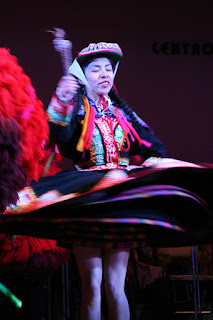
After the libations, it was on to the Centro Qosqo de Arte Nativo for some folk and traditional dance from the region. A selection of regional dances - each necessitating a new, more elaborate costume - were performed with style, energy, and vigour from both the women and men.


Dancing folk

The purposes of the dances were understandable: a celebration of the arrival of rain, a courting dance, and a bizarre war dance in which a comic relief character - very possibly representing the Europeans with his silly pink face and pronounced nose - interrupts the performance with his pranking.

Friday, 3 July 2015

Conquistadors in Cusco

We marched down the hill from our quiet retreat this morning, past the fields of red and black quinoa and the Temple of the Moon and arrived in the midst of the bustling town centre. Cars were ushered around the Plaza de Armas by traffic officers in green uniforms and gloves in Peruvian red and white, while women line the large grey stones of the walls brandishing massage pamphlets at the tourists.

Typical cusqueño street

At the tourist information office, we bought a boleto turístico - the only way to enter the Incan ruins in the Cusco area - which includes entrance to over a dozen places of interest. While we intend to take in the ruins on another day, we started with the small but informative museo histórico regional.


House of Garcilaso

In a white-washed colonial building with striking blue balconies, a series of rooms surrounding a central courtyard tell the story of Peru from the point of view of the town of Cusco.

Accelerating rapidly through the prehistoric times of South America, whose people fashioned pots and flints, like every other ancient culture, the museum quickly arrives at the Incas, the foundation myths of "Qosqo" and the people's animist beliefs. The Incas deified certain animals, such as the puma. In fact, the Qoa was a giant mythological animal in the form of a puma, whic shot lightning from its eyes, spat hail from its mouth, urinated rain, and growled thunder.

Fast forward to the middle of the 16th century and the Spanish arrived, opening the doors to the Andean treasures to the kingdom and the rest of the Europe. In fact, the arrival of the Spaniards in the new world precipitated the plundering and melting of the Inca gold and silver, and an almost wholesale suppression of their beliefs and culture.

The Spanish evangelised to and attempted to convert the indigenous people, righteously believing that a Christian God supported their actions. Various Saints appeared to leaders of battle, assuring them of victory, as they murdered people with superior force. In fact, in a display which may well have been written by the victors, the apostle Saint James (Santiago) appeared before the frightened 'Indians' in the form of a terrifying lightening storm.

Having imposed Spanish dress and customs on the native people, the conquistadores spent centuries subjugating them with corrigimientos (places of correction), repartos (distribution of European goods), and mitas (collective work for the state).

One particular Inca, Túpaq Amaru II, having witnessed the punishment meted out to his people by the Spanish, fomented revolt among the Incas and eventually captured and executed one of the corregidores, José Antonio de Arriaga. In retribution, the Spanish captured and executed Túpaq Amaru in Cusco's Plaza de Armas on 18 May 1781.

The nuns of the Santa Catalina monastery loaned a crucifix to the executioners to "grant them a disguised indulgence", but did not accept its return because of the dreadful acts committed by them.Ironically, his ancestor, Túpaq Amaru I, died in similar circumstances at the hands of the Spanish two centuries earlier.

Over a century before Túpaq Amaru II began his revolt, another man of mixed descent - his mother an Inca, his father an influential Spaniard - started a different kind of revolution using the pen. Owing to his fortunate position, he benefited from a good education. He eventually went under the name "El Inca" Garcilaso de la Vega and, using his literacy, recounted tales of pre-Columbian Incan greatness in his book Comentarios Reales, giving identity to the new generation of mestizos. He died in 1616, on the same day as Cervantes and Shakespeare, and his work would later be influential to Túpaq Amaru's more physical rejection of the conquest.

On leaving the museum, we got a steer to what must be the best vegetarian restaurant in Cusco. At Green Point, we drooled at the general menu and food arriving from the kitchen into the small and incredibly busy restaurant. To avoid choosing and because it was superb value for money (12 soles), we both decided on the set lunch menu.

Best vegan salad

The lunch came with a serve-yourself salad of healthy, delicious, vegan and mostly raw items. This was followed by sopa china - an Asian-inspired soup with a spring roll floating in it.

Waiter, there's a spring roll in my soup

For the segundo, I had a plate of arroz verde with pumpkin fritters, while K tucked into a decadent mound of quinotto - a vegan quinoa-based risotto which had a creaminess not attributable to dairy products. With a cup of chicha morada and finishing with a vegan chocolate truffle, we were convinced to return.

Green rice

Peru, having done substantially better than Bolivia in the Copa América, saw Paraguay in the third place playoff this evening. Our host, not usual given to follow football, was glued to the match out of a fit of patriotism, and saw them reach a 2-1 victory.

Shunning the match, we instead settled into our cosy bungalow in front of a raging log fire with a glass of Peruvian red wine.

Thursday, 2 July 2015

Cusco, Cuzco, Cuszco, Qosco

There are many variations on the spelling of the old Inca capital, being hispanicised from the Quechau name, Qosco. However you choose to spell it, we are here, looking at the magnificent UNESCO heritage city from atop a hill in Tambillo.

We started today with a drink we prepared from a bag of Soykima - an acronym of the powdered soya and Andean grain kiwicha (amaranth) and maca root. With a banana and a cup of Peruvian coffee, it felt like the healthiest thing we had put into our bodies after the nutritionally dubious food of Bolivia.

Inca trail

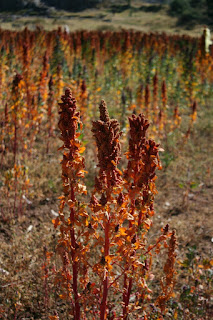
Our walk into town takes us down the hill using a direct Inca trail, past fields of red and black quinoa.

Temple of the Moon and a field of quinoa

Black quinoa

Red quinoa growing

The route follows the cobbled streets of San Blas, the artisan area, which is replete with alleyways and courtyards brimming with handicrafts, from textiles to ceramic bulls (for good luck), to beautiful tableaux of daily life created from a paste containing potato, corn and wheat that dries incredibly hard.

San Blas streets

Of course these stalls and the larger feria are aimed at the tourist souvenir market. The streets are lined with women dressed in typical Peruvian costume holding baby lambs (often also wearing a knitted hat) in their arms for petting. As we continued towards the main square, Plaza de Armas, whose white colonial buildings stand on the foundations of Inca masonry, the cute lambs give way to women offering massages at every ten paces.

The central square is a strange mix of Inca, Spanish colonial architecture, and North American brands, McDonalds, Starbucks, and KFC. There is, naturally, even an Irish pub on one corner.

Plaza de Armas

A multicoloured rainbow flag flies prominently in many locations, from bars and shops and even on the roof of La Catedral del Cuzco, right next to the cross.

Love everyone

Given all the recent news about gay pride and the landmark ruling that gay marriage has been made legal in all states of the USA, I initially took this to be a message of solidarity from Peru and the Church. However, this is a misconception that many visitors make, as the flag is in fact the official flag of Cuzco and apparently represents Tawantin Suyu, or Inca territory.

Fire in the square

Food in Peru, we discovered before arriving, is a big deal. Our Spanish teacher in Santiago declared Peruvian food "the most delicious" of all Latin America. Internet research revealed a number of excellent restaurants in Cusco, many of which are vegetarian. We picked one of the more interesting ones and went for lunch.

Shaman. Vegan. Raw

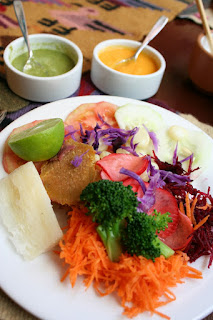
Our healthy eating kick continued at a Shamanic "vegan and raw" restaurant, where we enjoyed three courses for 9.90 soles. This included a delicious salad a soup packed full of vegetables and a main of rice and quinoa with pumpkin stew and a vegan cauliflower cheese. A glass of chicha morada - a non-alcoholic drink made from purple corn - did a very good impression of looking like red wine.

Colourful salad

Healthy soup

Quinoa and chicha morada

In the afternoon, we took a walk along the picturesque streets of Cusco town centre, through Plaza de San Francisco and to the main market at Mercado San Pedro. Part of the market was given over to fresh produce, meat and cheese, while at the back, lines of cheap eateries plied customers with bowls of hot food.

Queso!

Pff... idiot

The front of the market was dedicated to arts and crafts, some of which we had seen at San Blas, while others were quite disturbing indeed.

O....K...?

Given the time difference (one hour behind Bolivia), it gets dark around 6pm. As dusk fell and the already waning moon made an appearance, we made our way to La Esencia for a performance of art and drama. La Esencia is a cosy upstairs place which serves exclusively hot drinks perfect for the chilly evenings, such as mate (infusions) made from local herbs hierba buena, toronjil, and muña, among others.

The drinks complement the performances, which tonight were a double bill. The first, Voces Ancestrales, was a storyteller from Chile, whose folk tales of precolonial times centred around love and respect for the earth and environment, which had been forgotten by the people that lived there, with dire consequences. Complete with puppets, the performance was suitable for children but attended by only one vocal young boy. Fortunately, the simple language and clear enunciation meant that we could understand a good deal of what was going on.

The same could not be said of the next display, Un Deseo, which involved an Argentinian lady dressed in a silver chef's hat, talking a nonsense language as she pretended to be an alien landing in Earth's desert. Despite the lack of a language barrier, this confounded me more than the previous round of stories.

Wednesday, 1 July 2015

Hello Cusco

There is a Latin American tendency, which we have observed so far in Chile and now in Bolivia, to speak in diminutives. In Spanish, this involves changing the end of a word to -ito/a or -illo/a, such as changing casa (house) to casita (little house or cottage). This can literally imply that the thing so named is physically small, but is most often used just to soften speech. In the Spanish school in Santiago, our teacher often referred to us as chicillos, rather than chicos (guys), and even called one of the students, who was particularly young, Mattito. Our horse trekking guide made reference to caballitos, and many women will talk about having put on a few kilitos, as though this were a different unit of measurement to the standard kilo.

This morning at 4am, we presented ourselves at Jorge Wistermann airport in Cochabamba for a number of "vuelitos" (the check-in desk lady's word) to Cusco. And small were these flights indeed. Forty five minutes to Santa Cruz, and a further hour each onwards to La Paz and then Cusco. The reason for being bounced around Bolivia, before reaching escape velocity bound for Peru, is that Amaszonas cancelled the more direct and convenient flight without notifying us. Much frustrating administration ensued and the current convoluted route was agreed upon.

Lies, maps and statistics

Having ping-ponged our way to La Paz, we had a tight (forty minute) connection to get our final onward flight, which was rendered quite exciting by landing ten minutes late and encountering some Bolivian emigration administration. Our documents had already been processed and removed at Cochabamba, but now in La Paz, we had to fill out yet more slips while the officials riffled through the pages of our passports. Eventually, after yet more baggage inspections and scanning, we were allowed into the departure lounge. We needn't have hurried, however, as the flight was delayed owing to "adverse weather conditions" at Cusco. After half an hour, these didn't seem to present a problem any more, and we boarded for take off.

Soon after reaching cruising altitude, we found ourselves flying over the magnificent and enormous Lake Titicaca. It takes a flight from 30,000 feet to truly appreciate its magnitude.

Lake Titicaca

We didn't get to discover what the "weather conditions" might have been - there was a whispered rumour of volcanic ash - but the weather on landing in Cusco was perfect.

Perfect landing in Cusco

Our host, Mary, was ready to meet us and whisked us up out of the centre of Cusco to an area of town known as Tambillo. Here, perched on a hill overlooking the valley, she has built her own traditional bungalows.

By the hearth

Wooden beams

Mary, a retired architect, designed the buildings herself, which are light and airy, with white walls and tasteful furnishings, and surround a sunny central courtyard of "tronquitos" - short tree stumps that double as seats.

"Tronquitos"

After settling in, Mary kindly invited us for a home-cooked lunch. The food was simple and yet exquisitely prepared. We snacked on roasted yuca with guacamole, which hands down beats any roast potato I have ever tasted, while the soup was warmed up. We were then presented with a thick and hearty quinoa soup with broad beans, served with traditional Peruvian bread filled with cheese. After second helpings, we were sated, having had nothing much beyond a sandwich at 5 o'clock this morning.

Being remote from town - although only half an hour's walk along an old Inca path - there is no WiFi, so we decided to make the short walk to the centre and buy a SIM card for mobile data. Owing to the ubiquity of WiFi in many of the countries we have visited, this is something we have found necessary to do only twice; once in Langkawi (staying in the jungle), and then in New Zealand (on the road in a camper van). On both occasions, the SIM was popped out of the packaging and we were up and running in less than ten minutes. Not so in Peru, which seems to take its bureaucracy very seriously.

We spent well over an hour in the vast and soulless offices of telecoms provider Movistar, stuck in a process of endless paperwork that bore all the hallmarks of, ironically enough, the film Brazil. The queue for the shop was out of the door on Avenida El Sol. We joined the queue, which seemed to entitle people to a numbered ticket to proceed to the next room where they waited to be called forward as though at the post office. Our fate, however, was different. Having explained that we wanted a pay-as-you-go SIM card, we we directed to an unmarked kiosk, where a lady assured us that her colleague would be only too willing to sell us an 8 soles 'chip' on presentation of adequate documentation.

I presented my passport as a means of identification, whose details were entered painstakingly into the computer. The passport was then photocopied twice, each copy of which was stapled to a print-out of a contract, onto which its details were transcribed in duplicate. The lady and I signed and dated both copies, she stamping them, while I inked my finger and validated my signature with a fingerprint. The signed contract was then photocopied and I was presented with this and an invoice for the 8 soles, which I was to pay at the cash desk. The cashier took my money, stamped the forms and gave me a coupon to redeem at the next desk - almacén. Here they took all the paperwork I held (including the contract) and exchanged it for a SIM card and a receipt.

Finally, I inserted the card into the phone and asked now how I make calls. I was ushered by the man on the desk to a fourth counter, labelled "recargar", where I could top up to a desired amount. Phew.

With newly enabled Peruvian phone, we returned triumphantly up the hill, where the full moon could be seen rising spectacularly over the city.

Moonrise over Cusco

At the top of the hill, we stopped a while, fittingly, at the ruins of the Temple of the Moon and watched the white disc ascend into the rapidly darkening sky. Although only shortly after 6pm, evening had set in and we had been awake since 3am. We called it a night.